


May 14, 2026
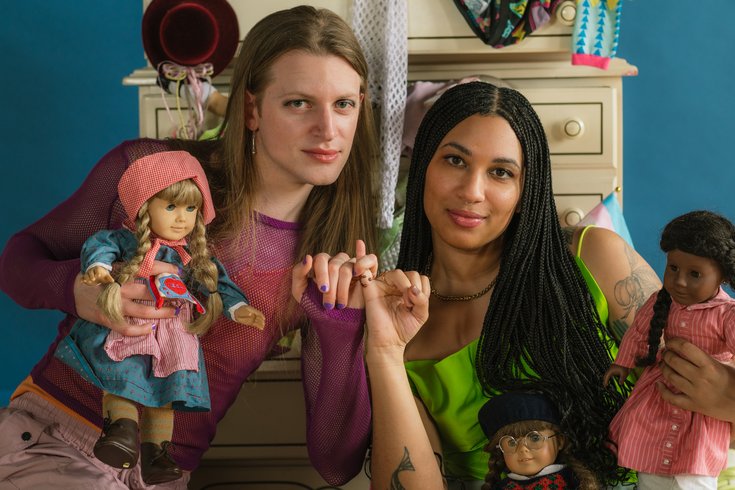 Provided image/Kenzi Crash
Pax Ressler, left, and Jackie Soro, right, wrote and star in an original musical about American Girl dolls. It's produced by Bearded Ladies Cabaret.
Pax Ressler and Jackie Soro have hard opinions on American Girl dolls, the educational toy prized by millennials and subsequent generations. Samantha is rich and pretty. Felicity is a horse girl. Kirsten has "iconic" looping braids. Josefina is kinda boring. Molly is spunky and "canonically gay."
All these snap judgements and some deeper observations are woven through "Girl Dolls," the pair's original musical playing FringeArts through Sunday. The Bearded Ladies Cabaret production examines girlhood, history and patriotism through the lens of these 18-inch Mattel models, all while offering nostalgia and inside jokes to the adults who once played with them.
"When you mention American Girl dolls to people in our generation or above or even below, there's always some kind of reaction," Soro said. "People have really strong reactions to hearing about them, reminiscing about them, wanting them. It just really evokes something in people that's really powerful and we're like, why is that?"
The show opens in a perfectly preserved tween girl's bedroom circa 1996. Pastel rugs, an iridescent inflatable chair and a box TV covered in stickers dot the stage, where Ressler and Soro and the so-called Backstreet Toys band rip through 18 original numbers. The songs range from a cult-y praise hymn for American Girl founder Pleasant Rowland to a rapid-fire skewering of the "OG" historical dolls, who each came with backstories informed by real U.S. history. (Felicity, the girl living through the American Revolution, gets an especially brutal read.) There's also a satirical rendition of the pitch meeting for Addy, the only Black doll in the original lineup.
Per her accompanying books — each doll got six — Addy Walker was enslaved with her family on a North Carolina plantation in the midst of the Civil War. She later escaped to freedom in Philadelphia, where she learned to read and write.
Soro said the prospect of playing with the "slavery doll" held little appeal for her as a young Black girl growing up in the Chicago area. She asked her parents for Molly, the white World War II era character, instead.
"As a mixed race child, I felt really confused about where I was supposed to belong and what doll I was supposed to play with," she explained. "And it ultimately came down to the hair that I thought was pretty and the hair that I wanted to brush, which is really complicated because there's a long history, several histories, all entrenched in that, and then my own journey with my own hair. Even as a child I was like, this is above my pay grade."
These thorny feelings inform numbers like "Doll Test." The title refers to a series of psychological experiments that married researchers Kenneth and Mamie Clark designed to demonstrate the mental impact of segregation on Black children. The Clarks presented Black kids with a set of four dolls, identical in every way except for their skin color. Two were the white, the others Black. Then the psychologists asked their subjects which toy they preferred. Most children picked the white dolls. When pressed to identify the "bad" dolls, a majority picked the Black ones.
"In sharing our own experiences of our own childhoods and our relationships to these dolls then and now, it's turned out to be a lot more complicated than I would've guessed a couple years ago," Soro said.
Ressler also gets personal in "Girl Dolls." Not a lot mainstream toys got through her Mennonite household in Lancaster, where PBS was the only acceptable TV channel. American Girl dolls were an exception, since they offered some historical education. Kirsten, the blond Swedish girl making a new home in 1850s Minnesota, vaguely resembled Ressler's immigrant ancestors. But her sister got the doll. Toys like that were unavailable to Ressler, who identifies as nonbinary transfemme.
"American Girl dolls represent the girls we wanted to be," she said. "And the girls who were protected and cared for and beloved by society or brave enough and strong enough and smart enough to be loved. I think for me there's a lot of learning about me longing for girlhood as a kid who didn't have access to it through these dolls and through wanting the doll. I think that was something that felt really clear as an adult now looking back."
The creative partners and stars admit "Girl Dolls," which they've been working on since 2023, is arriving at an "auspicious time." They didn't manage to secure any semiquincentennial funding for their project — Soro says they "tried to say that in a lot of grants and [sponsors] weren't having it" — but they do see the show as an America 250 production of sorts. It's about simplified history lessons we learn as children that fall apart when we get older, the pair says, and how patriotism is nurtured from a young age.
But it's also a lot of fun. Soro and Ressler encourage audience members to sing along with them at multiple points in the 75-minute show, and rope people in the front row into their comedic bits. Seeing the musical with an American Girl doll is also highly encouraged. By this writer's rudimentary count, Samantha, Molly and Kirsten attended the Tuesday performance. Another woman made herself into a life-size version of Molly, striding into the black box in a beret and glasses — and unmistakable spunk.
"That is the most real impact statement we could have," Ressler said. "People are still thinking about these dolls and still processing their childhoods through these dolls."
Follow Kristin & PhillyVoice on Twitter: @kristin_hunt
| @thePhillyVoice
Like us on Facebook: PhillyVoice
Have a news tip? Let us know.