


September 17, 2026
 Kristin Hunt/for PhillyVoice
'Noguchi to Asawa: Designing Postwar America,' a new exhibit opening Sunday at the Barnes Foundation, highlights the work of influential Japanese American artists who were incarcerated during World War II.
In the wake of the bombing of Pearl Harbor, the U.S. government indiscriminately locked up over 120,000 Japanese Americans in internment camps along the West Coast and Midwest. This compulsory relocation had profound personal effects on the individuals forced out of their homes and siloed off from society. But it also fundamentally shaped modern design.
The Barnes Foundation explores furniture, sculpture and pop culture in the context of World War II internment through its latest exhibit "Noguchi to Asawa: Designing Postwar America." Opening Sunday, the showcase features five artists incarcerated at the camps and another who worked for the military. Their experiences are reflected in the roughly 80 objects on display, which will remain at the Barnes through Jan. 10.
Curator Cindy Kang selected three Japanese Americans with established careers prior to the 1942 executive order that authorized mass incarceration, and three whose artistry was shaped in the camps. The older generation includes furniture designer George Nakashima, who was sent to Minidoka, Idaho, and sculptors Isamu Noguchi and Leo Amino. The latter two were exempt from internment due to their New York residency, though Noguchi voluntarily reported to the Poston War Relocation Center in Arizona to spearhead artistic programs at the camp. Amino translated for the U.S. Navy during the war.
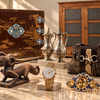
After he was released from an Idaho internment camp, George Nakashima moved to New Hope and created this coffee table, among other pieces of craft furniture.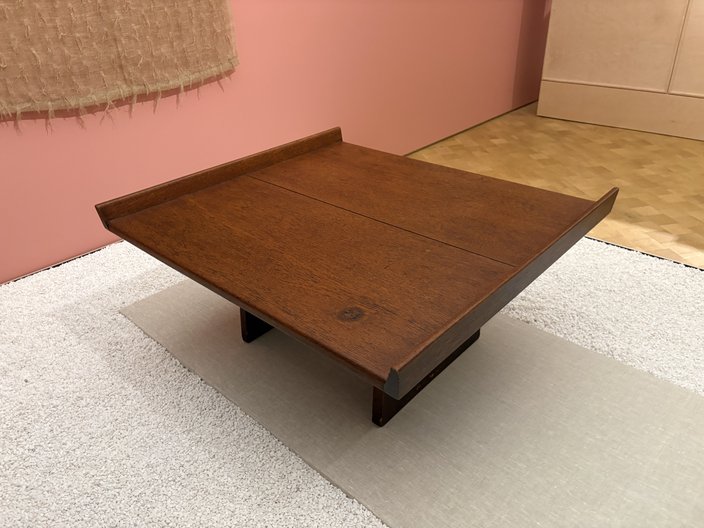 Kristin Hunt/for PhillyVoice
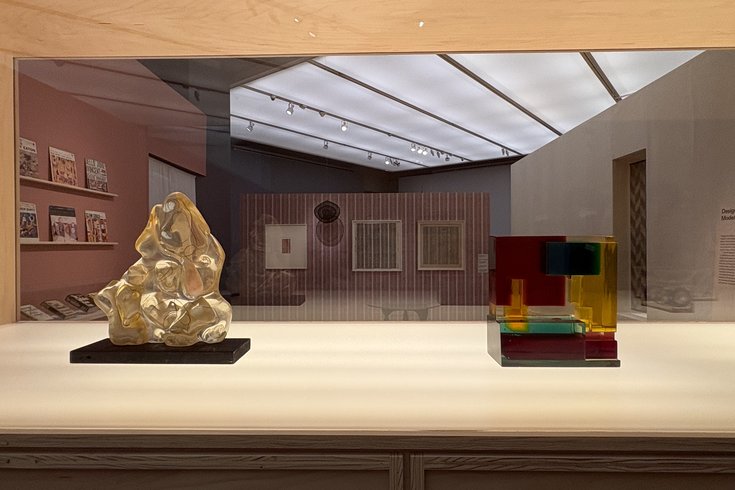
When the trio returned to normal life, they didn't necessarily pick up where they left off. Amino abandoned the wood he once favored in his sculptures and turned to plastics, materials developed for the war. After learning traditional Japanese carpentry methods from a woodworker at the Minidoka camp, Nakashima moved to New Hope and began creating furniture that emphasized the beauty of the trees that produced it. He and Noguchi both crafted pieces for companies like Herman Miller and Knoll, contributing to the emerging mid-century modern movement.
"This exhibition makes clear that Asian American history is not separate from the American story, but woven into it, into the very objects that furnished people's homes," Thom Collins, executive director and president of the Barnes Foundation, said at a news conference Wednesday.
Leo Amino, who worked as a translator for the U.S. Navy, experimented with plastics in his sculptures.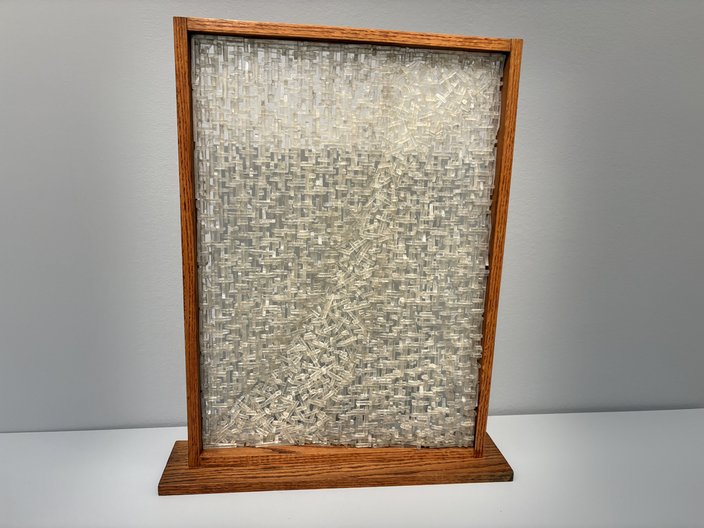 Kristin Hunt/for PhillyVoice
The younger cohort developed their craft at the camps. S. Neil Fujita, whose art school education was interrupted by incarceration, did graphic design for the newspaper at the Heart Mountain, Wyoming, center. Ruth Asawa and Kay Sekimachi took drawing and painting classes from professional artists interned with them at the camps in Rohwer, Arkansas, and Topaz, Utah, respectively. The women were just teenagers at the time.
Ruth Asawa created numerous looped-wire sculptures. She and her family were incarcerated in Arkansas during the war.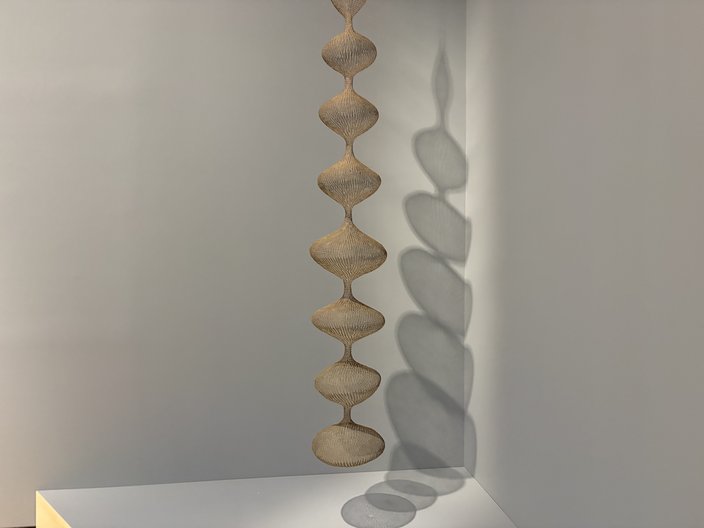 Kristin Hunt/for PhillyVoice
They both went on to create intricate hanging sculptures — Asawa's usually made with looped and coiled wires and Sekimachi's drawing from industrial materials like nylon monofilament, the fibers used in fishing lines. These materials and the processes that accompanied them could be hard on the artists. It took Sekimachi an hour to weave a single inch of the monofilament layers in her pieces. Asawa frequently cut her fingers on the wires as she bent them into designs.
"There is actually a sense that repetitive, compulsive labor was a way of exerting control when your life has been completely taken out of your hands," Kang said.
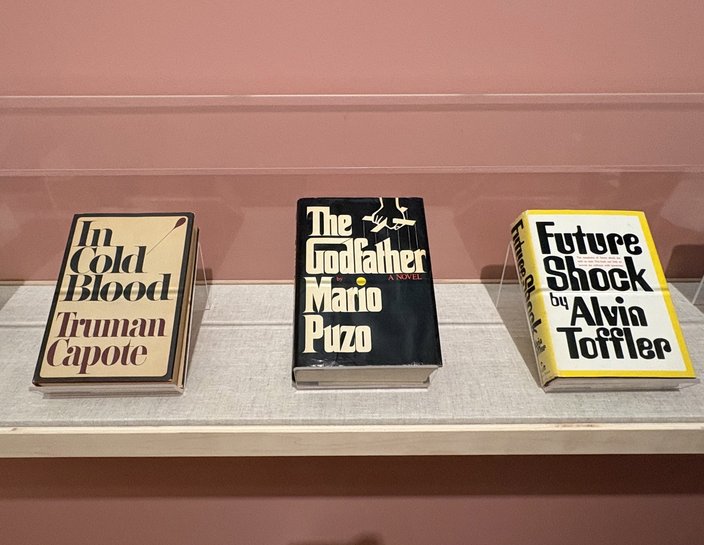
Fujita became an influential art director and designer. After working for an ad agency in Philadelphia, he moved to Columbia Records and created album covers for artists like the Dave Brubeck Quartet. He also designed packaging for General Mills and the logotype for numerous novels, most notably, "The Godfather." The Oscar-winning adaptation would use his type, too.
S. Neil Fujita was the influential designer responsible for the logotype that appeared on the novel and movie poster for 'The Godfather.' Some of his other book designs are displayed in the exhibit.
"Everybody knows 'The Godfather,'" Kang said. "Nobody knows Fujita. ... But Fujita defined the look of American jazz in the mid-century with his designs for these albums. He had an incredible impact on American popular culture with graphic design, particularly for 'The Godfather.' And he has pretty much disappeared as an artist, as an American artist.
"It is my hope for the exhibition that we can recognize these artists who are so important to American art and design and were not given their due."
Follow Kristin & PhillyVoice on Twitter: @kristin_hunt
| @thePhillyVoice
Like us on Facebook: PhillyVoice
Have a news tip? Let us know.