


November 12, 2025
 Provided Image; Tiny Reparations Books/Provided Image; JerSean Golatt
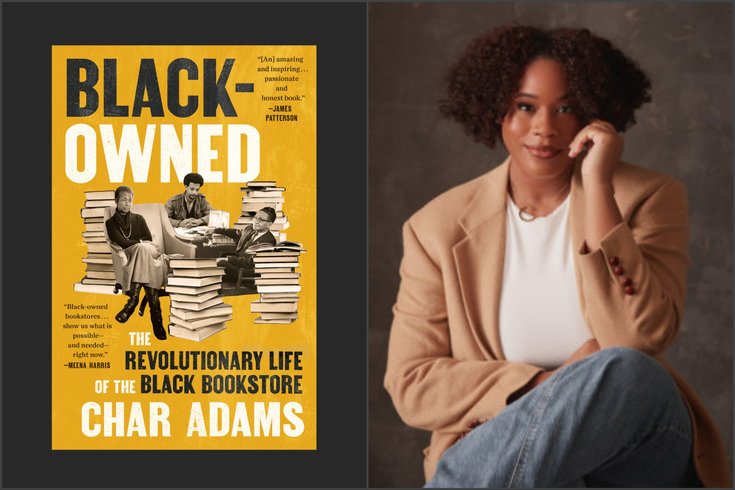
In her new book, Char Adams explores the history of Black-owned bookstores in the United States, including Hakim's Bookstore, which has been in business in Cobbs Creek since 1959.
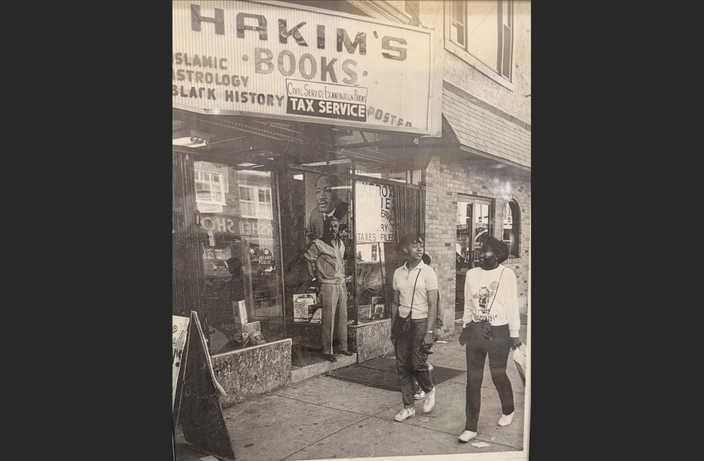
In 1959, after reading J. A. Rogers' "100 Amazing Facts About the Negro" and "The Five Negro Presidents," Dawud Hakim set out to open a bookstore in West Philadelphia that would be a resource for the community about Black history.
The concept was not an instant success. His daughter, Yvonne Blake, who now owns the Hakim's Bookstore at 210 S. 52nd St. in the Cobbs Creek neighborhood, said that as a child, she couldn't understand why her father owned a store that had no customers.
"It was very, very slow going," Blake said, "which surprised him, because he thought that once he became aware of our history, that everybody would be knocking down the doors to read books about African Americans, and that wasn't the case."
Hakim's is among the shopkeepers and stores described in the new book, "Black-Owned: The Revolutionary Life of the Black Bookstore," in which author Char Adams unpacks the history of Black-owned bookstores in the United States, beginning in 1834 with activist David Ruggles' New York City store and progressing through the decades to present day. Despite targeted attacks, the spaces have endured as education centers and community hubs.
Adams, a journalist who is originally from West Philly, became intrigued with the history of Black-owned bookstores after reading a 2018 Atlantic article by Joshua Clark Davis about how shop owners had been targeted by the FBI in the 1960s for the books they sold. She finished the piece wanting to know more about the stores and how that surveillance impacted their abilities to run their businesses.
She unearthed the answers while writing the book, finding both historical narratives of stores that have come and gone and speaking with current bookstore owners about their businesses. Each chapter explores trends across different decades, from the radical bookstore boom of the 1960s and 1970s, when some stores were primarily spaces for activists to gather, to the explosion of Black women's fiction and romance in the 1990s.
"The overall legacy of Black bookstores is a commitment to community and resistance," Adams said. "I feel like those two themes have been very present in Black bookstores since the very first one opened in 1834."
Hakim's was the target of FBI surveillance in its early years, but despite that, Blake said her father built his customer base with the rise of the Civil Rights movement and Black Panthers, as well as the assassinations of Malcolm X and President John F. Kennedy. Hakim also made enduring connections to his community. Blake said people still come to the shop and tell her about how they could talk to her father about anything.
Dawud Hakim, pictured above standing near his shop's entrance, opened Hakim's Bookstore at 210 S. 52nd St. in West Philly in 1959. Today it is run by his daughter Yvonne Blake.
He made an effort to educate those who couldn't get to the shop, as well, and started a mail order program to send books to people in prison, Blake said.
"Once he found his passion and his desire to educate people, he didn't deter from that and he remained committed. He never compromised his principles," Blake said. "And he just was determined to do what he wanted to do, which was to educate, not just African Americans, but everybody about the history and the contributions we made to America and the world."
Despite the boom in the 1990s, Adams said that many bookstores struggled over the next two decades with the rise of the internet. Hakim's almost closed in 2016, Blake said, although it was able to persevere with community support. Then there was a renewed interest following the death of George Floyd in 2020, when people sought out texts on critical race theory.
For many Black-owned bookstores, that attention has waned again, forcing them to attract customers in new ways. Shop owners can't survive by just selling books, Adams said. They're building cafes in their brick-and-mortar spaces, like Uncle Bobbie's in Germantown did, and they are partnering with schools and adding new programming.
"They are extremely passionate about engaging with their communities in ways that go beyond just selling," Adams said.