



April 22, 2026
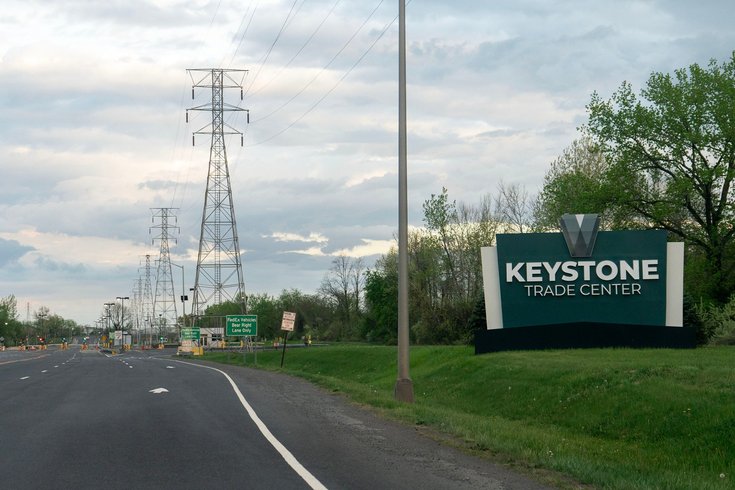 Daniella Heminghaus/Imagn Images
Amazon is building a data center on the Keystone Trade Center campus in Falls Township, Bucks County.
Over the past year, Pennsylvania lawmakers have pushed a flurry of bills aimed at regulating data centers. Their proposed laws would introduce new transparency measures, like mandated reports on energy and water usage, as well as consumer protection guardrails that prevent facility owners from passing construction costs onto the community.
But for some residents, nothing less than a complete halt to development will do.
Organizers from 15 community groups will march on the state capitol Wednesday morning to demand a three-year moratorium on new data centers. Their rally illustrates the significant backlash these projects have faced from residents near the proposed sites who have called on their representatives to protect them from the higher energy bills, noise and water pollution these facilities are expected to bring. Inside the divided state legislature, though, it's unclear which — if any — of the proposed reforms will make it to Gov. Josh Shapiro's desk.
Some of them have cleared at least one chamber. The Pennsylvania House of Representatives recently passed a trio of bills related to data centers, two of them last week. HB 2150 would require data centers to provide annual reports on energy and water consumption, and impose penalties if they do not, while HB 2151 would create a model zoning ordinance laying out noise limits and other standards that communities could adopt for a new data center project. Every Democratic representative and about two dozen Republicans supported each bill.
The third bill, HB 1834, is designed to impose "financial responsibility" on the facility's owners. It would prevent utilities from passing data centers' operational costs onto consumers' energy bills, levy security deposits and early exit fees on the facilities, and require them to fund an energy assistance program for low-income Pennsylvanians. It narrowly passed 104-95, with the support of only two Republicans.
Another half dozen bills pertaining to data centers are currently before the state House and Senate, with more on the way.
Rep. Kyle Donahue (D-Lackawanna), the lead sponsor of HB 2151, says he started brainstorming regulations with his colleagues after attending a heated public zoning hearing for a data center project in one of his townships. He kept listening when his constituents objected to the original wording of his bill, which placed the model ordinance framework under the authority of the Department of Community and Economic Development. To avoid any appearance of industry pressure, he rewrote his bill into the general municipalities code. But he's reluctant to pursue blanket bans on data center development. He cites the state's fair share doctrine, which makes exclusionary zoning illegal.
"A lot of people want to just say no to them," Donahue said. "And I get that, right? There's so many issues with them when it comes to energy, water usage, noise pollution, light pollution. But I think it's also my job to be responsible, to look into and make sure that all this stuff passes legal muster.
"... I think one of my concerns is, and I've told this to my constituents that are like, just say no, (is) we tried that with fracking 20 years ago. And we never got there. But then at the same time, we didn't have common sense guardrails and limits on what they could do. So in the end, we lost."
Many residents in Philadelphia's collar counties would rather just say no. Petitions against proposed facilities in Limerick Township and Conshohocken in Montgomery County have netted a couple thousand signatures. One opposing a facility in Pennhurst has over 22,000. In a recent Quinnipiac poll, 68% of Pennsylvania voters said they would not want a data center in their community, compared with just 20% who would be supportive. Another 12% did not offer an opinion.
Concerned community members routinely mention the massive amounts of water and electricity that data centers require to function. These facilities churn through 300,000 to 5 million gallons of water in a single day. Large ones can consume as much power as 50,000 homes. But detractors aren't just worried about the drain on natural resources, or potentially footing the electric bill for big corporations. Some organizers say the data itself is the issue.
Immigration advocates point to the software company Palantir, which partnered with Nvidia to introduce turnkey architecture for data centers last month to accelerate their spread. The tech giant has worked with the federal government on numerous surveillance initiatives, including an AI-powered platform to aid the Immigration and Customs Enforcement agency in its mass deportation mission. Tammy Murphy, public policy and advocacy manager with Make the Road PA, says a moratorium is preferable to the "mind-boggling" amount of local legislation "in every direction" because it would lend the community more space and time to consider all possible avenues.
"Are there alternative energy options?" she said. "Is this going to be a boom and bust cycle? Are we going to watch this trend come and go, and then have areas that could have been developed for wiser economic use lying vacant? I think just taking our time and slowing down and looking at it, we could come to the conclusion after further studies or watching how it develops elsewhere that it's not for us in Pennsylvania. Or we could come to the conclusion that it is, but we just wanna do it more carefully."
Both sides tend to agree on Murphy's larger point: data centers are spreading at a rapid clip and should be scrutinized more closely. According to Pew Research Center, there are already over 3,000 in the U.S. and another 1,500 in development. Rep. Kyle Mullins (D-Lackawanna), who introduced HB 2150, believes most municipalities are "not prepared" for these projects and deserve more information from the developers.
"The very least, and the most responsible thing, they could do is be transparent with the amount of those resources they plan to use and ultimately end up using throughout their operation," he said. "That would ensure that there is public awareness of this industry's impact and would guide the legislature in the event that we need to make further refinements to guardrails that we hopefully will have by that time."
As Mullins' bill and others battle their way through the split Pennsylvania legislature, it remains to be seen which guardrails the state government can actually erect. Murphy and others participating in the Harrisburg rally fear they might not be enough.
"I think all of us need to slow down and think about what we're doing to ourselves, what we're setting ourselves up for," Murphy said. "Is this the kind of life that we want?
"... The gold rush that's happening right now is proliferated by companies like Palantir that want to make everybody think that they have to do this and rush to it, and just make it a hot item without thinking, so that they can then build out what they have in mind. And then once it's built, how do you scale it back? You can't really."
Follow Kristin & PhillyVoice on Twitter: @kristin_hunt
| @thePhillyVoice
Like us on Facebook: PhillyVoice
Have a news tip? Let us know.