



May 20, 2026

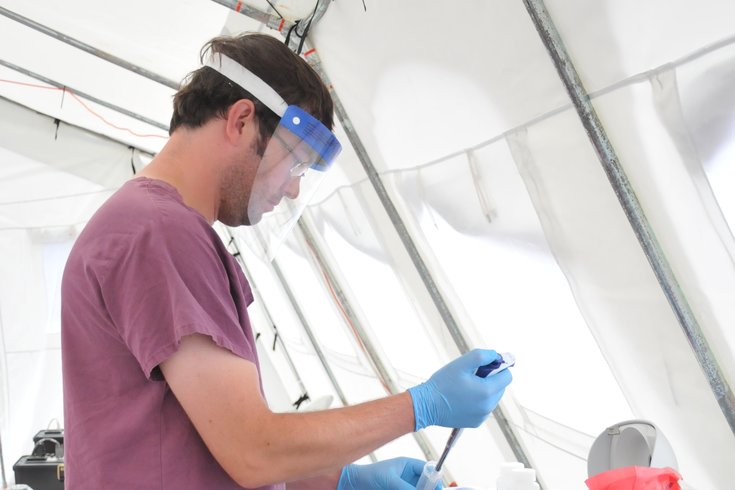 Aphaluck Bhatiasevi/World Health Organization
The risk of Ebola transmission to people living in the United States is low at this time, a Jefferson Health infectious disease specialist says. Above, a CDC technician works with inactivated Ebola samples at a field laboratory during the 2014 Ebola outbreak in West Africa.
The risk of Ebola infection is "probably low" for people in the United States, but Americans planning to travel to one of the African countries impacted by the outbreak may want to heed caution, a Jefferson Health infectious disease specialist said.
For most Americans, Dr. Eric Sachinwalla said, "it's important to be aware of what's going on, but you don't need to necessarily change any of your day-to-day plans."
MORE: American doctor being treated for Ebola works for missionary organization based in Philly suburbs
But people may want to reconsider any plans to visit the Democratic Republic of the Congo or Uganda, the countries impacted by the outbreak.
"I would be discussing, 'Do you need to postpone, reevaluate, take precautions," Sachinwalla said. "But if you're going on vacation to anywhere else — Europe, Asia, the Caribbean, anywhere in the United States — I don't think you need to necessarily take any additional precautions at this moment in time, understanding that this is something that we are experiencing minute to minute, and so as the situation changes, the calculus might change."
Ebola is not spread through airborne transmission, so people who may have been exposed are at low risk of spreading the disease if they are not experiencing symptoms.
Ebola is spread through direct contact with bodily fluids – including urine, blood, feces, saliva and semen – from an infected person or from someone who has died from the virus. Contact with contaminated needles and animals may also spread the virus, the Centers for Disease Control and Prevention says.
Symptoms initially may include fever, headache, muscle and joint pain, fatigue, loss of appetite, gastrointestinal symptoms or unexplained bleeding. They may appear 2 to 21 days after exposure.
The current Ebola outbreak involves the Bundibugyo strain of the virus. There are no vaccines to prevent infection or medications for treatment. People who become infected with the Bundibugyo strain need advanced "supportive care," Sachinwalla said.
"Somebody who develops Ebola virus disease can have a lot of loss of fluids, either related to vomiting, diarrhea or leakage from their blood vessels, where they get a lot of swelling and fluid in the tissues," Sachinwalla said. "We can support them with that, whether it's giving them fluid and electrolytes and nutrition."
People also may need supportive oxygen or to be put on a ventilator, Sachinwalla said.
People who do not get this supportive care are at higher risk of death. During the last two Ebola outbreaks caused by the Bundibugyo strain, fatality rates ranged from 30% to 50%, the World Health Organization said.
As of Tuesday, the current Ebola outbreak had caused 135 suspected deaths and more than 540 suspected infections in Congo. Uganda also had a small number of confirmed cases. The numbers are expected to rise as health officials conduct more contact tracing in Congo and Uganda.
But Sachinwalla said the death toll does not appear likely to reach 2013-2014 levels, the largest Ebola outbreak since discovery of the virus in 1976. That outbreak killed 11,325 people and infected 28,600 others.
"We're definitely not at that level at this moment in time," Sachinwalla said. "Again, we have to wait and see. We're getting information kind of day-by-day, even minute-by-minute. But the total numbers of that we're seeing is not anywhere near what we saw in the West African outbreak in 2013 and 2014, and we're not seeing cases outside of the immediate countries that are involved."
The American doctor who contracted Ebola during the current outbreak in Congo is receiving advanced medical care in Berlin, according to Serge, the Jenkintown-based Christian missionary organization that employs him.
Dr. Peter Stafford, a surgeon who specializes in wound care, had been working with Serge for the past three years in the Ituri Province of Eastern Congo where the Ebola outbreak started. Stafford, 39, tested positive for the Bundibugyo strain of the virus Monday, after he became symptomatic.
His wife, Dr. Rebekah Stafford, who was also treating patients there, has left Congo with their four children to a place where they can receive advanced medical care if needed, Serge said Wednesday. Another American doctor, Dr. Peter LaRochelle, who may have been exposed to Ebola, also has been transferred out of the area.
"Serge leadership is actively monitoring the situation and working closely with health authorities and medical partners," the organization said in an email Wednesday.
Peter LaRochelle, LaRochelle's father, told the New York Times on Tuesday that his son, Rebekah Stafford and their four children – all quarantined – are asymptomatic.