






May 14, 2026

 Provided Image/CDC
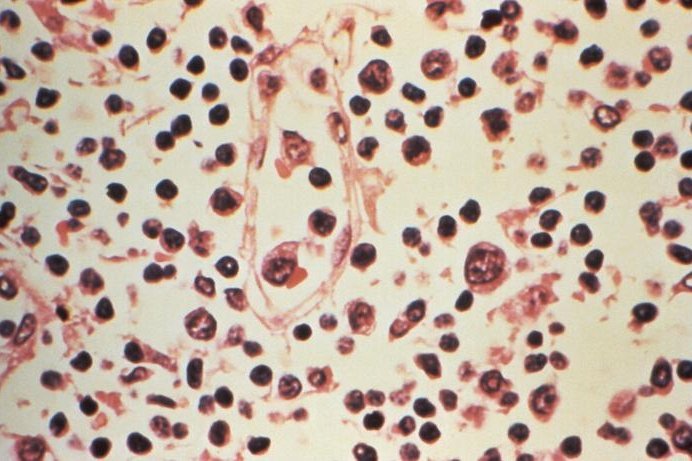
The CDC is monitoring 41 Americans for symptoms of hantavirus, the rare disease that spread among passengers on a on a cruise ship. The federal agency maintains the risk to the public is low. The file photo above shows a lymph node specimen extracted from a patient suspected of having a hantavirus illness.
The Centers for Disease Control and Prevention has increased the number of staff dedicated to tracking the threat of a hantavirus outbreak as health officials maintain the risk to the general public remains low.
At a news conference on Wednesday, a CDC official stressed that the agency was not blindsided by last month's outbreak aboard the Dutch cruise ship MV Hondius.
"This is not a novel virus. This is a known virus and we've seen this in the United States before and we know how to respond to it," said David Fitter, incident manager for the CDC's hantavirus response. "And that's what we're doing and we're putting into action all the things that we have in place to ensure that American communities remain safe and healthy. What we really want to do is ensure that we're also communicating about this."
At least 11 confirmed or suspected cases have been found among passengers who were on the cruise ship, including three people who have died.
The U.S. Department of Health and Human Services said Sunday one American had tested "mildly" positive for the Andes strain of the virus, which can be transmitted between humans, but later tests came back negative. The CDC maintains there are no known cases in the country at this time, and 41 people are being monitored for symptoms. Among the 18 Americans being held in quarantine, most are at the University of Nebraska Medical Center's National Quarantine Center in Omaha and two are at Emory University Hospital in Atlanta.
"These in-depth health assessments include asking each passenger about their exposure to the confirmed cases," said Brendan Jackson, a medical epidemiologist leading the CDC's efforts in Nebraska. "And the University of Nebraska team here is conducting regular temperature monitoring, symptoms screening, and general wellness evaluations."
Jackson said the monitoring period lasts 42 days — a long incubation period for a virus — starting May 11 when passengers disembarked from the cruise ship. MV Hondius departed April 1 from Argentina, were the Andes strain of the virus originates from rodents and has been traced to past outbreaks among people.
Since the outbreak on the cruise ship, the CDC has boosted its hantavirus team from three people to about 100, according to data reviewed by the Wall Street Journal. Federal officials have sought to balance urgency with caution in public messaging, hoping to avoid panic similar to what occurred during the early stages of the COVID-19 pandemic.
Although hantavirus is more deadly than COVID-19 — killing between 20-40% of those infected — the virus is much less transmissible between people. Acting CDC Director Jay Bhattacharya has said close, sustained contact with a symptomatic person is needed for transmission.
Some former CDC staff and other public health officials have criticized the Trump administration for waiting before issuing a Health Alert Network advisory about the outbreak. The World Health Organization, which the U.S. withdrew from in January, flagged the outbreak days before the CDC took action.
Although hantavirus researchers acknowledge the virus is not highly contagious, some told the New York Times public guidance may be downplaying nuances of transmission observed during past outbreaks in Argentina and unknown factors in human-to-human transmission. People generally become infected with hantavirus by breathing in particles that enter the air from rodent droppings.
“We have so little data that it’s really hard to say anything concrete or definitive,” Kartik Chandran, a virologist at the Albert Einstein College of Medicine, told the New York Times.
The CDC is still treating the hantavirus response as a Level 3 emergency, the agency's lowest level of activation typically used for localized outbreaks and surveillance.
"To the American public, please know we are here to protect your health and based on current information the risk to the general population remains low," Fitter said Wednesday. "So far our response has followed our playbook. A swift action across federal, state, and local public health. The systems and partnerships that we've built exist precisely for situations like this."