



June 04, 2026
 George Grantham Bain Collection/Library of Congress, Prints and Photographs Division
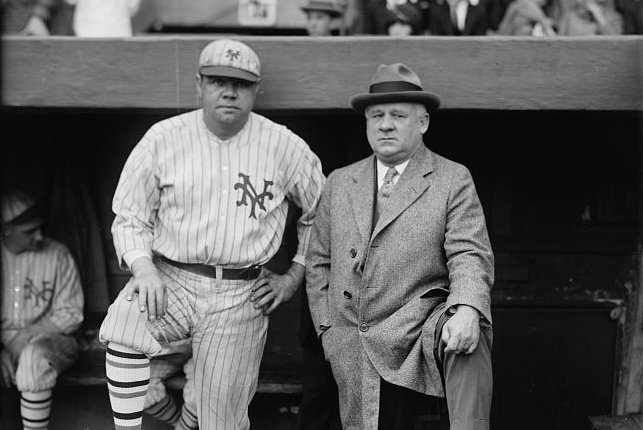
Yankees legend Babe Ruth, left, poses with John McGraw, the longtime New York Giants manager, in 1923. Ten years later, Ruth smacked a home run to lead the American League to victory in baseball's first All-Star Game. McGraw managed the National League.
The first aspect of Philadelphia’s celebration of America’s 250th birthday was revealed seven years ago, when Major League Baseball announced the 2026 All-Star Game would be played at Citizens Bank Park.
The announcement was made so far in advance mostly as a courtesy to former Phillies chairman David Montgomery, who had lobbied for Philly to host the game and was dying of jaw cancer. But it would have been hard, even then, to fathom the game being played anywhere else.
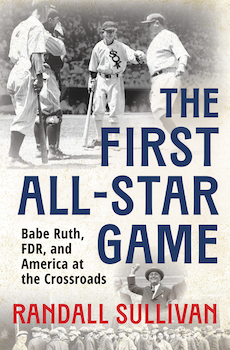
It’s only natural for a baseball game to take a central role in America’s anniversary celebrations, even if football has long since surpassed it in popularity. That this year’s All-Star Game is tied to a wider celebration calls to mind its origins, documented extensively in Randall Sullivan’s new book, “The First All-Star Game: Babe Ruth, FDR and America at the Crossroads.”
The All-Star Game was created to help drive people to the World’s Fair that Chicago had undertaken in 1933. The exposition itself was daring, held amid the Great Depression in a city with a reputation muddied by gangsters and gamblers. Yet, at a time when Americans were searching for optimism, the All-Star Game, billed as the Game of the Century, delivered.
An aging Babe Ruth — but still America's biggest sports celebrity — smacked a two-run home run and made a memorable catch against the right field wall, propelling the American League to a 4-2 victory at a sold-out Comiskey Park.
Naturally, Ruth was the game’s star, but Philly sent four players — two Phillies and two Athletics — to the game, and Connie Mack served as the American League’s manager. Al Simmons and Jimmy Dykes — two former A’s that Mack had sold to the White Sox the prior fall — also played.
Randall Sullivan details the origins of the MLB All-Star game in his new book.
“Philly, next to Chicago because that's where it was played, probably had the greatest impact of any city because it sent all those great Athletics players, plus Chuck Klein and Dick Bartell from the Phillies,” Sullivan said in an interview last week.
Lefty Grove, the A’s ace, pitched three scoreless innings in relief to record the save.
“He was by far the best pitcher in baseball for years,” Sullivan said. “I mean, incredibly dominant. And it's sort of forgotten, I think, how dominant he was. He towered above the rest of the pitchers at that time.”
The All-Star Game proved to be an enormous success. So much so that it’s now a 93-year-old tradition.
Sullivan sat down with PhillyVoice last week to discuss the first All-Star Game and its parallels to the 2026 game.
(The interview has been edited for brevity and clarity.)
PhillyVoice: Chicago was hosting the World's Fair and the Chicago mayor felt that it needed an epic sporting event. So he turned to the publisher of the Chicago Tribune for help. And then with a big contribution from the sports editor, they landed on the concept of the All-Star Game. So I'm curious, why did they land on baseball and not another sport that was popular at the time? What made baseball so attractive to them?
Randall Sullivan: Well, there was no sport to compare to baseball in popularity. It outdrew any other team sport. Boxing and horse racing were probably the only two things that could draw crowds that even compared. But baseball was 10 times basketball and football put together in those days. In fact, some of the players who played in that game were the best basketball and soccer players and football players in the country, but they couldn't make a living at it. So they played baseball.
PV: You also write that the first All-Star Game was conceived and carried out all within the span of several months. Was there any sense at the time that this would become more than just a one-time game?
RS: At the time, they imagined it just as a game. I mean, it turned out to be more than a game, but the conception was that it would be this one-time exhibition that would hopefully put baseball more centrally back in the national discussion. At the time, the economic circumstances were just overwhelming everything. People were consumed with this country that seemed to be spiraling downward for more than three years.
So it seemed pretty bold, first to stage the World's Fair, and to say they were going to hold this exhibition game and make sure all of the greatest players got there. And they really weren't sure they'd be able to sell the tickets, but in fact, the tickets sold almost the moment they were put up for sale.
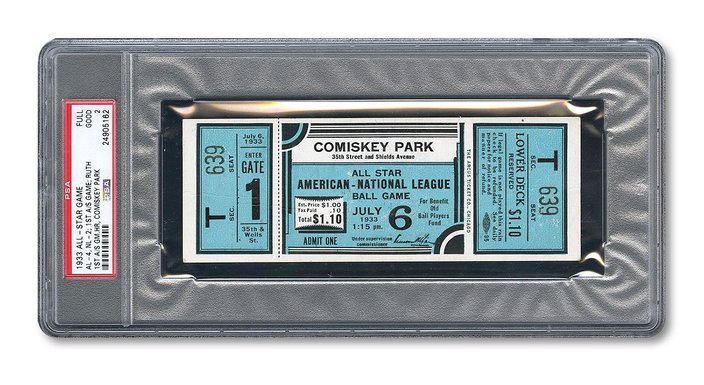
The first MLB All-Star Game was played at Comiskey Park in Chicago in 1933. Created as part of a World's Fair, it quickly sold out. Above, a ticket from the game.
PV: Do you think the organizers were surprised by the number of people that showed up, by the publicity that this ended up getting? You wrote about how many newspapers ran articles on this on the front page at the time. Was that reception expected or was it kind of surprising?
RS: They were very afraid at the beginning, given the fact that the fans were not coming to baseball games anymore. Major League attendance was half of what it had been pre-Depression and the only tickets they were selling were in the bleachers, the cheap seats.
So they had a considerable fear that people just might not be able to afford this. But it became obvious very quickly that the whole country was caught up in enthusiasm. Every paper in the country wanted to print All-Star ballots. So I think they got a good idea that this was going to be big and then they put on (sale), initially, the most expensive seats. They offered those for sale and they sold out in an hour.
Each time they would add the next level of seats — they would be gone immediately. So they knew in the build up to the game that it was going to be a big event and sell out. But, again, they started out really doubting that that would happen.
PV: Obviously, your book focuses on the first All-Star Game, but how did the second All-Star Game come about and how did it become an annual event?
RS: The epilogue of the book is the second All-Star Game. It’s about the Negro League All-Star Game that happened that year, but the second Major League All-Star Game happened because of the success of the first one. They realized that there was a real appetite for this among the fans. And so they decided to stage a second one.
The second one turned out to be equally, if not more, successful than the first one. And at that point it sort of became an inevitability that there would be a third and fourth. And as you know, it went on … with two interruptions, one for World War II and one for the COVID pandemic. But for going on 90 years, it's been uninterrupted except for that.
PV: You mentioned that appetite for the game. Do you feel that All-Star Games, in general, still captivate people the way that Game of the Century did? And, if not, is there something comparable in the sports landscape today that does, that holds that sway that that first game did?
RS: I don't think there's anything really to compare with it because there's nothing that people went into it believing this was a one-time event, this was going to be a singular experience. Obviously, the Super Bowl's a gigantic, global phenomenon, but everybody knows there's going to be a Super Bowl next year, too.
But at that time, people didn't think they'd ever see the best players in the American League playing against the best players in the National League. And again, you have to remember that baseball was so preeminent among sports. I mean, it was really the national pastime and baseball players were paid far better than any other athletes. Even during the Depression, attendance was many times that of other sporting events.
The organizers behind the World's Fair that Chicago hosted wanted an epic sporting event to be included as a centerpiece. They landed on a baseball game, and the MLB All-Star Game was born. The photo above shows a poster for the fair.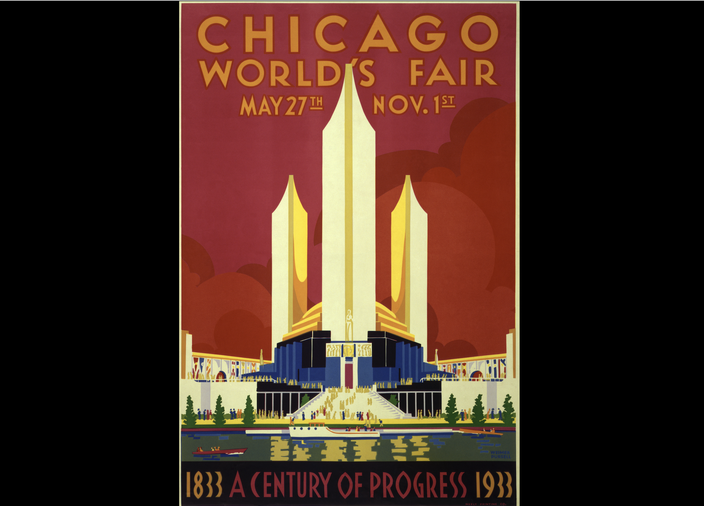 Provided Image/Public Domain via Grove Atlantic
PV: At least for me, it was hard to not think of this year's All-Star Game, with it being in Philadelphia, while I was reading your book. Obviously, the first All-Star Game was the centerpiece or a centerpiece of the World's Fair. This year's, it's a big part of Philadelphia's celebrations for the nation's 250th birthday. Do you see similarities between this upcoming game and the first game, or are they pretty different?
RS: Well, of course, there's a lot of difference, but this is probably the first All-Star Game that ties in so well to a national (celebration). Actually it wasn't a national celebration. The game itself was a national celebration in 1933, but the country wasn't much in the mood for celebrating at the time. It needed it. It was a great relief, but, now being held in a city where the United States was invented on its 250th anniversary is — you can't avoid the sense of connection.
And it does elevate the game. I think the All-Star Game hasn't been in recent years, nearly the big event — the national event — that it was for many years, at least as late as the 1960s and even into the ‘70s and ‘80s. But this year's will have some extra resonance.
PV: One of the things that I was fascinated in your book was some of the similarities in the logistics of the game. You noted that the rosters were formed in part by a fan vote for that first one, and that still happens today. And that they wanted one player from each team, and that still happens today. In terms of the game itself, how true is the modern All-Star Game to that first one that was played?
RS: Baseball, I'm sure we all agree, has done a great job of sort of conserving its history, honoring its history. It has dishonored it in some ways. Its records don't mean what they once did, because they've been watered down for either political reasons or the inability to face the fact that some guy cheated to set the record.
But you can't really change what baseball is. The field itself is the same field that they were playing on in 1933, although they may not all be real grass. But the bases are still 90 feet apart. The dimensions of the parks are similar. Pitches are thrown off a mound 60 feet from home plate. It makes it the most compelling one-on-one confrontation in all of sports, with the possible exception of a boxing match. And so you could do a lot of things to shave the edges off of baseball, but you can't change it fundamentally.
It's got an integrity and a sort of historical continuity. This is what people still love about it. It is more part of the American tradition than any other game.
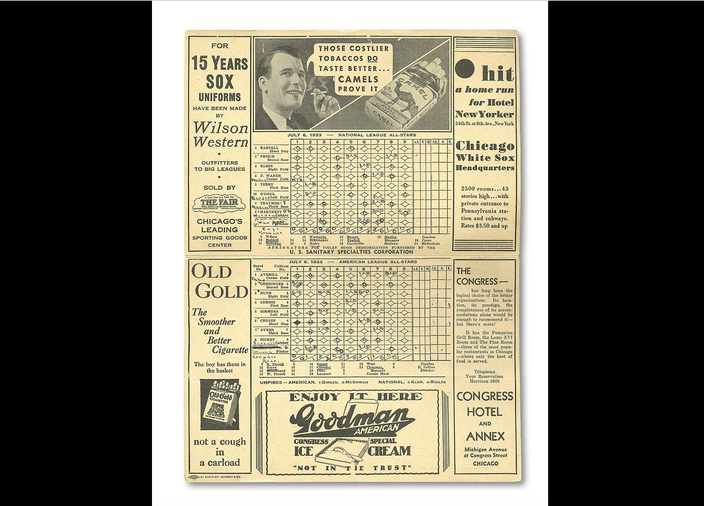
The scorecard above details the plays made during the first MLB All-Star Game, including the home run Babe Ruth hit in the third inning.
PV: Your book spent almost as much time talking about Babe Ruth and the role that Babe Ruth played in shaping the game at that time. He obviously had a starring role in that first All-Star Game. Presumably, this year Shohei Ohtani is going to appear in the game. There's obviously been so many comparisons between the two of them from a baseball standpoint. But I was curious, from a celebrity standpoint, how does Shohei compare to the Babe? It seemed like the Babe would have been the star of the 1920s and the 1930s.
RS: Shohei Ohtani would have a long way to go to measure up to Babe Ruth. In terms of a career, he hasn't had enough yet. But really until I started working on this book, I didn't realize myself the enormity of Babe Ruth. He was by far the biggest sports celebrity in this country's history. And his greatness as a player can't be overstated either.
When he hit 54 home runs in 1920, it absolutely blew people's minds. He hit more than the (players with the) next three highest totals combined. You look at from a historical perspective, for Shohei Ohtani to say that he hit more home runs than any other team in the league in his first season in a Dodgers uniform, he'd have had to hit 214 home runs.
PV: Yeah, it's a lot. Impossible.
RS: When you look at Babe's career, too — the wins above replacement has become the most defining statistic in baseball. The three best WAR seasons in the history of Major League Baseball belong to Babe Ruth. He has six out of the top 13 and (it) would have probably been eight, except for the two seasons he missed with a suspension and an illness.
His career WAR is by far the highest in the history of the Major Leagues. It's more than twice the highest WAR of anybody playing right now. And that's Mike Trout. Babe's career WAR was 182.6 and Mike Trout's is (90.3).