




June 22, 2026
 Provided Image/Independence Historic Trust
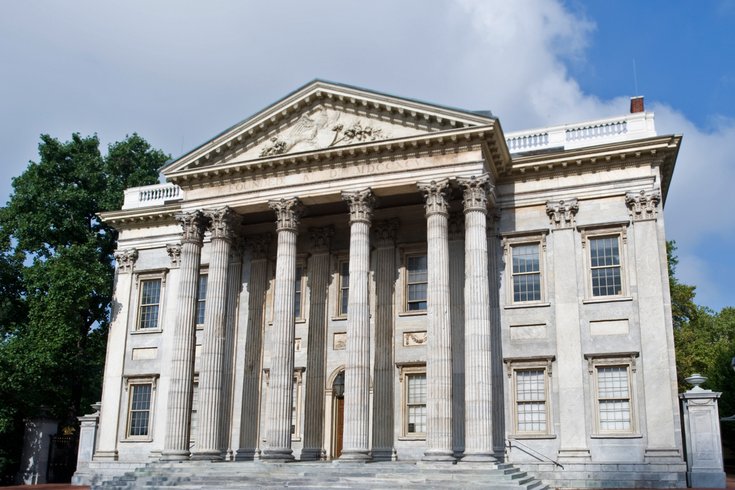
The First Bank of the United States is reopening as a museum July 1. The building has been closed for decades.
The historic First Bank of the United States reopens as a museum on July 1 — three days before America's 250th anniversary.
The First Bank building has been closed for decades, leaving many unfamiliar with its 18th century origins, beyond a few bars in the "Hamilton" musical. But in 2017, the Independence Historical Trust and Independence National Historical Park began securing the money needed to restore the building at 120 S. Third St. Since then, they have received $39.3 million in federal funding and $4.5 million in private donations.
MORE: Contents of America's Time Capsule revealed ahead of July 4 burial at Independence Hall
Historic preservationists sought to complete renovations by July 4, and the building will be ready just in time. Repairs have been made to the First Bank's marble facade and its interior rotunda has been restored. The upgrades also include a rear addition that includes bathrooms, a staircase and an elevator.
With the grand opening just a few weeks away, here's a look back on the building's history, and its significance during the post-Revolution era.
Despite the name, the First Bank wasn't the first attempt at a centralized bank. In 1781, the Continental Congress established the Bank of the United States, which opened the following year in Philadelphia. However, that bank was short-lived, and Alexander Hamilton advocated for another national bank to stabilize the country's credit.
Hamilton wanted to replace state currencies with a national currency and pay off debts from the Revolutionary War. But establishing the First Bank took some convincing.
James Madison and Thomas Jefferson, then secretary of state, opposed the bank, claiming the U.S. Constitution did not specifically call for a national bank. Hamilton argued that it didn't prohibit the creation of one, either. Congress approved a bill to create the bank, but Jefferson urged President George Washington to veto it. Washington offered Hamilton a week to address Jefferson's concerns, and Hamilton wrote a 15,000-word rebuttal that ultimately swayed Washington to support the bank.
The First Bank was established Feb. 25, 1791 through a 20-year charter. It initially was located at the Carpenters' Hall building at 320 Chestnut St., but moved to Third Street in 1797.
The three-story brick building with a marble facade was designed by Samuel Blodgett, Jr., who also helped develop Washington, D.C. His design features a marble keystone with a likeness of Mercury, the Roman god of commerce. Above that sits a carved marble panel with a baby wearing a helmet similar to Mercury's. The baby symbolizes the young nation. It leans against a globe, which represents the international economy, according to the National Parks Service. The panel also features a beehive for industriousness, a cornucopia of coins, financial ledgers, ships at sea and the American flag.
At the top of the pediment — the triangular shape above the front exterior columns — sits a mahogany eagle. Made by French wood carver Claudius LeGrand, it is thought to be the oldest known architectural reference to America's seal.
In the late 1810s, politicians disagreed on the bank's future. Some wanted to renew the charter, but others preferred to let it expire. By that time, Hamilton had been killed in a duel, and his political party had been removed from power. Many state-run banks had popped up over the decades, as well. The renewal vote failed, allowing the charter to expire.
In 1816, leaders established another central bank — the Second Bank of the United States — at 420 Chestnut St. However, a renewal vote for that bank in 1832 was vetoed by President Andrew Jackson, and all of its funds were redistributed to state banks by 1836. That building is now a portrait gallery.
After the First Bank closed, merchant Stephen Girard purchased the building in 1811 and opened his own bank. The building was left to the city after his death in 1831. The building's interior was remodeled in the early 1900s, and Girard Bank moved out of the space in the 1930s. In 1955, the National Park Service purchase the bank building, and used it as a visitor's center until the 1976 bicentennial.