





July 03, 2026
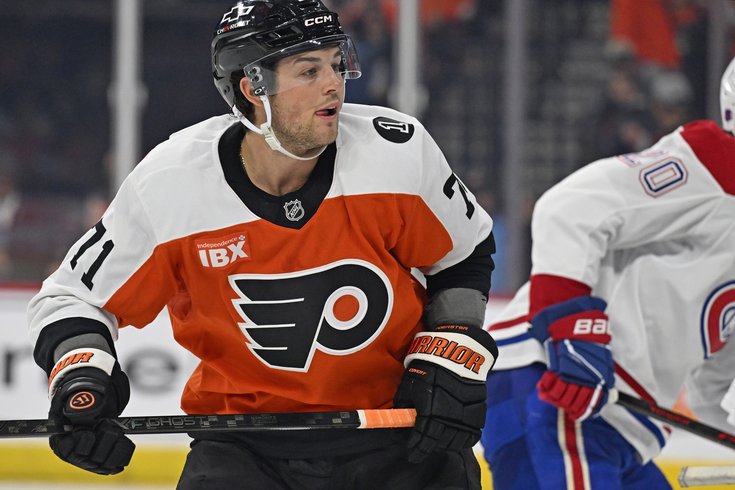 Eric Hartline/IMAGN IMAGES via Reuters Connect
Tyson Foerster has quietly become one of the Flyers' better scorers.
The way Danny Brière is looking at it, the Flyers have Tyson Foerster for 10 years now.
Before NHL free agency's start on Wednesday, the emerging two-way winger was playing on a two-year bridge deal that Brière signed him to last summer at a $3.75 million cap hit.
But by that point, the Flyers' general manager was probably safe to just go straight to the big contract.
Foerster had broken out to a 25-goal season and his second straight of scoring 20 or more, all within his first two full years as a regular NHLer, which made him out to be a clear core part of the Flyers' future.
Then, up to December of this past season, he was taking off on a pace that might've just seen him reach into the 30-40 goal range, had a freak upper-body injury not sidelined him until late into the playoff push in April.
But at 24 years old, Foerster had developed into a strong and largely complete 200-foot winger, who had also quietly become one of the Flyers' better scorers.
So now that made it the time for Brière to reward Foester with the big eight-year, $56.8 million extension (at $7.1 million per), which was signed in a bit of a surprise on Wednesday, not long after the ink finally dried on goaltender Dan Vladar's five-year deal that caught absolutely no one off guard.
But to that end, what was the initial holdup last summer? Why a bridge deal for Foerster first?
"I could've signed him last year to an eight-year deal," Brière told the media Wednesday, after an initial chuckle over what his reservation was. "That number would've been maybe a little lower than what we have him now. In my mind, now we have him for 10 years, you know, at a slight increase. So it's just a little bit more years, and instead of having him become a free agent at, you know, 30-31, now we have him throughout all his years where he should be performing at his best."
Foerster's term will expire in 2035, when he'll be 33 years old. Hopefully, the Flyers will have raised the Stanley Cup by then. They certainly hope he's part of the long path toward it.
"We believe he's a big piece and part of our future," Brière continued from the Flyers Training Center in Voorhees after Day 1 of free agency closed. "[He's] another great leader, grown inside the organization. The leadership part, the scoring threat that he is, the 200-foot game that he plays, the size, he's worked really hard to improve his physical condition, to improve his skating.
"You probably remember when we drafted him, the big knock on him is that 'He'll never play in the NHL! This is a fatal flaw, he can't skate!' He worked really hard at overcoming that, and I mean, when you watch him now, it's not even a question, the skating part. So a lot of credit goes to him, and he's grown into a leadership role that's very important on our team. [He's] very respected by his teammates, and yeah, we see him as a big part and piece of our future."
Maybe at what could end up being an insane bargain relative to the rest of the league, too.
Last season's injury, which cost him about four months, muddies the picture a bit. But before he sustained it while following through on a shot against the Penguins on Dec. 1, Foerster had 10 goals through 21 games to lead the Flyers in scoring during the early part of the year, playing a noticeably stronger and meaner game along the walls where he was looking to work his way inside with the puck to shoot.
It was working for him.
While attention, understandably, was more fixated on Trevor Zegras and Matvei Michkov as the more natural offensive stars, Foerster was building a more understated reputation as a two-way force who was starting to score in greater numbers comparable to Mark Stone in Vegas – the premier example most default to when they think of a 200-foot winger.
But Stone is 34 with a $9.5 million cap hit.
Foerster is 24, considered to be on the rise, and will be at a $7.1 million cap hit through all of his prime years in Philadelphia now.
Is it a higher cost compared to what Brière might've paid had he just given the long-term deal to Foerster last summer? Yeah.
But the salary cap is rising over the next several years ($104 million this year, and $123 million by 2028), and presuming Foerster stays healthy and starts maintaining a floor of at least 30 goals a season, would $7.1 million end up as one of the league's best values? Absolutely.
"We believe he's going to be a big-time goal scorer and overall player for us," Brière said of Foerster. "If we didn't do it now, it's gonna cost us a lot more down the road."
But now the Flyers don't have to worry about it. They didn't have to worry much about keeping Vladar around for a while as their leading netminder, either, who also signed to a relatively friendly $5.5 million hit per season.
Both wanted to stay Flyers, though, which for Brière is a crucial development for where the team is headed.
"Look, we're at a time where a lot of players are dictating where they want to go," Brière said. "They wanna leave their team. We see it all over the place. It's crazy around the league what's going on. We have a guy [in Vladar] that wants to be here. Tyson Foerster, it's the same thing. He wants to be here. Travis Konecny, when he committed. Cam York, you know, I could go down the line with other guys, [Christian Dvorak]...Our guys wanna stay here, and to me, that's a really good sign."
With hope that it's setting up for better ones ahead.
*Cap numbers and projections via PuckPedia.
SIGN UP HERE to receive the PhillyVoice Sports newsletter
Follow Nick on Twitter: @itssnick
Follow Nick on Bluesky: @itssnick
Like us on Facebook: PhillyVoice Sports