






October 09, 2025
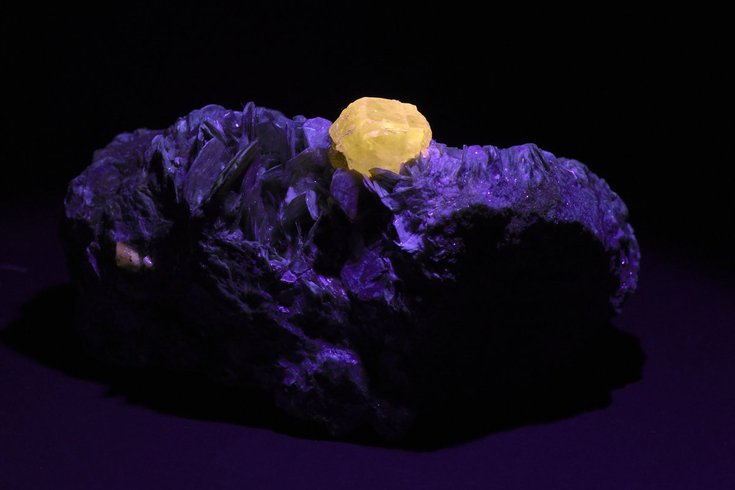 Provided image/Science History Institute
'Earthly Matters,' the new permanent mineral exhibit at Science History Institute, includes specimens that glow under ultraviolet light, like pink apatite (pictured above).
The specimens in the Science History Institute's latest exhibit are spiky, striking and, in some cases, fluorescent. A few are toxic, and at least one is otherworldly. All of them are on permanent view in the museum's Old City lobby, which just got its own $3.3 million glow-up.
"Earthly Matters," the institute's new mineral exhibit, opened Wednesday night at a party with rock candy cocktails and scientific lectures. The display includes over 20 crystals, metals and other minerals acquired from a donor in California and mounted in custom cases from Germany. To set it apart from the collections in natural history museums around the world, the curatorial team focused on the chemistry of these objects, rather than their taxonomy or geology.
"What's different about our exhibition is that we have displayed these around historical questions that people have asked about the minerals before we knew their chemical structure," said Michelle DiMeo, the vice president of collections and programs at the Science History Institute. "So today we know minerals by using high-tech microscopes that can show us how atomic structures and crystals are built. But before that, what kinds of questions did we ask?"
DiMeo and her colleagues came up with seven, and organized the exhibit around them. One section asks, "How hard is it?" The query serves as a springboard to discuss the Mohs scale, a scratch resistance test developed in the 1800s that's still used today. Another prompt reads, "Does it glow?" Visitors duck behind a wall to find out; a small collection of minerals are hidden there, faintly glowing under ultraviolet lights.
The final question was also one DiMeo heard a lot as images of the collection circulated: Is it from Earth ... or outer space? Despite the almost alien qualities of some of the rocks, the vast majority do come from our planet. There is one meteorite, which DiMeo jokes "is in some ways the most boring looking." Its wider history, however, is anything but. Villagers who reported rocks falling from the sky were mostly written off as lunatics until 1803, when a meteorite crashed into a small French town, scattering over 3,000 fragments. It was too big to ignore, and the scientific study of meteoritics was born.
The minerals in "Earthly Matters" greet visitors in the museum's newly updated lobby, part of a wider renovation that shut down the building for several months. The $3.3 million project marked the first major redesign since the Science History Institute opened in 2008, and it gave the museum a new gift shop, production studio and exhibition space.
The redesigned lobby at the Science History Institute also features a new gift shop.
DiMeo hopes that visitors will find the entryway minerals exhibit inviting and accessible, even if the science underpinning it is a bit complicated.
"When you get into the exhibition itself, we have a lot of very technical equipment like black boxes or things that might look scary or off-putting or too technical," DiMeo said. "But we want people to feel comfortable and familiar asking these (questions), inspire their curiosity before they even walk into the museum.
"Everything is made from matter. Everything is made from the material world. We're using these familiar objects like minerals and rocks that everyone sees, but trying to do a unique and surprising spin on them so that you can ask these questions."
Follow Kristin & PhillyVoice on Twitter: @kristin_hunt
| @thePhillyVoice
Like us on Facebook: PhillyVoice
Have a news tip? Let us know.