



April 24, 2026
 Brian Fluharty/Imagn Images
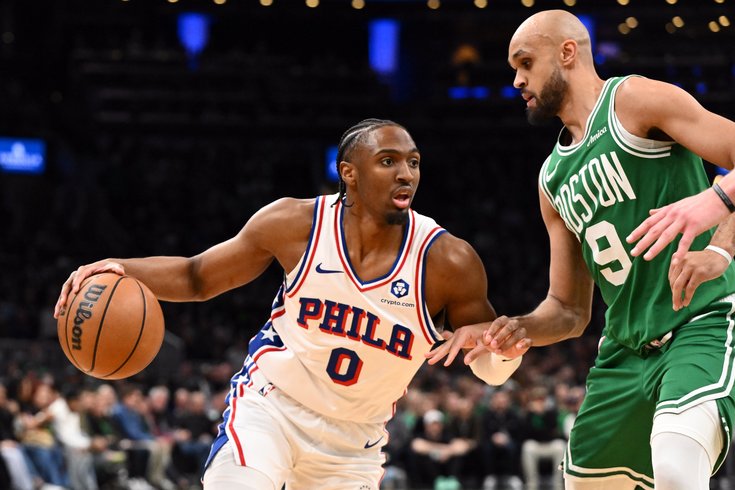
Can Tyrese Maxey continue to find success against Derrick White?
Recency bias is quite a powerful thing.
A few days ago, Sixers fans had awful tastes in their mouths. After a wire-to-wire demolition at the hands of the Boston Celtics on Sunday afternoon, the Sixers looked completely outclassed by their rivals. For more than 48 hours, they were ruthlessly mocked around these parts. Sans Joel Embiid, the Sixers looked hopeless.
Yet heading into Thursday's Game 3 at Xfinity Mobile Arena, there is considerable intrigue. Tyrese Maxey and VJ Edgecombe took over in Boston in Game 2 on Tuesday night, evening up the series and restoring interest. Embiid, 15 days after his emergency appendectomy, is shockingly listed as doubtful, indicating he could return far earlier than anticipated.
Some major adjustments from Sixers head coach Nick Nurse helped the Sixers make this a series, and he will surely be aiming to find new tricks. Celtics head coach Joe Mazzulla, the presumptive NBA Coach of the Year Award winner, will look to show the Sixers different looks in an attempt to regain control of the series. What options do Nurse and Mazzulla have as they try to stay one step ahead of where this series is going?
On paper, Boston's choice to spend most of the game defending Maxey is not much of a choice. Derrick White is arguably the most impactful guard defender in the NBA, not just for what he can do on the ball against elite scoring threats but also because of his shot-blocking prowess, hands plays in transition and mastery of the little things that can take a defender from great to elite.
If there is one part of White's defensive profile that is not elite, though, it is his quickness. He is not a stellar athlete and his first step is not nearly as fast as that of Maxey. Boston has leaned on White to handle Maxey for the vast majority of the first two games of this series, but just about everyone else to take brief cracks at him has succeeded. Maxey is not his best self right now – not just because he cannot play off of Embiid, but because his right finger injury has severely limited his pull-up three-point shooting. But he has found success against White that has not existed against anybody else:
| Primary defender | Maxey FG | Maxey 3P |
| Derrick White | 12-24 | 4-9 |
| Jayson Tatum | 1-8 | 0-3 |
| Sam Hauser | 2-4 | 1-1 |
| Jaylen Brown | 0-3 | 0-0 |
| Wide open / transition | 2-3 | 0-0 |
| Jordan Walsh | 1-2 | 0-1 |
| Payton Pritchard | 1-2 | 0-1 |
| Max Shulga | 1-1 | 1-1 |
| Nikola Vučević | 0-1 | 0-0 |
So, could Mazzulla shift around the matchups a bit? In both games, he has opened with White on Maxey, Sam Hauser on Edgecombe, Jaylen Brown on Paul George, Jayson Tatum on Kelly Oubre Jr. and Neemias Queta on Adem Bona. If Embiid plays, the only thing that changes is Queta defending Embiid instead of one of his backups.
Tatum has been outstanding against Maxey – reviewing film of all eight of Maxey's shots against Tatum confirms this – but it is not a realistic matchup for an entire game.
The obvious answer would be Brown, who years ago did spend a decent bit of time defending Maxey in the playoffs and did his best to use his strength as a weapon. Maxey has bulked up a lot since then, but is still not nearly as powerful as Brown, whose quick-twitch athleticism and first step might still be better than White's despite his additional size. Brown frequently fails to remain engaged as an off-ball defender; perhaps asking him to hone in on Maxey at the point of attack would get the best out of him.
Hauser, who is probably the Celtics' weak link (only because of the strong defenders across the board), is a viable option against Oubre. That would allow White to take on the Edgecombe assignment, with Tatum continuing to defend George.
Yes, Edgecombe also has an athletic advantage over White, but his ball-handling is far less fluid, so his functional speed in a half-court setting is not as threatening. White is far more likely to cause chaos as a defender and do what he does best if he is defending Edgecombe rather than Maxey. Not only would he have chances to pick the pocket of a shaky ball-handler, but he would have more freedom to take gambles off the ball, where his instincts are brilliant.
MORE: Sixers mock draft roundup 1.0
No matter what, Nurse is going to play Maxey, Edgecombe, Oubre, George, Quentin Grimes and two centers in every game. Lately, that pairing has been Bona and Andre Drummond. If Embiid is back, it will likely just be Drummond. After those seven players, the questions begin.
In Game 1, Nurse went with a nine-man rotation, giving Dominick Barlow – a starter for the majority of the year but a rotation player from start to finish – and Justin Edwards spot minutes off the bench. That was his initial outlook in Game 2, also, but early foul trouble for both George and Oubre forced Edwards into the spotlight earlier than expected.
Edwards' feel for the game and willingness to compete defensively and take quick-trigger spot-up three-pointers offensively have endeared him to Nurse in a major way. There is real trust there, and Edwards held up well defending Tatum and Brown on the wing, giving the Sixers significant innings-eating minutes to help keep George and Oubre safe from foul trouble. He ended up knocking down an important triple early in the fourth quarter, too.
Just as notably: Barlow did not play in the second half of Game 2 after a mostly ineffective first half. Barlow only made one play of note in the first two quarters on Tuesday. To be fair, it was a heck of a play:
The only stat that Dominick Barlow recorded in the Sixers' Game 2 victory in Boston on Tuesday night came in a very fitting fashion: pic.twitter.com/ff1xnzCwGm
— Adam Aaronson's clips (@SixersAdamClips) April 22, 2026
If the Sixers are going to seriously compete at the level that gives them a chance to win this series, they are going to have to make up at least part of what projects to be a significant discrepancy in three-point volume any time these two teams face off. The easiest way to do that: removing from the rotation Barlow, a non-shooter whose only pathway to generating a three-point shot is off an offensive rebound, and playing more of Edwards, whose most valuable asset as an offensive player is his confidence stepping into spot-up triples.
This would mean the Sixers would not be playing any traditional power forwards; any lineup Nurse put out would have either three guards and one wing or two guards and two wings. (Barlow could become an option to play small-ball center over Drummond and/or Bona, which would be more likely if Boston carries out the next adjustment.) They would be giving up a bit more size in the process, but at this point the sample size is large enough to suggest that Barlow is not going to make a meaningful difference for the Sixers on the defensive glass.
MORE: Matt Cord reflects on 28-year run as Sixers' PA announcer
Barlow sliding up to the five more regularly at some point in this series remains a distinct possibility, in large part because all of the stars are aligning for Boston to at least give their own small-ball look a chance.
Neemias Queta is a very good starting center and backups Nikola Vučević and Luka Garza can each have their moments as floor spacers, but none of those players – especially Vučević or Garza – can be trusted to guard in space, particularly against the Sixers' dynamic guards. Boston's drop coverage was torched by Maxey and Edgecombe in Game 2, and the Sixers will certainly continue to hunt against Vučević in particular. The former Sixers first-round pick has had a tremendous career, but he continues to decline athletically. At this point, Vučević is barely viable in a playoff setting considering how brutal his defense has become.
The simplest option for Mazzulla would be to play Garza over Vučević and hope for better results. But Garza is not cut out to switch, either. Tatum, one of the best rebounding wings in the NBA who averaged 10.0 rebounds per game despite his limitations after returning to action late in the regular season, can anchor the Celtics on the glass, particularly against smaller Sixers units. If Embiid plays, any Boston lineup that faces him will need a center with size on the floor. Otherwise? Things could get interesting.
Sure, Tatum would struggle to box out Drummond, but Drummond would not be playable at all against a lineup of five perimeter-oriented Celtics. Nurse's likely counter to a Tatum-at-center lineup: using Barlow at center and crossing his fingers that the 22-year-old can hold his own against Tatum. Both teams would be capable of switching any and all screens. For the Celtics, the goal would be to turn the water off when it comes Maxey and Edgecombe's casual pull-up triples.
Going to Tatum in Vučević's slot would also open up more minutes for better players, namely Baylor Scheierman, who was outstanding for months to close out the season but has not played a ton in this series so far. Scheierman is another solid option to defend Maxey; he had a prolonged stretch of exceeding expectations with that assignment in a game in March. It could also mean more Jordan Walsh, who locked up Maxey in the final minutes of an early-season Celtics win in Philadelphia.
Mazzulla is now renowned as a brilliant coach, but he is very firm in his process. It takes a lot for him to switch things up in any sort of dramatic way. Perhaps one loss in a game full of outlier three-point variance on both sides is not enough to clear that threshold. But if there is one thing Mazzulla avoids, it is complacency. The Celtics had a margin for error to remain comfortable favorites; it is now much slimmer – especially if Embiid suits up.
MORE: Sixers-Celtics Game 2 observations