




February 02, 2026
 Bill Streicher/Imagn Images
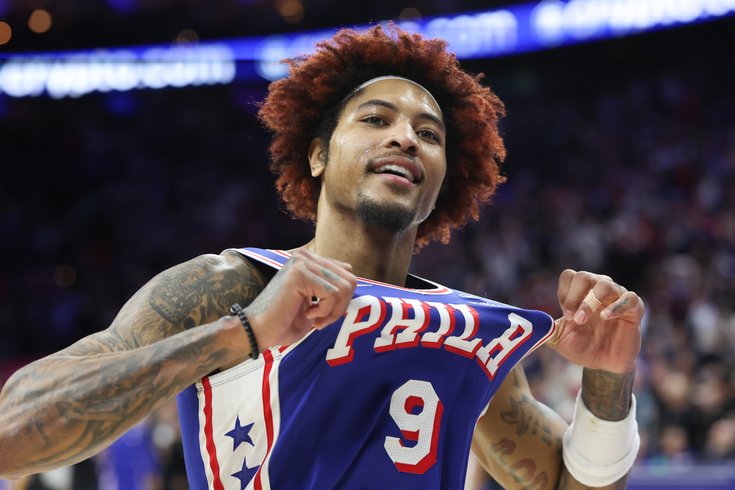
In many ways, veteran swingman Kelly Oubre Jr. was the Sixers' pivot point at this season's trade deadline. Now, he is essential to keep.
Front offices across the NBA spend months preparing for the trade deadline, charting dozens upon dozens of hypothetical pathways in all sorts of different directions. But all of those scenarios are dependent on the same math, and generally that math does not change.
On Saturday afternoon, the math suddenly changed for the Sixers. Paul George was suspended for 25 games, and among the many ramifications of the news is that the Sixers will be given a luxury tax credit of just under $5.9 million. Instead of entering the deadline about $7 million over the tax threshold, the Sixers are now only $1.26 million above the line. It makes ducking the tax and finding a rotation upgrade or two pretty easy.
Joel Embiid stood at his locker last Thursday, one week away from the deadline, and fielded a question he has been asked around this time in many different seasons: Do you want to see changes to this roster? His answer was strategic.
"Obviously, we've been ducking the tax the last couple of years, so hopefully we'll keep the same team," Embiid said. "I love all the guys that are in here, so I think we got a shot, so hopefully – I don't know what they're going to do, but I hope that we'll get a chance to just go out and compete, because we've got a good group of guys in this locker room and vibes are great. So, like I said, in the past we've been, I guess, ducking the tax. So hopefully we think about improving, because we have a chance."
At that time, the likeliest pathway to getting below the tax was trading veteran swingman Kelly Oubre Jr., who had recently rejoined Sixers head coach Nick Nurse's starting lineup and was one of the team's only reliable two-way players. Not only is Oubre an essential piece until George is eligible to return on March 25, but his expiring salary of just under $8.4 million no longer needs to be moved in order to help the Sixers get under the tax.
To be clear: the financial benefits of ducking the tax are significant – instead of paying a tax bill, a team becomes a recipient of tax money from the teams that do stay over the line. But there is no basketball-centric or roster-building advantage to doing so. It is not like the first or second apron, both of which come with penalties or restrictions.
In more ways than one, Sixers fans feel they have a history of the team pulling rugs out from under them. Saturday's stunner is the latest example. Embiid, clearly, was weary of where this week might take the organization, even before the George news broke. And it is worth noting: Embiid did not spend much of his answer to the aforementioned question begging for reinforcements. He merely wants the current group of core pieces to remain in tact.
This is a team that is flawed, but one with the sort of high-level talent to be a serious threat in a particularly weak year for the Eastern Conference. Embiid has made massive strides in terms of production and availability over the last five weeks, and Tyrese Maxey is set to start in the All-Star Game later this month. With a supporting cast eventually led by George again, alongside 20-year-old rookie VJ Edgecombe, there are enough impact pieces to make this a team that, if some things break right, can be a tough out in any seven-game series in this conference.
Those facts lead one to imagine the Sixers pushing in any chips available to them to bolster Nurse's rotation ahead of a potential playoff run. Embiid, however, is the most notorious injury risk in the NBA. George is not far behind him, even without factoring in his suspension. Typically, teams this close to the tax line will find a way to maneuver below it, because it is doable without gutting a rotation. This would be the fourth season in a row that the Sixers begin a season over the tax, only for their trade deadline moves to get them under.
After the nightmare that was the 2024-25 season, Sixers fans are just now beginning to believe again. Embiid is looking more like his best, Maxey has made another leap – this one to the fringes of superstardom – and the team plays a likable brand of basketball. It has finally figured out how to survive when Embiid is off the floor, too, though George's long-term absence will challenge that.
This team is good now, and there is an avenue for them to reach much greater heights.
So, which players on the Sixers are liable to becoming cost-cutting casualties? How might the Sixers duck the tax without downgrading any of their roster spots? What are the Sixers' best trade assets? Who can they acquire if President of Basketball Operations Daryl Morey is empowered to seek upgrades? How do the possible conversions of Dominick Barlow and Jabari Walker from two-way contracts to standard deals factor into all of this?
Welcome to our 2026 Sixers trade deadline primer:
It is difficult to fathom any deals involving Embiid ($55,224,526) or George ($51,666,090). Maxey ($37,958,760) should be considered untouchable; the same is true for Edgecombe ($11,108,880). All four of those players seem exceptionally unlikely to be traded.
Quentin Grimes ($8,741,209) is, on paper, the most obvious trade candidate on the Sixers here. He has a medium-sized expiring salary and his minutes and production have dwindled for two months. After a contentious and fruitless restricted free agency, many expect Grimes to be elsewhere next season. But in the fine print on that paper: Grimes has the right to block any trade this season, because his Full Bird rights would not travel to his new team, limiting their ability to commit the sort of long-term dollars to the 25-year-old that he wants.
Unless Grimes is so desperate to escape Philadelphia that he is willing to incur significantly more financial risk than he already has, the only way he would even consider waiving his veto power is if he can get to a team set to have plenty of cap space in the upcoming offseason. Among the theoretical options: the Chicago Bulls, Utah Jazz, Charlotte Hornets, Los Angeles Lakers and Washington Wizards.
Trading Grimes would also create more responsibility for Jared McCain ($4,221,360), who has made major gains over the course of the Sixers' last few games but still has a lot to prove to be part of what would turn into a three-guard rotation where everyone involved has to play quite a bit. McCain is a potential asset himself, but given how much he has struggled this season compared to last and his relatively low salary, the Sixers would be better off hanging onto him for now. If there is ever a right time to trade McCain, it will come later.
The other medium-sized salary is Oubre ($8,382,150), but his role at this deadline has changed. He was first the main piece of any tax-ducking scenario; now he would be the main piece of a trade that lands the Sixers a player whose salary is in the range of $10 million to $15 million. Given the makeup of the Sixers' George-less roster, for the sake of maintaining competitiveness for the next several weeks trading Oubre would almost have to bring back a wing.
That puts plenty of focus on Andre Drummond ($5,000,000), the only other player who can be reasonably useful salary filler in most deals. But unless someone needs a backup center and views the veteran as a solution, Drummond is always going to be more valuable to the Sixers than another team. The Sixers' third-string center is just as important as the average team's backup five. If they trade Drummond – a distinct possibility given his salary – they will need to find another player who can give them reliable minutes behind Embiid.
Then there are the minimum salaries: Eric Gordon ($2,296,274) is the most likely Sixer to be traded this week; Kyle Lowry ($2,296,274) should be considered much more likely to stick around as one of the team's few most important leadership figures. It would be extremely surprising, but not quite stunning, to see a youngster with long-term control like Justin Edwards ($2,048,494) or Johni Broome ($1,272,870) on the move. A trade involving Adem Bona ($1,955,378) feels almost implausible given his light salary, multi-year control and status as Embiid's primary backup and occasional frontcourt partner. There is also Trendon Watford ($2,461,463), who has a team option at a $2.8 million next season, and has some passionate fans in important places between Nurse and his close friend Maxey. Watford has failed to separate himself from Barlow and Walker in a constant battle for minutes at power forward, but he is one of a few players Nurse singled out as having a more important role in the aftermath of George's suspension.
On the picks side, the Sixers have three future first-round picks they are allowed to trade, with the first – and arguably most valuable – being the Los Angeles Clippers' unprotected first-rounder in 2028. The Sixers also have top-three protected first-round swap rights with the Clippers in 2029; they can trade the more favorable of their own pick and the Clippers' pick that year. They could also trade one of their own first-rounders – either in 2030, 2031 or 2032, depending on if they trade any of those earlier picks.
A deal made with Washington last deadline gave the Sixers an abundance of second-round picks; they own 10 of them over the next seven drafts (though one of those picks is very unlikely to convey and another is not eligible to be traded). Most of them have about as much upside as any second-rounder can. Here they are, broken down by year:
| Year | Sixers second-round picks |
| 2026 | none |
| 2027 | - own - more favorable PHX/GSW |
| 2028 | - own (not tradable because of conditions of another trade) - GSW - DET (top-55 protected) |
| 2029 | - own |
| 2030 | - more favorable GSW/POR - WAS |
| 2031 | - own |
| 2032 | - own |
For a more in-depth explanation of the Sixers' future draft picks, click here. That breakdown will be updated as trades happen.
What are the Sixers actually allowed to do, and what can they do while getting and staying under the tax line? The answers to both of these questions were already extremely complicated, and George's suspension has made it an even more difficult situation to digest.
Here are the main facts you need to know as it relates to the cap, the tax and other financials heading into the deadline:
• As of this writing, the Sixers are not hard-capped at the first or second apron (these are thresholds above the league's soft salary cap which, if teams cross, come with roster-building limitations; being hard-capped at an apron means a team cannot exceed that number in total salary at any point for the remainder of the season).
However, the Sixers are less than $1 million under the first apron, and they would incur a hard cap at the first apron if they take back more money than they send out in any trade (if the Sixers trade a player making $5,000,000 for a player making $5,000,001, they would be hard-capped at the first apron).
How does this impact trade talks? A basic rule of thumb that will help when looking at prospective trade targets is that the Sixers are unlikely to take back much more than $1 million in salary than they send out in any trade (if the Sixers trade $5,000,000 in outgoing salary, do not expect the incoming salary to be much more than $6 million).
• The George suspension puts the Sixers within striking distance of the tax line, now only $1.26 million over it. The fact that they were initially set to be over $7 million above the threshold is irrelevant; calculations for luxury tax payments only take into account what a team's cap sheet looks like at season's end. Dumping the salary of any one player on the roster would get the Sixers under the tax, but not by enough to then convert Walker and Barlow to standard contracts while staying under.
The Sixers could create enough breathing room by salary dumping Drummond on his own, or by dumping Gordon along with one of the other minimum players (Watford, Lowry, Edwards, Bona and Broome). That math is explored and explained a bit more in this video, if you are interested in getting somewhat into the weeds:
I have never been one to pivot to video, but I thought this would be an easier way to explain many of my initial reactions to today’s Paul George news.
— Adam Aaronson (@SixersAdam) January 31, 2026
Some thoughts on how the Sixers will replace George’s minutes, the luxury tax situation, possible moves to come & a bunch more: pic.twitter.com/Q4peFygqKt
Gordon's removal from the roster feels inevitable. Which of those other players is most likely to move if the Sixers want to hold onto Drummond for the sake of maintaining center depth? It is certainly not Bona. Lowry has the least basketball utility of the group short- and long-term, but his clout in the locker room is serious. Edwards and Broome are early on in their careers with lots of control. Watford has a better chance than both players of being a rotation piece in important games, but he also plays the position where the Sixers will have the most depth once George is back; his close friendship with Maxey is also relevant.
There is no easy answer here, and perhaps it will hinge on whether or not another team is willing to give the Sixers an asset for someone in this group, whereas the Sixers will likely have to give something up for another team to take Gordon off their hands.
Walker and Barlow have been tremendous assets to the Sixers on their two-way contracts, but the Sixers are very quickly running out of days to utilize them on those deals. Both players need to be converted to standard contracts in order to participate in postseason action and their limited days of NBA availability are dwindling. Barlow has been far more important to the Sixers' rotation than Walker, but both are essential, and the fact that Walker is the only Sixers player to be active for every single game this season means he very well could get converted before Barlow.
On Thursday afternoon, the deadline will officially come and go. Just hours later, the Sixers will begin a road game against the Los Angeles Lakers. Assuming Walker is active for Monday's game against the Los Angeles Clippers and Tuesday's game against the Golden State Warriors, the 23-year-old will not be eligible to dress for that Lakers game on Thursday unless his deal has been converted to a standard contract.
Barlow, meanwhile, will have 10 games of availability remaining on his two-way deal, but the Sixers would need to be at 15 players on their standard roster while using those up. Charles Bassey has not spent a day with the NBA team despite signing a 10-day contract last week; re-upping with him or signing a different player to a 10-day deal can help kick the can down the road. The Sixers do not have to exhaust every bit of two-way availability they have with Barlow, but if they want to they can get to the start of March before converting him.
There are two things that should be kept in mind most at the trade deadline as it pertains to Walker and Barlow...
First, as was mentioned in the previous section: the conversions of Walker and Barlow will tack on additional money against the aprons and tax; the combined number should be somewhere around $1.5 million and $1.9 million. If the Sixers incur a first-apron hard cap or are resolute in putting together a plan that prevents them from paying a tax bill, they will have to bake in that projection.
Second: the Sixers will need two roster spots that can be committed to those players; right now they have one spot that is essentially vacant (technically, Bassey is occupying it right now). The Sixers need to send out one more player on a standard contract than they acquire over the course of the trade deadline so that there is room on the roster for Walker and Barlow.
Some might be confused if Walker indeed gets a standard contract before Barlow, but such a development would not be any sort of indication that the team has soured on Barlow or has been unable to come to terms with the 22-year-old. It is the sort of financial manipulation teams almost always go through when converting two-way players, and Barlow's multi-week absence early in the season is going to afford the Sixers a bit of extra time if they want it.
The prospect of Giannis Antetokounmpo being moved has never been more realistic than it appears to be now, with his departure from Milwaukee imminent. Whether the two-time NBA MVP is traded this week or over the summer, his days with the Bucks are clearly numbered. Could the Sixers actually make a play for Antetokoummpo? The guess here is that such a thing happening is extremely unlikely. But it would be silly to tackle dozens upon dozens of trade targets that may or may not be available and not mention an all-time great set to be moved.
If the Bucks get a call from the Sixers about Antetokounmpo, their first request should be that the deal is centered around Maxey. The Sixers' ideal scenario would probably be dealing George – he can be traded while suspended – alongside draft picks and secondary young pieces like McCain. Antetokoummpo reportedly has the Sixers on his radar because of Maxey's ascent; his interest in coming to Philadelphia would presumably wane if Maxey was the piece the Sixers were using to get him.
If a middle ground existed here, it would be a deal centered around George and Edgecombe. Milwaukee could try its hardest to reroute George as part of a larger deal, but his suspension likely makes that more difficult. The Bucks might have to hold onto George until the offseason in this scenario, and it is far from a given that Milwaukee would have a remotely easy time shedding what was believed to be one of the least valuable contracts in the NBA even before the suspension.
But it is difficult to argue that any player mentioned as a centerpiece of a potential Antetokounmpo package – Miami's Tyler Herro, Golden State's Jonathan Kuminga and Brandin Podziemski and Minnesota's Jaden McDaniels are examples – has value in the same stratosphere as Edgecombe, who has obliterated expectations as a rookie after being drafted No. 3 overall. Edgecombe appeared to have the floor of an elite role player, and in addition to confirming those suspicions, the 20-year-old has made major strides as a shooter and ball-handler, suggesting star outcomes are far more likely than previously anticipated.
Would Milwaukee be willing to take on George's contract if it meant getting the best asset possible in Edgecombe? Would the Sixers trade a prospect this young, this exciting and this productive this early when their team would still be built around two players with histories of poorly-timed injuries in Embiid and Antetokoumpo?
If the core pieces of a trade are Antetokounmpo, George and Edgecombe, there are compelling cases on both sides for the Sixers and Bucks. It is a hell of a concept to consider, even if it seems quite unlikely.
And now, for the main event.
Players are listed from highest to lowest 2025-26 salary; one player being listed above another is not a statement that they are a superior or more likely option:
2025-26 salary: $14,386,320
Remaining contract: Four years, $68.4 million
With a three-year contract extension worth over $53 million set to kick in next season, trading for Gafford would not just lock the Sixers into the tax this year, but likely for years to come. There would be tremendous value in having this good of a backup center behind Embiid, but if the Sixers are willing to shop in this sort of aisle salary-wise, they are probably more likely to go for a player who can be part of their closing lineup.
2025-26 salary: $14,000,000
Remaining contract: Three years, $45 million
Last year, Toppin was closing NBA Finals games for the Indiana Pacers, sometimes as a small-ball center. He has tremendous offensive talent and can give the Sixers a scoring punch, either off the bench or as a starting power forward. He is limited defensively, though, and the 27-year-old has been out since October due to a foot injury. He would be a strong stabilizer for the Sixers' rotation at power forward with some small-ball five optionality if the medicals check out.
2025-26 salary: $13,937,574
Remaining contract: Five years, $96.4 million (player option for 2029-30)
Jones has a rather large extension kicking in after next season, but that means for now he is a cost-effective role player. Jones, 27, very quickly developed a reputation as one of the league's elite perimeter defenders, and when he shot well over 40 percent on long-range tries two seasons ago he appeared to have blossomed as one of the best role players in the NBA. But his production on both ends of the floor has quietly dipped since then. New Orleans reportedly remains adamant that it will not trade him, even though it might make sense for the Pelicans to consider it.
2025-26 salary: $13,445,754
Remaining contract: Three years, $45.3 million (player option for 2027-28)
Portis is more of a sure thing than Toppin – he is healthy and far more experienced – but he turns 31 years old next Tuesday and might not be as easy to integrate into a star-laden team. But Portis is having the best three-point shooting season of his career by far, has some of the four/five positional versatility that would benefit the Sixers and brings the toughness on the glass and elsewhere that this team could use some more of.
2025-26 salary: $9,187,573
Remaining contract: One year, $9.1 million (restricted free agent afterwards)
Mathurin's time in Indiana seems to be nearing its end; the former lottery pick is a gifted scorer but has never exactly fit with what the Pacers do best. With many teams able to make him compelling offer sheets in restricted free agency, could Indiana look to move Mathurin now and ensure it gets something for him? He might not be a perfect fit for the Sixers, either, but it would continue their pivot to betting on young players. And the Sixers know as well as anyone that restricted free agency plays into the hands of incumbent teams.
2025-26 salary: $9,000,000
Remaining contract: Two years, $18.4 million
If the Sixers' sole focus at this deadline is bolstering their rotation for a potential playoff run, Marshall might be the best-fitting piece. Among the top needs for this team: wing defense and ball-handling. Trading for Marshall can kill two birds with one stone, and do so at a salary that prevents the Sixers from having to totally upend their rotation to get him. Dallas will certainly be starting its price at a first-round pick if the Mavs trade for Marshall, though. Would the Sixers have the appetite to meet that mark? If not, could their abundance of second-round picks entice a Mavericks team with next to no second-rounders moving forward?
2025-26 salary: $9,000,000
Remaining contract: Two years, $18.4 million
Another stretch big with positional versatility between power forward and center, Smith might not have a solid enough track record of NBA success for the Sixers to go in on him at this price point. But he fits the archetype of player that will always be especially valuable for a team with Embiid: someone who can share the floor with the former NBA MVP or back him up.
2025-26 salary: $8,307,692
Remaining contract: One year, $8.3 million
A solid, no-nonsense role player wing, Fontecchio will never do anything that blows anyone away, but he is consistently solid at what he does. Fontecchio, 30, topped 40 percent on three-point tries two seasons ago. Any team that trades for Fontecchio would inherit his Full Bird rights, so he would not necessarily be a rental.
2025-26 salary: $8,200,000
Remaining contract: One year, $8.2 million
A return for Niang, a favorite among fans and players alike, is unlikely. But do not rule it out; Embiid has always appreciated playing alongside true stretch fours and this Sixers team does not have one in the traditional mold. Maxey named Niang as one of a few veterans to have a critical impact on his growth into the organization's central leadership figure in an interview with PhillyVoice last month.
2025-26 salary: $8,000,000
Remaining contract: Three years, $24.0 million (team option for 2027-28)
Speaking of traditional, Jones is a classic table-setting point guard whose lack of size might make him exploitable in a playoff setting. But he provides value in terms of organization offensively, and there are often times when it feels the Sixers need more of that. If the Sixers traded for Jones and it did not work out, they could probably flip him in the offseason with relative ease.
2025-26 salary: $7,518,518
Remaining contract: One year, $7.5 million
He would presumably have a much higher price, even on an expiring deal, but Dosunmu is the Bulls guard worth pursuing the hardest. Dosunmu has spent most of his career defending above his size in three- or four-guard lineups, so in addition to strong defense at the point of attack he can be an option against some wings defensively. He is also a capable ball-handler, and would probably be in an optimal offensive role on this team where he would be asked to create offense in small bursts and mostly utilize his three-point stroke, which has improved leaps and bounds.
2025-26 salary: $7,163,000
Remaining contract: Two years, $14.3 million (team option for 2026-27)
Whether or not Oklahoma City will part with a player too important to their chemistry in the locker room is unclear, but Williams is a rotation-caliber piece who last playoffs only logged 7.4 minutes per game. Williams would give the Sixers a little bit of everything: physical defense, spot-up shooting, rebounding and occasional passing flashes.
2025-26 salary: $6,670,882
Remaining contract: One year, $6.6 million (restricted free agent afterwards)
If anyone is likely to be removed from Oklahoma City's roster, it is probably Dieng, the 22-year-old former lottery pick who has never had much opportunity to break out on a loaded team. Dieng is a lanky wing who stands at 6-foot-9 and, if his improved three-point shooting this season sustains over a larger sample, could be a useful rotation piece for a team. His salary and lack of NBA production probably makes him a difficult sell for the Sixers unless their pro scouting department is particularly high on him.
2025-26 salary: $6,383,525
Remaining contract: One year, $6.3 million (restricted free agent afterwards)
The more realistic option in a very similar mold is Agbaji, the most likely cost-cutting casualty for a Toronto team that is all but certain to get under the luxury tax threshold before Thursday is over. Agbaji is a far more proven player than Dieng, someone the Sixers could reasonably trade for and assume he can be a rotation option on the wing.
2025-26 salary: $6,250,000
Remaining contract: Two years, $12.5 million (team option for 2026-27)
Sharpe is an elite backup center, and if the Sixers are interested in bolstering their rotation at the five behind Embiid, their best bet is trading for the Nets' 24-year-old backup big. Sharpe is a stellar rebounder and a very good passer for a center, and while he is not much of a shooter he is an efficient play finisher. Sharpe's contract is a total bargain, and while Brooklyn might ask for a first-round pick, it is difficult to see a team gladly meeting that price point. Could the Sixers use salary filler and either a young player or collection of valuable second-round picks to get Sharpe?
2025-26 salary: $6,250,000
Remaining contract: Two years, $12.5 million (team option for 2026-27)
The same is true for Williams, whose case as a wing reinforcement for this group would be a bit stronger if he had a better track record as a three-point shooter. Williams is a good player and still only 24 years old, but Sharpe should be considered the main prize in Brooklyn.
2025-26 salary: $6,118,644
Remaining contract: Two years, $12.5 million
A Villanova product, Bey missed all of last season due to injury before returning to action this season in New Orleans. The Pelicans are his third team, and there is a decent chance he is moved to his fourth this week. Bey torched the Sixers on Saturday night, scoring 34 points on 19 shots. He can score from a whole lot of places on the floor.
2025-26 salary: $5,616,000
Remaining contract: One year, $5.6 million
Highsmith has yet to play this season, but it is not entirely clear how much that has to do with his meniscus surgery in August versus the fact that he is on a Brooklyn team looking to play young players and trade established ones. A former Sixers developmental project, Highsmith became a trusted two-way wing for the Miami Heat, playing high-leverage NBA Finals minutes a few years ago.
2025-26 salary: $4,923,720
Remaining contract: Three years, $17.4 million (team option for 2027-28; restricted free agent afterwards if accepted)
Carter has been on the trade block for the majority of his NBA career despite being a lottery pick. Does that say more about him or the Kings' ineptitude? In any case, believers in Carter see a guard who can be impactful on both ends of the floor; nonbelievers see a player who has yet to make an NBA impact.
2025-26 salary: $4,500,000
Remaining contract: Two years, $9.0 million (player option for 2026-27)
Maybe an optimized version of Carter would look something like Alvarado, one of the league's most energizing players. If Philadelphia can handle another Jose Alvarado in its ranks, the city would love this one, too. The guess here: if New Orleans trades Alvarado, there will have been guard-needy teams who were willing to offer more than the Sixers did.
2025-26 salary: $4,010,160
Remaining contract: Three years, $14.6 million (team option for 2027-28; restricted free agent afterwards if accepted)
Even as McCain sputters in his sophomore campaign, the Sixers' decision to draft him over Knecht looks like a tremendous call. Knecht has completely failed to find his footing in Los Angeles, will turn 25 years old in April and appears to be nearing his exodus from the Lakers. His shooting stroke could make him a compelling "second draft" target for teams that believe in the ability.
2025-26 salary: $3,634,153
Remaining contract: Two years, $7.4 million (player option for 2026-27)
Harris has been there and done that, a prototypical 3&D role player now in his 11th NBA season. He is more guard than wing, though, which might make his fit with the Sixers trickier. If the Sixers need to backfill their perimeter mix, he could be acquirable easily; the Bucks might want to just avoid him picking up his player option as they inevitably head towards a youth movement.
2025-26 salary: $3,353,040
Remaining contract: Three years, $12.4 million (team option for 2027-28; restricted free agent afterwards if accepted)
Speaking of youth, Missi had an inspiring rookie season just last year. But a new Pelicans front office regime drafted Derik Queen in June, and he is New Orleans' center of the future. Missi has been one of the most well-documented names on the trade block, and it seems likely that a team with ambitions of turning him into their starting center would outbid the Sixers here. But perhaps not.
2025-26 salary: $3,303,774
Remaining contract: Two years, $7.1 million (player option for 2026-27)
Prince has been out for a prolonged stretch due to injury, but while his teammate Harris is more guard than wing, Prince is a full-fledged wing with a history of playing on competitive teams. He is clearly an injury risk, but could be acquired for little to no cost if the Sixers end up with a roster spot to use with enough space below the tax and/or first apron.
2025-26 salary: $3,080,921
Remaining contract: Two years, $6.5 million (player option for 2026-27)
For now, a potential pursuit of Antetokounmpo will be at the forefront of any Warriors trade rumors. If they do not hit that home run, could they take a step back with Jimmy Butler sidelined for the remainder of the season? It feels unlikely that the Warriors will ever sell with a healthy Stephen Curry, but perhaps taking a slight step back this season would allow them to load up for next year. For what it's worth, the Sixers own two future Golden State second-rounders.
2025-26 salary: $2,886,720
Remaining contract: Two years, $8.0 million (restricted free agent afterwards)
Like the Sixers, the Pistons have to clear a roster spot for an eventual two-way conversion; Daniss Jenkins has been a revelation in Detroit. Perhaps they could elect to move on from Sasser, who is young enough to be considered a player with upward mobility with enough flashes of promise in NBA minutes to make sense for someone. Sasser makes very little money this season before a bit of a jump next season, and that could make him very useful salary filler in a trade next year if he does not pan out.
2025-26 salary: $2,790,720
Remaining contract: Two years, $7.8 million (restricted free agent afterwards)
The same point regarding finances is true for Sheppard, and a year removed from being part of an NBA Finals rotation it is difficult to fathom Indiana moving him. But this season has been massively disappointing for the Belmont product, and perhaps it is an opportunity for the Sixers to buy low on a young player whose best minutes have come on great teams.
2025-26 salary: $2,546,675
Remaining contract: One year, $2.5 million
Tillman is one of two odd men out in Boston's makeshift frontcourt rotation, and while the Celtics' surprising surge has likely dashed their initial tax-dodging plans, they could look to move an unwanted salary or two to save some money. Tillman, a savvy big, is one cheap option if the Sixers need to backfill their center rotation.
2025-26 salary: $2,461,463
Remaining contract: Two years, $5.2 million (player option for 2026-27)
Another option would be Sims, who is much more of a vertical threat than Tillman and probably has a better chance of being impactful for the Sixers. He also might come at a small price, though, and has a player option for next season. Sims has not had tremendous opportunity with the Bucks this year, and some of that may be for good reason – it is not as if he is much of a proven commodity to this point.
2025-26 salary: $2,349,578
Remaining contract: Three years, $8.0 million (team option for 2027-28)
A much different player than the other backup center options listed so far, Huff is a stretch big who has started a lot of games for the Pacers this season. Indiana does need to find its long-term solution at center with Myles Turner gone, but even on a great contract they should be open for business on Huff, 27, if teams have interest. He is a useful player, even if flawed.
2025-26 salary: $2,349,578
Remaining contract: Three years, $8.0 million (team option for 2027-28; 2026-27 and 2027-28 salaries not guaranteed)
Whether the Sixers want to duck the tax or not this week, they should call Washington and make an offer for Champagnie, an elite wing rebounder who does just enough of everything else to be a useful rotation piece. He is on a stunningly team-friendly contract, and given the three max contracts atop the Sixers' books it would be an enormous benefit for them to have a near-minimum rotation piece locked in for three years. He would have been the best candidate for the Sixers to backfill Oubre's spot while staying under the tax before George's suspension, but Champagnie remains one of the players Morey and his front office should be most focused on.
2025-26 salary: $2,301,587
Remaining contract: Two years, $4.7 million (team option for 2026-27)
Williams had a breakout season as a sophomore in 2023-24 and has stagnated since. Injuries have been an issue, as has Memphis' heavy collection of young players deserving of looks. At his best, Williams can score, rebound and pass; at his worst he is too inefficient to be a rotation piece.
2025-26 salary: $2,296,274
Remaining contract: One year, $2.2 million
Another potential moving piece as the Bucks evaluate Antetokounmpo's future, Anthony is optimized as a change-of-pace scoring guard a team does not rely on but has in its back pocket when looking for a spark. He will never be a particularly efficient player, but one who can erupt on any given night.
2025-26 salary: $2,296,274
Remaining contract: One year, $2.2 million
"He will never be a particularly efficient player, but one who can erupt on any given night" is perhaps the tagline of Clarkson's entire career, and that lack of efficiency has caused him to lose his spot in New York's rotation. If the Sixers want insurance behind McCain and Grimes, this is the sort of player that would be realistic.
2025-26 salary: $2,296,274
Remaining contract: One year, $2.2 million
Why would Denver trade Brown, the veteran champion who came back to the Nuggets looking for more? They just went a month-plus without most of their key rotation pieces, and it somehow turned into one of the best things that could have happened to them. A few depth pieces in Denver have taken major leaps forward, and as the main components of the team get healthy the Nuggets could move someone as they themselves are about $400,000 over the tax.
2025-26 salary: $2,296,274
Remaining contract: One year, $2.2 million
Bagley will always be known for being drafted one spot ahead of Luka Dončić, but he has quietly been productive on a bad Washington team this season. He is an energetic big with athleticism and rebounding prowess who could give a team viable minutes in the regular season, even if he does not profile as a playoff option.
2025-26 salary: $2,296,274
Remaining contract: One year, $2.2 million
Tate does not shoot nearly well enough to be a trusted rotation piece come playoff time – hopefully you are picking up on the trend now that we are in the veteran's minimum category – but he is a strong, athletic wing defender. He has little to no role on a Houston team that has not even fully incorporated Dorian Finney-Smith yet.
2025-26 salary: $2,296,274
Remaining contract: One year, $2.2 million
Landale, 30, has had a surprisingly productive season in Memphis as a part-time starter. It has been powered by a leap as a three-point shooter: Landale never made 30 threes in a season across his first four years in the league, but has surpassed that with ease this season, shooting 39.3 percent on 2.9 long-range attempts per game.
2025-26 salary: $2,296,274
Remaining contract: One year, $2.2 million
A veteran center with eight years of experience across six teams, Eubanks could be an innings-eater at center if the Sixers need to replace Drummond.
2025-26 salary: $2,296,274
Remaining contract: One year, $2.2 million
Another veteran innings-eater type of option at the five, Plumlee is currently sidelined with a hamstring issue and has fewer flashes of being an NBA-caliber center than Eubanks in recent years. He does have some passing chops, which could help in lineups centered around Maxey.
2025-26 salary: $2,296,274
Remaining contract: One year, $2.2 million
The Sixers are perpetually connected to Boucher for three reasons: he has theoretical versatility between power forward and center, he was coached by Nurse and he has had many of his best games against the Sixers. He is another odd man out in Boston.
2025-26 salary: $2,296,274
Remaining contract: One year, $2.2 million
A three-point shooter who has not posted gaudy three-point shooting numbers in recent years, the 28-year-old would have a stronger case here if he had a sturdier frame.
2025-26 salary: $2,221,677
Remaining contract: Two years, $4.6 million (team option for 2026-27; 2026-27 salary not guaranteed)
Cleveland quietly needs Porter, somehow a terrific offensive rebounder with some equity as a change-of-pace ball-handler, because Lonzo Ball is prone to injuries. Perhaps Ball being moved for a better guard could make Porter expendable.
2025-26 salary: $2,221,677
Remaining contract: Two years, $4.6 million (team option for 2026-27; 2026-27 salary not guaranteed)
One of a bunch of Golden State youngsters, Jackson-Davis appears one of the least likely members of the group to become long-term fixtures with the Warriors. He is an outstanding rebounder with very intriguing per-minute stats, but his skills have never been tested in a larger role. To be fair, they would probably not need to be in Philadelphia.
2025-26 salary: $2,221,677
Remaining contract: Two years, $4.6 million (team option for 2026-27)
The No. 45 overall pick in the 2023 NBA Draft, Jackson looked like a stellar pick for Memphis after his exciting rookie season, then only played 29 games shooting well below 40 percent from the field last year. He has been quite inefficient this season, but the makeup of an enticing rotation wing remains.
2025-26 salary: $2,111,516
Remaining contract: One year, $2.1 million
Another big formerly coached by Nurse, Achiuwa is a stellar frontcourt athlete, even if he is a positional tweener: the Sixers have a much better version of his athletic, rebounding-oriented form at power forward in Barlow, and he is not exactly a center. But he is so gifted athletically and, because he did not sign with Sacramento until the season had already started, makes less money than players signed to full-season minimum deals.