





June 16, 2026
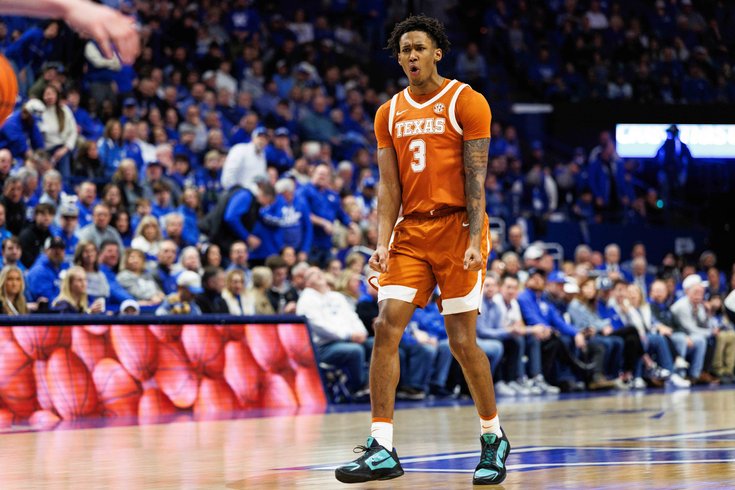 Jordan Prather/IMAGN IMAGES via Reuters Connect
How would Dailyn Swain change the Sixers' outlook?
Leading up to the 2026 NBA Draft, PhillyVoice is speaking with scouting experts about prospects they believe the Sixers should be targeting with the No. 22 overall pick they acquired in the Jared McCain trade.
Up next: Dailyn Swain, a dynamic scoring prospect who emerged after two years at Xavier by submitting a terrific year with the Texas Longhorns. At 6-foot-7 and 200 pounds, Swain averaged 17.3 points, 7.5 rebounds, 3.6 assists and 1.3 steals per game, firmly cementing himself as a likely first-round pick.
Here to make the case for Swain: Matt Powers, whose outstanding work on the NBA Draft can be found at SwishTheory. Matt has been ahead of the curve on Swain, higher on him than the consensus for quite a while.
Let's talk to Matt:
Adam Aaronson: Can you walk Sixers fans unfamiliar with Swain’s game through some of the basics of who he is as a player? What are his primary strengths and weaknesses? Where has he shown the most improvement since you started scouting him?
Matt Powers: Right off the bat, let’s look at Dailyn Swain’s scoring this season:
• 135-for-210 at the rim (64.3 percent), with 83 percent self-created
• 39-for-82 from midrange (47.6 percent), with 95 percent self-created
• 32-for-92 from three (34.8 percent), with 41 percent self-created
• 161-for-198 from the line (81.2 percent), a 51.6 free throw rate
That’s higher self-creation rates than AJ Dybantsa, and with better efficiency. Dybantsa seems likely to go No. 1 overall, considered a generational scoring prospect, while Swain is likely to go in the 15-35 range. Now, Dybantsa is younger by a year and a half and tested much better athletically, but Swain has also had better ancillary production since he was a young freshman.
Swain is of average size and athleticism for a small forward, per Tawny Park Metrics. Over his college career he’s been a solid passer (17.6 percent assist rate and 1.5 assist-to-turnover ratio), a good rebounder (19 percent defensive and 6 percent offensive rebounding rates) and gotten a good number of stocks (3 percent steal and 2 percent block rate). He’s really been a Swiss Army knife for Xavier, then Texas, all the while increasing his scoring and on-ball burden.
Perhaps the best trait of Swain’s is his ability to push the pace; he is an effective transition ball handler who can create transition opportunities with his defense as well.
MORE: Predicting decisions on Sixers' team options, Knicks win it all
AA: Why should Swain be a player the Sixers target at No. 22 overall? How would you envision him helping this team early on in his career, and where do you see his long-term impact coming from?
MP: I like Swain for the Sixers because he permits you to go multiple directions. He seems well-equipped to score inside the arc with his strong touch (1.19 points per possession on heavy driving is excellent) and continued handle improvements. His outside shooting technique is not pretty, but he’s been consistently above 80 percent on free throws, with his three-point percentage improving each season. Give him some on-ball reps and see just how high his scoring ceiling might be.
If you want him in more of a connecting role, he can do that, too. When his offensive burden has been lighter, Swain has been able to up his stock rates, conserving more energy on offense while still moving the ball effectively. While not dominant athletically, Swain glides across the court and appears quite bursty on tape.
Swain has developed in unexpected ways already in his year 18-20 seasons; what develops next might be unexpected, too. That role flexibility should be something the current Sixers team values.
MORE: Asking an expert about Allen Graves' fit with Sixers
AA: If the Sixers draft Swain and he does not pan out in the way you would expect, what do you believe would be the most likely cause(s) of that disappointment?
MP: The shot regressing is the biggest potential ceiling-capper, as Swain has seen his turnovers spike occasionally when opponents sit back and crowd his passing lanes. His low release means he has to create space to get threes off, not a significant day-one spot up threat. If Swain can’t hunt the same driving lanes he did in college, the scoring could be an issue, limiting him as a non-spacing connector.
Without that on-ball upside, Swain would become more of a defensive-slanted player, somewhat similar to a (much) less athletic Thompson twin. While he has better touch than either, ineffective driving could mean consistent rotation minutes are hard to come by.
MORE: Asking an expert about Ebuka Okorie's fit with Sixers