





August 19, 2026
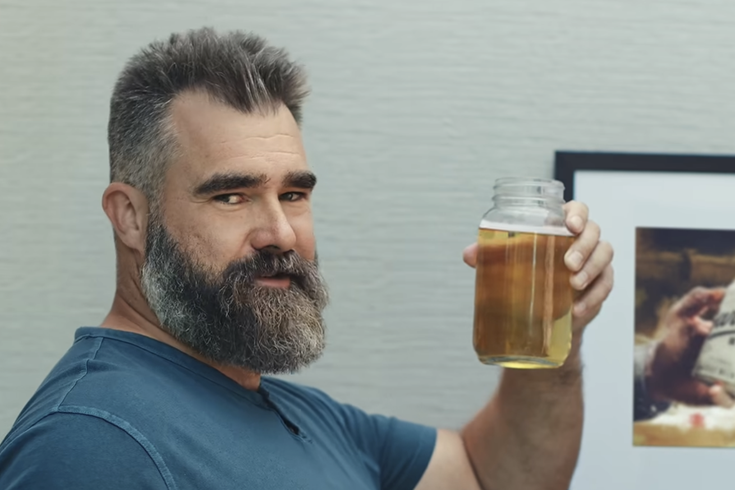 Liquid Death and Garage Beer/YouTube
In a new ad for Garage Beer and Liquid Death, former Eagles center Jason Kelce leads a jingle calling for people to send in jars of urine to use as a resource for cooling data centers.
Jason Kelce stars in a satirical new ad campaign calling attention to the heavy water consumption required by many data centers to cool their servers. He proposes we all pee in jars and have millions of gallons of urine dumped on computers. Problem solved.
The ad is a collaboration between Kelce's Garage Beer and the canned beverage company Liquid Death, which are tapping into widespread opposition to the environmental toll of proliferating data centers.
"We want your pee. Please give us your pee," Kelce sings, carrying a mason jar full of urine. "Let's pee on computers together, 'cause we need lots of pee, endless gallons of pee. Join our important endeavor."
As the commercial progresses into absurdity, Kelce is joined by a chorus of concerned citizens. The camera eventually pans to the sky, where an eagle is shown peeing.
Kelce, who's a major stakeholder in Garage Beer along with his brother Travis, takes the lead in the latest ad campaign leveraging public sentiment against AI and data centers. In June, Polaroid rolled out a billboard campaign imploring people to reflect on their smartphone use and reconnect with more analog technologies like their cameras.
"Go jump in some water before the data centers drink it all up," said a Polaroid billboard at a Coney Island beach.
A Gallup poll in May found 7 in 10 Americans oppose the construction of AI data centers in their local areas, including 48% who said they are strongly against such projects. Half of those opposed cited excessive use of resources, including water and energy, as their primary objections.
Leading tech companies, including Microsoft and Amazon, have pushed back against claims that water and energy use at their facilities puts severe strain on local utilities. They often point to their use of closed-loop and hybrid systems that recirculate cooling water to limit on-site consumption. These cooling systems may reduce depletion of local water supplies through evaporation, but critics say the tradeoff instead shifts the heaviest burden onto energy providers.
A group of experts who fielded questions from Gizmodo earlier this month agreed the environmental impacts of data centers can be significant depending on the scale of the project, the local climate, an area's power mix and the water sources used to support a facility.
Grassroots pushback and lawsuits to halt data center construction have led a growing number of states and localities to impose restrictions on new projects. By reining in approvals and speculative proposals, governments and citizen-led watchdogs hope they can buy time to evaluate the costs, zoning implications and environmental impacts of data centers while tech companies race to scale their processing power.
Pennsylvania Gov. Josh Shapiro (D) signed an executive order Tuesday imposing new standards and guardrails on developers, marking a change in tone from his administration's earlier embrace of large tech sector investments in data centers.
"I've heard loud and clear from the good people of Pennsylvania as I've traveled our commonwealth, and I'm here to say today that we will not be bullied by these developers," Shapiro said. "We will not be bulldozed by the lawyers working for these Big Tech companies."
The ad from Garage Beer and Liquid Death includes an important piece of fine print.
“The suits want us to tell you to please don't actually send your pee," the disclaimer says.
Out of curiosity, and for what it's worth, Google's AI Overview strongly shuts down the idea that pee could actually be used to cool data centers. There would be too much mineral buildup, equipment would get corroded and bacteria would build up into a "biosludge" under the heat generated by servers.
"From an engineering and biochemical standpoint, trying to use urine as a data center coolant would be a disaster for several reasons," the AI Overview says.