




June 13, 2026
 Eakin Howard/IMAGN IMAGES via Reuters Connect
Could the Sixers replace Jared McCain with another smaller guard?
Leading up to the 2026 NBA Draft, PhillyVoice is speaking with scouting experts about prospects they believe the Sixers should be targeting with the No. 22 overall pick they acquired in the Jared McCain trade.
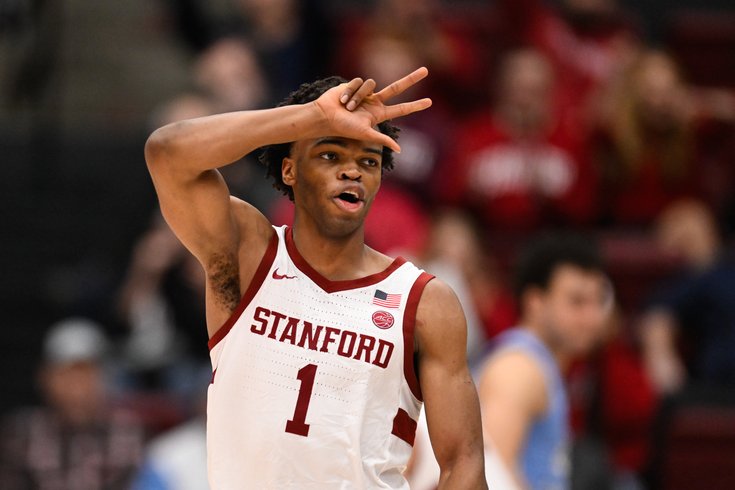
Up next: Ebuka Okorie, a dynamic scoring guard from Stanford who handled a massive workload and still posted strong efficiency marks as an 18-year-old. Okorie carried one of the largest offensive burdens in college basketball and will be better off for it. He is slight of frame, though, and his fit with the Sixers specifically could be scrutinized – especially in light of the fact that this pick was the prize of the McCain deal.
Here to make the case for Okorie: Brian Geisinger, whose stellar work on college basketball and the NBA Draft can be found at several places, including Split The Action.
Let's talk to Brian:
Adam Aaronson: For the Sixers fans unfamiliar with Okorie’s game, what would you describe as his major strengths and weaknesses as a player?
Brian Geisinger: Okorie is obviously on the smaller end of the top prospects in the 2026 Draft (6-foot-2, 185 pounds), though his wingspan checking in at just under 6-foot-8 at the combine was encouraging. Despite that lack of size, he’s one of the most threatening and crafty playmakers in this draft cycle. He possesses arguably the best first step in his class: lightning quick and incredibly smooth with his acceleration while demonstrating excellent body control. Okorie is exceptionally fluid at changing direction mid-drive, combining his burst and balance to unlock a powerful dribble-drive game.
Stanford built a top-65 offense with Okorie as their only meaningful ball-handler and pull-up shooter; the delta between him and the team's next-best player was massive. While Kyle Smith is a great coach, he placed a heavy burden on Okorie to constantly initiate spread pick-and-rolls or attack off the ball in Floppy action. The freshman guard was up to the task, though.
Ebuka Okorie - Downhill driver
— Brian Geisinger (@bgeis_bird) May 8, 2026
Okorie blows by with first step, turns corner fast enough to beat peel switch from strong-side corner, and the body control + touch to finish through contact at the rim pic.twitter.com/BSC3BPHcnX
Given his status atop every opponent's scouting report, it would’ve been natural to see Okorie's efficiency crater under such high usage. Instead, he remained prolific — save for a few matchups against ace wing defenders like Duke’s Dame Sarr. This responsibility forced him to problem-solve and think on the fly in ways other top lead guards didn’t have to contend with on a nightly basis.
Unconcerned with Stanford’s lack of secondary creators, opposing defenses routinely loaded up on Okorie and mixed coverages. However, he consistently adjusted to keep generating quality offense. Okorie demonstrated the maturity to not force the action, routinely making the simple, correct read whenever teams threw two defenders at the ball. There’s a poise to his game: Okorie leverages his scoring gravity to make life easier for his teammates.
According to CBB Analytics, Okorie averaged 22.2 unassisted points per 40 minutes (99th percentile), with 88.9 percent of his two-point field goals and 58.7 percent of his three-pointers coming unassisted. These staggering figures anchored one of the most efficient and impressive statistical profiles in college hoops this season. On a per-possession basis, a strong case can be made that Okorie was the third-best player in the ACC last season, trailing only Cameron Boozer and Caleb Wilson.
Working against Okorie are his lack of size and historical precedents. The learning curve is steep for a smaller guard whose game relies on live-ball rim pressure. While his ability to touch the paint is excellent, Okorie struggles to finish around the basket — a legitimate concern given how critical that skill is to his offensive profile and draft projection. He logged eight dunks this season, which is respectable for his size, and he frequently mixes in artful, below-the-rim finishes. However, he converted just 54.7 percent of his layup attempts despite tracking in the 98th percentile for volume at 8.5 attempts per 40 minutes, according to CBB Analytics.
With life at the rim only getting tougher at the next level, Okorie must continue to develop his decision-making, in-between scoring package and long-range shot. He proved he could punish drop coverage with pull-up 3-pointers at Stanford (his destruction of NC State in Raleigh stands out), but his entire off-the-dribble creation game will rely on that skill translating against NBA length and more sophisticated defensive schemes.
MORE: Mike Gansey, Bob Myers, Jameer Nelson take center stage
AA: Okorie carried an enormous workload at Stanford, scoring 23.2 points per game and logging a whopping 31.0 percent usage rate. What gives you confidence in him scaling down on a Sixers team that already has two guards cemented as franchise cornerstones?
BG: Okorie’s aggression is one of the things that makes him special, but finding ways to dial it down is what will allow him to establish a sustainable foothold in the league.
To successfully scale into an impactful NBA creator, Okorie must learn that less can be more. Refining his pace — including by implementing two-foot counters in the lane to slow down, absorb contact and open up passing angles — could alleviate some of his finishing woes. Okorie doesn’t have the size and bulk of players like Kon Knueppel and Stephon Castle, but there are other young NBA guards who make great paint decisions, have adapted quickly to important offensive roles and excel at playing off two feet, allowing the game to slow down around them. If Okorie can complement his explosive rim pressure with more refined, real-time processing and intermediate shot-making, he has the foundation of a high-octane scoring spark.
Okorie was one of only four high-major freshmen this season to record 30 percent usage and a 23 percent assist rate, along with two top-10 prospects – Boozer and Mikel Brown Jr. – and Nigel James Jr. While Okorie may have served as a heliocentric creator for Stanford out of necessity, he finished his prep career at Brewster Academy. At that prep powerhouse, Okorie was teammates with several players who are now high-major talents: Killyan Toure (Iowa State), Sebastian Wilkins (Duke), Dwayne Aristode (Arizona) and Darien Moore (Seton Hall). During that time, he shared the floor with high-profile prospects (who demanded touches), showcasing savvy off-ball activity as a cutter, spot-up shooter and connective playmaker when called upon.
The Sixers make for an interesting hypothetical landing spot for Okorie. His lack of size might raise some intermediate-term fit concerns next to Tyrese Maxey and VJ Edgecombe, but Okorie has shown that he can play off the ball. According to InStat, he shot 39.5 percent on catch-and-shoot three-pointers this past season, albeit on lower volume. Plus, adding Okorie would give Philly the luxury of having at least one — if not multiple — dynamic ball-handlers capable of touching the paint for all 48 minutes.
MORE: 2025-26 Sixers year-in-review
AA: If the Sixers do draft Okorie at No. 22 overall and he does not end up becoming as successful as you are anticipating, what do you think the most likely cause(s) will be?
BG: If Okorie falls short, it will likely be due to a combination of a shaky jumper, a lack of counters to his dribble-drives and the sheer limitations of his size — all of which narrow his developmental pathway. If he struggles as a live-ball creator, there simply isn't a reliable safety net to fall back on.
MORE: Asking an NBA Draft expert about Allen Graves' fit with the Sixers