





January 09, 2026

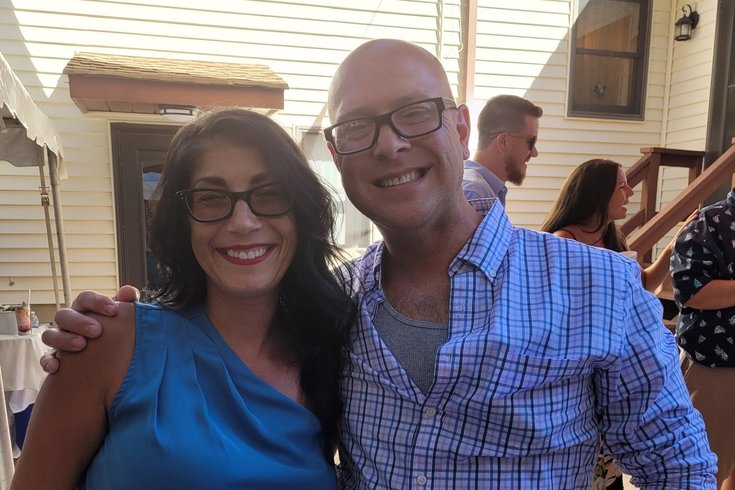 Provided image/Sherri Paulson-Atkinson
Peter Atkinson, right, is recovering from necrotizing fasciitis, a rare, flesh-eating bacterial infection that that led to sepsis and kidney failure. He says doctors are hopeful that his kidneys will regain function. Above, he poses with his wife, Sherri Paulson-Atkinson.
Peter Atkinson is the kind of person who puts in long hours, especially since he started his own business in 2012.
Every other week he is on "duty" all day in North Wales, where he lives, ready to tow cars involved in crashes and any other vehicles in the borough. Atkinson, 49, often gets cuts on his hands as he hauls cars and trucks onto his rig, he said.
One of those lesions may have been the source of a flesh-eating bacteria that landed him in the hospital last month, required major surgery, and led to sepsis and kidney failure, Atkinson said on the phone Tuesday from his bed at Penn Medicine Doylestown Health.
During a long towing job on Dec. 19, Atkinson texted his wife, Sherri Paulson-Atkinson, that he felt "terrible," like he had the flu, she said.
Atkinson spiked a 104-degree fever and became dehydrated from vomiting. An area under his right arm was red, inflamed and tender.
Finally, he decided, "I'm going to the hospital to get fluids. I can't handle this anymore,'" Atkinson said.
Good thing he did.
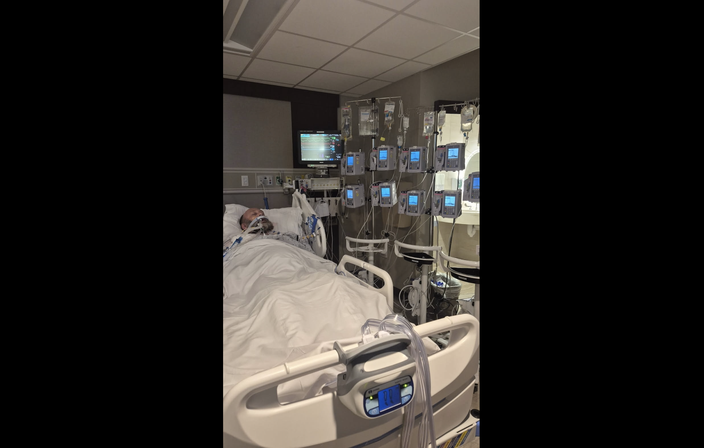
Peter Atkinson, of North Wales, developed sepsis and went into kidney failure after undergoing surgery Dec. 19 for a flesh-eating bacterial infection. His community has started a GoFundMe site to help him, his wife and three teenagers, because he cannot run his one-man towing company.
Atkinson's care team at Doylestown Hospital – now Penn Medicine Doylestown Health – diagnosed him with necrotizing fasciitis, a rare but serious bacterial infection that attacks skin and muscle.
Statistics show that between 700 and 1,200 people contract necrotizing fasciitis each year in the United States, though the actual numbers may be much higher, the Cleveland Clinic says.
Antibiotics and surgery are urgently needed to fight the infection and remove dead tissue. Complications may include scarring, loss of limbs, sepsis and organ failure. Up to 1 in 5 people die from necrotizing fasciitis, even with treatment, the Centers for Disease Control and Prevention says.
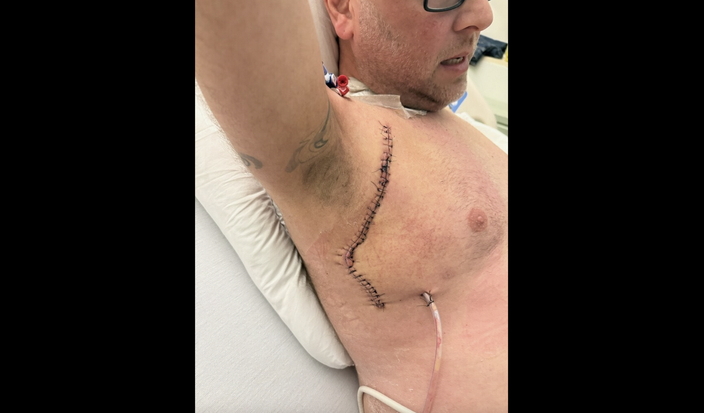
Surgery to remove infected tissue left Atkinson with more than 30 sutures. They look like a zipper snaking up his chest, around his right arm and toward his neck.
"I'm in pain, but I'm ignoring it," Atkinson said. "I don't want the drugs."
Peter Atkinson, 49, of North Wales received more than 30 sutures after he underwent surgery for a rare, flesh-eating bacterial infection at Penn Medicine Doylestown Health last month.
Atkinson was discharged to his home Thursday and is receiving outpatient dialysis three days each week to keep his kidneys going. On Friday, he said he's glad to be home with his wife and three daughters.
"It's gonna be a fight to get back to any kind of normal or my new normal," Atkinson said in a text message.
Atkinson is also worried about his business.
Aside from Paulson-Atkinson's salary as a preschool teacher, the family has no income at the moment. But the outpouring of support from the community – neighbors bringing meals, students writing notes, people texting and calling – has been "overwhelming," Paulson-Atkinson said earlier this week.
A friend set up a GoFundMe site for donations to the family.
"Probably when I get out of here and I've got my strength, I'll put whatever pieces back together, or sell whatever that's left or whatever," Atkinson said, referring to his business and three tow trucks.
Still, Atkinson is optimistic. His doctors – who were not available for comment due to the high volume of flu and other illnesses – told Atkinson his kidneys may start working again, he said.
"There's a lot of hope," Atkinson said.