




April 25, 2026
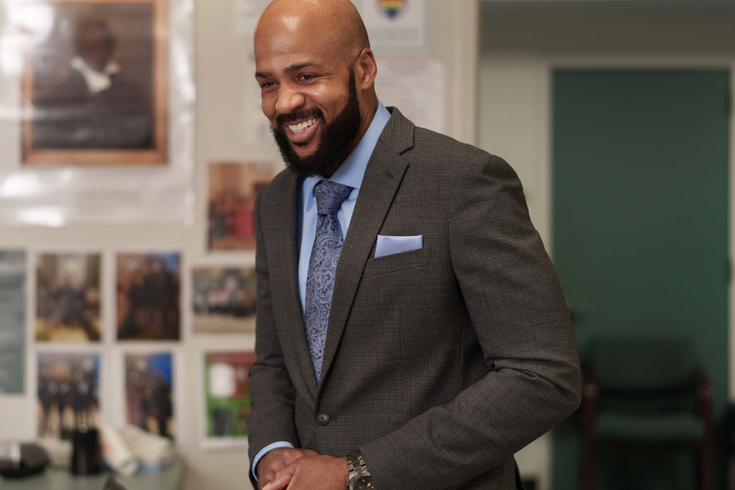 Brett Sims/CCSSO
Haverford High School history teacher Leon Smith was named the National Teacher of the Year by the Council of Chief State School Officers.
When Leon Smith was a kid at camp, adults would tap him to keep an eye on younger children and make a point of praising how well he handled the responsibility.
It sparked a thought — probably helped along by the fact that both his parents were educators — that teaching might be the way he could make a difference in the world and in the lives of others.
MORE: This New Jersey high school teacher makes movies on his summer breaks
He especially wanted to be the Black male teacher he only briefly got to experience as a child. That student teacher Smith had in 10th grade “made me feel the way that I hope all students feel in classrooms, and that is to feel a sense of belonging, a sense of dignity. And it just really gave me a great passion.”
Smith, a history teacher at Haverford High School in Delaware County, was named the 2026 National Teacher of the Year by the Council of Chief State School Officers on Tuesday. He’ll spend the next year as an ambassador for the teaching profession.
Smith teaches Advanced Placement U.S. history and African American studies and coaches basketball. His favorite era to teach is Reconstruction, when Black men and women just a few years out of slavery built community institutions to provide opportunity for the next generation.
“It’s just a real playbook for the power that people can generate when they are committed to a cause,” he said.
But his favorite lesson, one that calls for students to embrace the complexity and nuance of history, is about events from nearly a century later.
Chalkbeat spoke with Smith about that lesson, why teacher diversity matters, and why young people should consider teaching. This conversation has been lightly edited for length and clarity.
CHARTBEAT: You started an Educators Rising chapter to encourage students to become teachers. We hear a lot that fewer young people want to go into the profession. What concerns do you hear from young people about teaching and what do you tell them about why this is a good job?
SMITH: There are a lot of young people that do want to be teachers, and we really have to do a better job as adults of inviting them into the profession. We have to do a better job with our PR and really letting students see the greatness of the profession. So that’s one.
But students are always thinking about, hey, does this teacher understand me? Do I feel like I can talk to this teacher about anything? Are they going to give me grace if I’m going through a difficult time? I think many of our students just want the teacher to support them and to be someone that they can go to if they need a hand. And I think that type of compassion and joy and genuineness that they would receive from the educator is something that would then make them think, “I want to do that for someone else.”
Through kindness and through those types of understanding and gestures, we can really start to plant the seeds for the next generation of educators.
CHALKBEAT: You were the only Black male educator at your school for many years. What were the things that helped you keep going or feel supported and gain that comfort in bringing more of yourself into the classroom?
SMITH: My faith. I have a strong belief in God. I would also say my community, my mom, my wife. But what began to give me a sustaining power was some of the feedback that I received from students. I would often get cards and messages from students thanking me for just being a genuine person, for telling them about my experience. And as I started to read those notes, I began to be more confident in being who I was as a teacher and letting them know, hey, here are some of the things that I’ve gone through, good and bad.
The more that we as a society can share our experiences, talk to each other, the more we can understand each other and move forward.
CHALKBEAT: Some of this work around increasing the diversity of who’s in the classroom has come under political attack. What would you want the general public to know about the importance of having diverse people at the front of the classroom, in front of students?
SMITH: I think one thing that we can all agree on is that we want all of our students to be successful. Student achievement is driving all of our work in education. The research is clear, that educators of color not only benefit students of color, but they benefit all students. And that’s what we want. We want all of our students to be successful.
CHALKBEAT: You teach American history. I’m wondering if you have a favorite lesson.
SMITH: We did a Socratic seminar where the students listened to a podcast by Malcolm Gladwell, a Revisionist History podcast called "Miss Buchanan’s Period of Adjustment." It shines a light on an often untalked-about chapter when it comes to Brown vs. Board of Education and that is the number of Black teachers and principals that were fired in the wake of desegregation, over 100,000.
We talk about our teacher pipeline, and we talk about not having enough educators of color. There was a time when we saw many educators of color, and there were events that led to that decrease. And so when my students listened to that, they came back the next day and the classroom was buzzing. They’re like, “Mr. Smith, I can’t believe this.” It’s such a joy as a teacher to have the students be connected to their learning in that way.
We’ve had some great discussions. I had a young woman actually start to write the curriculum for an Asian American studies course as a result of that particular lesson, I’ve had another student that was more connected to her heritage as a result of that lesson.
So then they get a chance to choose any topic they want in American history and look at this topic from a different perspective or try to find an untold story with regard to this topic. And they get a chance to choose any medium in which they want to present that, and that’s our capstone project.
They set up in the library and the whole school comes and talks to them about their projects. And these are ninth graders, and they are just outstanding.
CHALKBEAT: Brown is one of the seminal civil rights Supreme Court decisions. What do you think students get from considering this other angle?
SMITH: It’s important for us to really look at things through multiple perspectives and to really understand the impact of context and point of view and intended audience. We build critical thinking skills in my classroom, not so that we can just decipher primary and secondary sources. I really want my students to take that out into the world and help them to be critical consumers of information, to be able to really evaluate the information that they’re seeing, to think about how it’s going to apply to them.
They’re going to be parents, they’re going to be voting citizens, they’re going to be homeowners. And so they really need to be able to think critically about a whole variety of things. And I’m excited that they get a chance to start doing that in my class.
Erica Meltzer is Chalkbeat’s national editor based in Colorado. Contact Erica at emeltzer@chalkbeat.org.
Chalkbeat is a nonprofit news site covering educational change in public schools.