




December 23, 2025
 Tommy Gilligan/Imagn Images
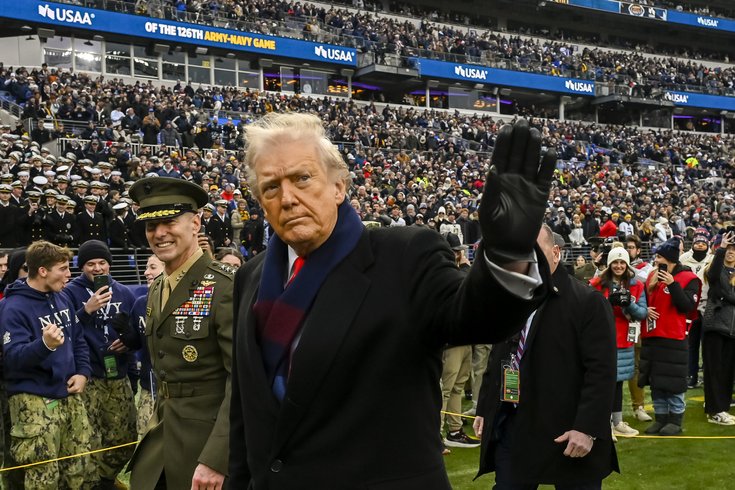
President Donald Trump has implemented new higher education policies in his second term and has paused federal funding from some institutions that haven't complied, including the University of Pennsylvania. Above, Trump attends the Army-Navy football game at M&T Bank Stadium in Baltimore on Dec. 13.
President Donald Trump has put higher education in his crosshairs since his first day of his second term, and the University of Pennsylvania has spent the year wavering between defying and complying with the administration's policies.
On Jan. 20, Trump signed an executive order requiring any university that receives federal funding to end diversity, equity and inclusion practices that could violate federal civil rights laws.
To comply, Penn scrubbed diversity mentions and initiatives from its website and equal opportunity policies – a move that some higher education leaders called an act of "over-compliance" during a public hearing in May. The university also decided to freeze most staff and faculty hiring to prepare for cuts that it expected to be more disruptive than the 2008 recession and the COVID-19 pandemic.
Penn was also being investigated by the Department of Education for Title IX violations after allowing Lia Thomas, a transgender woman, to compete on the women's NCAA swimming and diving team during the 2021-2022 school year. Thomas graduated in 2022.
Trump, a 1968 graduate of Penn's Wharton School, said in March he was pausing $175 million in federal funding to Penn over its transgender athlete policies. Months later, after the school agreed to erase Thomas' records and block transgender athletes from competing on female sports teams, the government released the previously frozen funds.
Threats from the administration continued into the summer, and Penn struggled to find a way to follow federal guidelines while also supporting the views of its students and faculty.
The university shuttered the Carey Law School's Office of Equal Opportunity and Engagement, which provided resources, training and other DEI services for students and faculty, including a guide on how to report discrimination claims.
The school at this time also said it would not be accepting applicants for the 2025-2026 Sadie T. M. Alexander scholarship, which provided full tuition to students who wanted to focus on racial justice in their studies and law practice. Alexander was born in Philadelphia in 1898 and later became the first Black woman to graduate from Penn's law school in 1927.
The loss of the scholarship led to backlash from the campus community. So in September, Penn announced it was launching the Sadie T.M. Alexander Post-Graduate Fellowship for students in the Carey Law School who were working on a civil rights project.
In October, Penn declined to sign the compact proposed by the Trump administration that would have given the federal government influence over the Ivy League school's operations – including hiring, admissions and tuition pricing – in exchange for funding advantages.
Under the compact, schools would have to agree to limit their enrollment of international students to 15% of an undergraduate class, ban the use of race, sex and other demographic factors in admissions, hiring and financial aid, and abolish "institutional units that purposefully punish, belittle and even spark violence against conservative ideas."
The proposal was initially sent to nine schools, and Penn was among the schools to reject it. The chancellor at Vanderbilt University signaled he had concerns about some of the terms, and leaders at the University of Texas at Austin showed interest.
Then last month, the administration sued Penn claiming it “refused to comply” with a subpoena that was seeking information on Jewish employees for a federal investigation into antisemitism on the campus. The refusal to turn over names, phone numbers and address was supported by students, faculty and staff in a petition that had hundreds of signatures.
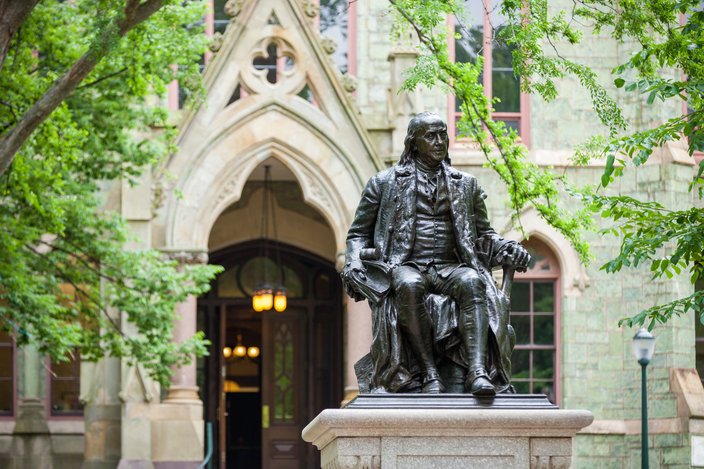
The University of Pennsylvania spent 2025 wavering between defying and complying with Trump administration policies on DEI and transgender athletes. This file photo shows the statue of Benjamin Franklin outside College Hall. Franklin was the primary founder of Penn.
But how will Penn continue to respond and how will the courts rule on outstanding lawsuits involving the government and higher education institutions?
So far, the school has shown a willingness to negotiate with the federal government by changing policies on DEI and trans athletes. But it has also been open to letting the judicial system settle some of these battles.
Either way, trying to play both sides is proving to be an impossible task. Any acquiescing to Trump has led to backlash from the campus community, and any refusal to comply to federal policies has led to lawsuits and threats to withhold funding.