





October 19, 2026
 Amanda Oglesby/USA TODAY NETWORK via Reuters Connect
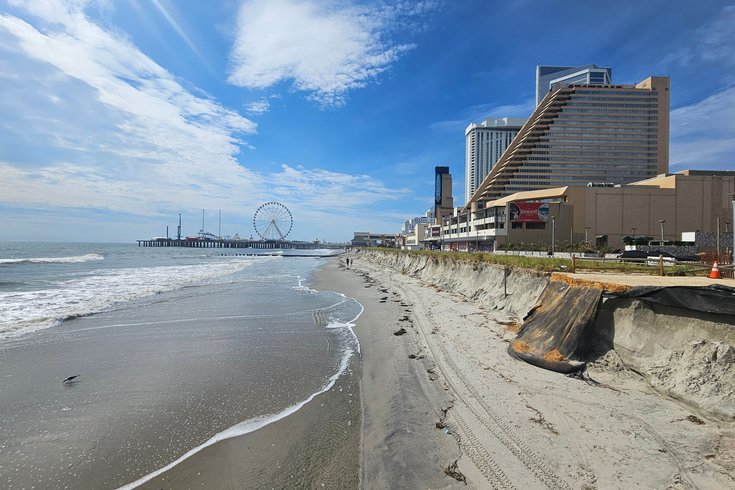
A powerful storm in September caused severe erosion in Atlantic City and other New Jersey coastal towns.
Less than a month after a powerful nor'easter slammed the Jersey Shore with heavy flooding and beach erosion, another storm is brewing in the Atlantic.
Shore communities can expect multiple rounds of coastal flooding over the next couple days, with particular concerns around high tide on Wednesday evening, the National Weather Service said. Moderate tidal flooding is forecasted from Atlantic City down to Cape May.
The incoming nor'easter could be cause for concern in towns hit hard by the September storm, which broke into dunes and caused massive drop-offs in Brigantine and Atlantic City. That nor'easter was particularly damaging as it moved toward land during a full moon, which strengthens the gravitational pull on Earth's oceans and creates higher tides. Last week, Gov. Mikie Sherrill requested emergency federal aid for replenishment projects from Sandy Hook to Cape May.
Atlantic City Fire Chief Scott Evans, who oversees storm cleanup, said the high tides during that nor'easter were "beating up our beaches very badly." He said the dune system was refurbished just over two years ago, and the storm caused the beach to lose almost everything from that project. Major erosion occurred from Central Pier to New Hampshire Avenue, he said.
Atlantic City replenishment happens every three or four years, but the northern section of the island often suffers significant damages before the scheduled restoration efforts, Evans said.
"With a full moon and a northeast wind and a high tide, we can see beach erosion," he said. "Just with those three elements in place at the same time, we will see beach erosion. This has been an ongoing problem since I can remember. It's just that it appears that it's much more frequent now."
The long-term impact of September's storm remains to be seen, said Stephen Rochette, legislative affairs program manager for the Army Corps of Engineers, which manages storm replenishment in New Jersey. Army Corps data shared with PhillyVoice marked it as a moderate storm for flooding, but a major event for erosion. Data from the NOAA Atlantic City Tidal Gauge showed it was the fifth-highest event out of 115 years of recordings for erosion potential.
Still, Rochette noted that the beach is a "dynamic environment." When a storm moves the sand out to sea, it can form sandbars that help reduce wave energy. And the fact that the dunes were damaged means they did their job of protecting shore communities.
"The projects are in place for these kinds of events to be sacrificial in nature, to absorb the impact from the storms and reduce the risk of damages to all the infrastructure behind them," Rochette said. "And in New Jersey, of course, it's very densely developed, so you're talking about homes, businesses, roads, utility lines, boardwalks."
Local governments are involved in assessing whether to issue emergency advisories and providing economic impact reports on what it means to have beaches closed. The official requests for mitigation projects have to come from the city engineer's office, Evans said. But, save for general maintenance, replenishment work is largely under the umbrella of the state's Department of Environmental Protection and the Army Corps of Engineers, so there's little that residents and local government officials can do in the interim.
Evans said he is concerned about the dune damage, and city officials are trying to work with the DEP to "button-up" some of the high hazard areas in town. Still, he remembers a time about four years ago when a dune on Rhode Island Avenue was reduced to 5 feet. He thought each storm would be the last before water went under the boardwalk and into the streets, but that dune survived three more storms.
Every storm is different, with wind direction, wave patterns and currents all playing a factor in how much damage is done. And in a coastal community, storms, nor'easters and hurricanes are business as usual.
"There's always a concern, we're always concerned about (storms)," Evans said. "We are at the mercy of Mother Nature, no doubt."
Storm season lasts through November on the East Coast, so even after Tuesday's nor'easter, there's potential for additional weather events. But, according to Rochette, there's little to be done to speed up the replenishment process, since it depends heavily on federal funding.
"There's not a quick fix when we do suffer significant erosion in different projects," Rochette said. "We work through a process to evaluate the storm and eligibility under what we call the Flood Control and Coastal Emergencies Program. ... So there's no immediate update in terms of any repairs or anything quite yet, but we're still working through that process."