


August 15, 2026
 Kriston Jae Bethel/for Chalkbeat
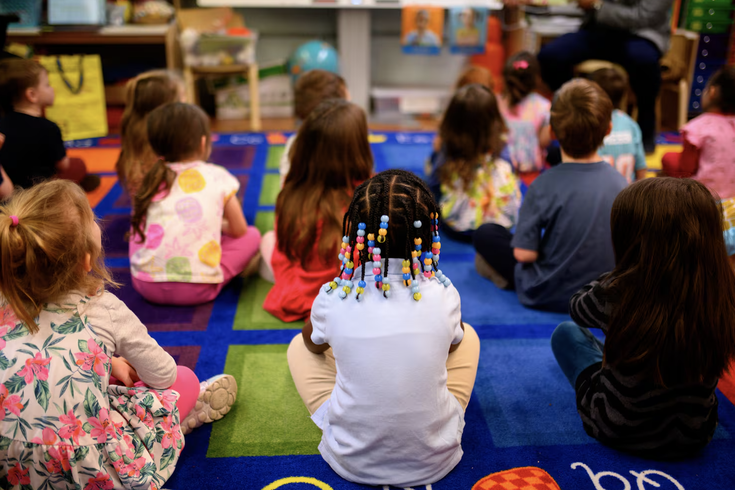
Philadelphia parents are asking the city to help prevent preschool suspensions and exclusions.
Philadelphia parent Hadria Leon was excited when her son started preschool in 2024, snapping a photo as Otto went off to his first day.
MORE: Cheltenham School District superintendent resigns in fallout from football team's hazing scandal
But when she went to pick him up, the preschool staff told her Otto could no longer attend. Otto has an autism diagnosis, and preschool leaders said they didn’t have the resources to support him, Leon said.
"I was devastated, I was crying," Leon said. "I begged the director. The school refused my offers of support and my ideas for how to best support my child."
Leon was one of several parents who testified during a City Council Education Committee hearing this month on young kids being suspended, expelled and excluded from Philadelphia preschool programs.
The practice, often called "preschool pushout," is difficult to quantify because many exclusions are never formally documented, and data collection is limited in Philadelphia and nationwide. But parents and advocates say excluding young kids from preschool programs in the city has taken a toll on their learning and development. They want the city to prohibit preschool exclusion and suspensions across the board and invest more in early childhood funding and training, especially to support kids with disabilities.
The city prohibits any prekindergarten program that receives city funding from excluding children from the classroom or sending children home early. But Sean Perkins, chief of early childhood education in the city’s Office of Children and Families, acknowledged that “in some cases, this commitment has been challenging for providers.”
The city funds around 5,000 preschool seats through its PHLpreK program, which all Philly families are eligible for. Perkins said the city has provided more coaching and paid professional training sessions meant to improve services for kids with disabilities.
The Philadelphia school district runs many of the publicly funded preschool programs in the city. Diane Castelbuono, the district’s assistant superintendent for early childhood education, said it also does not permit the expulsion of preschool students. She said there are limited circumstances during which a "temporary exclusion" may happen, like if a student presents a direct threat to themselves or others.
Still, families and advocates said exclusions persist across the city's wide range of preschool programs, including those that are publicly funded, run by the school district, or privately operated. They called for a ban on preschool suspensions in all programs, as well as more funding and resources for preschool providers.
"Pushout occurs across the board in both public and private preschool programs in Philadelphia, and is not the result of any single provider's actions," said Rose Wehrman, an attorney with the Education Law Center-PA. "These exclusions are rooted in discrimination and are both harmful to children's development and are developmentally inappropriate for all children."
Council members appeared sympathetic to the concerns, though none at the hearing committed to pushing for specific policy or funding changes.
"What I think we need is a system that says, if we're going to ask the providers to take the child, no matter what, then there should be resources available to address the needs of the child, no matter what," said Councilmember Isaiah Thomas, who chairs the Education Committee and called for the hearing.
Councilmember Nina Ahmad acknowledged the difficulty of understanding the scope of the problem.
"Pennsylvania has no system of tracking exclusion in early childhood settings, so most of it never happens in any record," Ahmad said. "What we do not count, we cannot fix."
Several preschool providers testified during the hearing that they need more resources, including funding and training, to better support kids with disabilities.
"What is being asked of childcare providers is fair," said Taneema Fannings, who runs Christ Like Childcare Center. "But no support or resources makes it impossible."
Unlike K-12 public schools, most preschools don't receive additional public funding when a student has a qualifying disability. Though Philadelphia families are supposed to get support services for infants and toddlers through publicly funded early intervention, they often wait weeks or months for those services. That can leave kids and preschool teachers without support when they need it.
Representatives from Elwyn, the nonprofit that runs the city's early intervention program, did not attend the hearing.
"Educators need help with children with special needs," said Natrice Johnson, who runs Candy's Kids Learning Academy. "We don't want to expel them. We don't want to suspend them. But we need help, supports, so we can be able to maintain them in our classrooms."
Preschool pushout can take many forms, parents said, from being asked to pick up kids early to being told that a certain program can't meet a child's needs.
Chandell Craig-Cromwell said her son Romaine's preschool told her the center was "no longer a good fit" for her child. Though she said she advocated for him to remain in the program, she was told the decision was final.
"I carried a lot of guilt," she said. "It felt like our only option was to keep him home again."
Another parent, Jennifer Garrison, who is Black, said she feared her son Terrell's preschool discriminated against him because of his race and disability. Terrell is on the autism spectrum and requires support to eat and communicate.
When she picked Terrell up from preschool, he was routinely hungry and thirsty, she said. She feared he did not get the support he needed during the day, leaving him without food and water. As a result, she felt she had no option but to withdraw him.
"The impact on my son has been devastating," she said. "As a Black parent of a child with disabilities, there is an added layer of concern that behaviors and needs associated with autism may be misunderstood or responded to differently."
For Hadria Leon, a few months after Otto was excluded from his first preschool, she was able to find a new program that welcomed him. Teachers there supported her son, and he later went on to elementary school. He graduated from kindergarten in June.
"We are all so happy that he is improving," Leon said. "What our family went through should not happen to anyone else."
Rebecca Redelmeier is a reporter at Chalkbeat Philadelphia. She writes about public schools, early childhood education, and issues that affect students, families, and educators across Philadelphia. Contact Rebecca at rredelmeier@chalkbeat.org. Chalkbeat is a nonprofit news site covering educational change in public schools.