



May 06, 2026
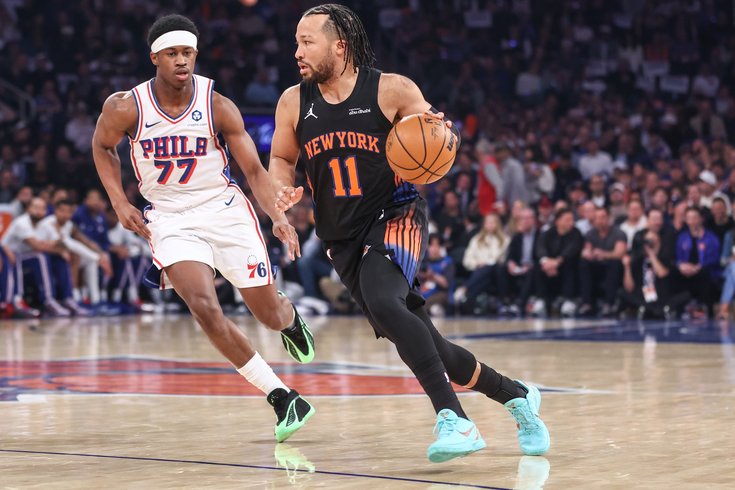 Wendell Cruz/Imagn Images
VJ Edgecombe spent much of Wednesday's Game 2 defending Jalen Brunson across all 94 feet.
NEW YORK – The Sixers might have come to Madison Square Garden with a renewed spirit on Wednesday night, but in Game 2 of their second-round playoff series against the New York Knicks it was not enough to withstand the absence of Joel Embiid.
The Sixers did not play a bad game in their attempt to even up the series – far from it, given the personnel available – but they made too many mistakes and took a few too many opportunities for granted. The game was close from wire to wire, and ultimately an intense back-and-forth battle went the way of the home team, as the Knicks escaped with a 108-102 victory to take a 2-0 series lead.
The game came down to a fourth quarter in which the Sixers ran out of gas. For a prolonged stretch of the final frame they created good shots and just missed them. Then their offense sputtered. Their tight rotation continued to show signs of immense fatigue in the wake of a taxing seven-game series against the Boston Celtics, and the much fresher Knicks had more big-time shots in them.
Takeaways from a gut punch of a Sixers loss:
It was obvious early that Wednesday's game would end up being decided down the stretch; no team ever led by more than seven points throughout the 48 minutes. The Sixers carried a one-point lead into the final frame because the game's three-point shooting balance had tilted in their favor dramatically.
Early on in the fourth quarter, the Sixers stagnated offensively; perhaps fatigue was kicking in for an extremely short rotation. Their lead finally evaporated, with New York pulling in front and forcing a Sixers timeout five minutes into the fourth quarter.
The partisan crowd went from jubilant to tense when Kelly Oubre Jr. sunk a pair of free throws, Dominick Barlow blocked a corner three and Oubre connected on one of his own to give the Sixers a three-point lead. But Josh Hart tied the game with a triple of his own and Jalen Brunson gave the Knicks the lead with a mid-range jumper.
On the Sixers' next three possessions, they earned open looks from beyond the arc. But VJ Edgecombe missed twice and Tyrese Maxey, who was not particularly efficient on the whole in Game 2, missed one from the corner. Brunson connected on another mid-range jumper, Mikal Bridges added one of his own, Maxey turned the ball over and Barlow did, too. Maxey drew a foul, but only split his free throws, which hurt when Brunson knocked down two shots at the line to give the Knicks a three-possession lead. Maxey finally converted a late shot, the Sixers' first basket in nearly six minutes, but then came a George airball that sealed their fate.
The Sixers will argue that fatigue remains no excuse, that they had the game in their grasp and lost hold of it. That is true. But, to be clear: fatigue is not an excuse for a loss. It is a reason for a loss. More importantly, it is a product of a front office entering the trade deadline with a team exhibiting poor depth and only subtracting from it by trading away Jared McCain, who made four three-pointers off the bench for the defending champions on Tuesday.
Nurse's continued insistence on playing an extremely short rotation can be criticized, but so, too, should President of Basketball Operations Daryl Morey's roster.
One positive from Wednesday night: Edgecombe played an important part in setting a stronger tone; after a brutal night for Edgecombe and the rest of the Sixers defending Brunson the rookie played with tremendous commitment against New York's superstar. Edgecombe spent much of the game tracking Brunson across all 94 feet, making it more challenging for Brunson to flow into any easy offense. Just as importantly, Edgecombe did a much better job of navigating screens.
Whenever they face great players, Sixers head coach Nick Nurse and his players talk about wanting to make them work as hard as possible for their points, knowing they cannot be outright stopped. After Brunson walked into 30 points in Game 1, the Sixers at least were able to make his shots challenging this time around.
What also helped the Sixers early on: another jump-shooting heater from Paul George, who made his first four shots – three of which came from beyond the arc – to help the Sixers settle into the game with confidence:
Paul George with 11 points for Philly already in the first quarter 🔥
— ESPN (@espn) May 6, 2026
76ers-Knicks Game 2 | Live on ESPN, ESPN App 🍿 pic.twitter.com/srDt5Z9IAd
Ultimately, George ran out of tough shots to make.
In Game 1, the Sixers allowed strong Knicks pushes and roars from the Madison Square Garden crowd to defeat their spirit. They were far from perfect on Wednesday – and, ultimately, have nothing to show for their improved competitiveness – but they continually hung in there and hit plenty of momentum-shifting shots to quiet Knicks fans before falling apart.
Embiid's absence meant Adem Bona, coming off a slew of shaky playoff performances that cost him a rotation spot, was back in the mix. And Bona actually held up better as the game went along despite a few predictably erratic plays. Bona's first six rebounds came on the offensive glass; in 13 first-half minutes he grabbed seven boards and swatted a pair of shots.
Nurse did not rule out playing someone other than Bona and Andre Drummond at center pregame, but those were the two players he leaned on once again.
Much was made after Game 1 about Embiid's struggles defending in space, and even if the Sixers' point-of-attack defense was equally problematic, Embiid did have a notably hard time not having his lack of mobility exposed by New York's five-out offense.
The biggest reason the Sixers held a halftime lead: Karl-Anthony Towns was limited to just eight minutes because of foul trouble. But whenever Towns was in the game, he tormented Drummond. He had the veteran on a string, stepping out to the three-point line, forcing Drummond to haphazardly close out and then blowing by him off the dribble. It was a complete one-on-one demolition, which caused Drummond to encounter foul trouble early in the second half.
Bona, after logging a successful 10-minute stint and then a shorter one prior to halftime, came into the game and quickly picked up two more fouls, giving him five personals for the night. Finally, Nurse called upon Barlow, the Sixers' starting power forward for most of the year and their best realistic option to defend Towns as a small-ball five.
On his very first play, Barlow made a quick read on a short roll which led to Oubre drawing Towns' fourth personal foul. (This was one of Oubre's best two games of the playoffs; he was largely under control, knocked down a pair of early corner threes to burn the Knicks for leaving him open and did a good job when tasked with defending Brunson. Given how short of a rotation Nurse is playing right now, he needs uplifting performances from Oubre more often.)
Suddenly, the Sixers could begin switching everything, and Barlow defended his tail off against New York guards who tried to isolate him, from Brunson to Deuce McBride. He continually converted finishes inside, which Bona struggles with mightily. Barlow helped change the tenor of the game at a critical juncture.
BARLOW. 💪 pic.twitter.com/sEuC2hnUfa
— Philadelphia 76ers (@sixers) May 7, 2026
The fact is there is no legitimate answer at center when Embiid is not in the game, whether he is resting for five minutes or unavailable for the entire game. It is fair to point it out as an issue with this roster. Drummond and Bona both had strong stretches during the regular season, but they are both flawed players who were far from perfect. Barlow, at least in this matchup, is the best option, and he was one of the only reasons the Sixers' fourth quarter was not even worse. It was clear down the stretch that Nurse regretted not leaning on the 22-year-old earlier.
Up next: This series will now head to Philadelphia, where the Sixers will host Game 3 on Friday night.