



October 21, 2025
 Provided Image/University of Pennsylvania Press
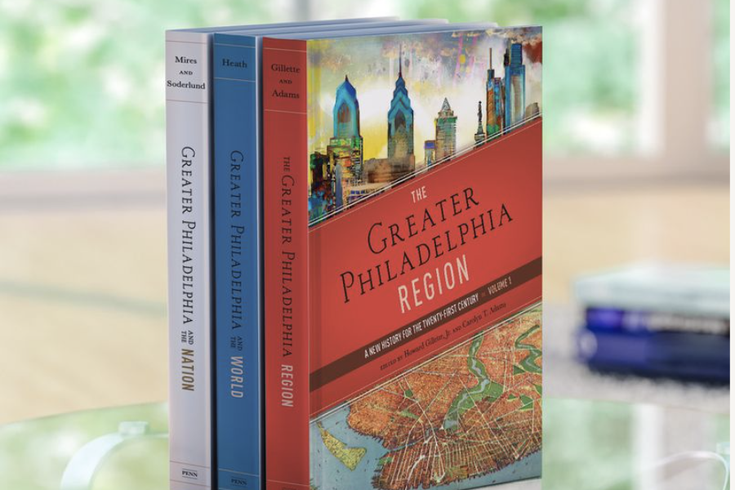
The University of Pennsylvania Press on Tuesday published three volumes telling the story of Philadelphia's history in relation to the region, country and world.
From the Lenape people shaping the regional footprint to the disbursement of Quaker communities during the American Revolution to the lingering impacts of the COVID-19 pandemic, a new book series tells the history of the Delaware Valley through a new lens.
By highlighting untold stories and unsung heroes, its editors hope that the volumes can help readers to view themselves as part of a larger community.
MORE: Film dubbed 'Cheesesteak' seeks extras in Philly for basketball scene
The University of Pennsylvania Press published "The Greater Philadelphia Region," "Greater Philadelphia and the Nation" and "Greater Philadelphia and the World" on Tuesday.
Charlene Mires, a retired professor emerita of history at Rutgers University-Camden and co-editor of the project, worked alongside hundreds of history experts to arrange information from the Encyclopedia of Greater Philadelphia, which she also authored, into digestible volumes organized by specific topics, time periods and regions. Each book also points to supplementary resources like reading materials, historic sites and related topics.
"With these books, anyone in the region could find the area where they live and understand how they're connected in that way, or they can find topics like public transportation and understand how they're connected in that way," Mires said. "By doing all those things, they'll better understand the problems we're faced with and maybe how they can contribute to solutions."
Carolyn Adams, retired professor emeritus of geography and urban studies at Temple University, was a co-editor on the series and spoke about how the accessibility of the information is crucial for its audience to feel connected to communities.
"It is increasingly important that Philadelphians and people living in the suburbs think of themselves as part of a region, a whole metropolitan area, not just part of the locale within which they live," Adams said. "We're in a global economy and people around the world are now beginning to understand that."
Next year's celebrations for the 250th anniversary of the signing of the Declaration of Independence are expected to bring new eyes to Philadelphia, and editors stressed the importance of focusing the books' efforts on more than just the founding fathers.
"The lives of all these people who appear in the print version are likely to be lives that many of our readers will not have encountered before," Adams said. "We think we're adding something to the general celebration that Philly is going through in a way that informs people about the other people we live among."
Despite having dedicated their careers to the region's history, Mires and Adams were able to understand their own fields of study in a new way through the creation of the books.
For example, while researching the history of Great Wagon Road, which stretched from Philadelphia to the backcountry of Virginia, Mires found that many Quaker communities were exiled from the city due to their pacifist nature and refusal to support the American Revolution. Their pilgrimage generations ago down the historic route has led to a persistent Quaker population along its corridor.
"One of the things I also did not have a full appreciation of when we started was the extent to which our regional geography builds on the regional geography of the Lenape people," Mires said. "For the first time, this project put together a map of the Lenape trails on both sides of the Delaware River. ... That's the beginning of our regional footprint. I'm very proud of that."
In "The Greater Philadelphia and the World," a section on epidemics spans from yellow fever to AIDS to COVID-19.
"Something I gained from this project was recognizing the central role county governments played in the COVID epidemic in our region and throughout the state," Adams said.
While helping readers better understand the place from which they come was the main goal, the editors also hope the books can be used as a tool for hope during uncertain times.
"In a time when a lot of people wonder about government as an institution that protects us and advances us, I think it's going to be extremely useful for people to read about how citizens of this region have sort of taken their life and future into their own hands at various different points in our history," Adams said. "We can change our context and even change our future in that sense. That's a pretty heartening message in what are, sometimes, disheartening times."
The three books were published in association with the Encyclopedia of Greater Philadelphia, which is produced at the Mid-Atlantic Regional Center for the Humanities at Rutgers University-Camden and the Philadelphia Funder Collaborative for the Semiquincentennial. Each book is about 360 pages, includes maps and illustrations, and will sell for $44.95 each. A set of all three books is $125 on the Penn Press website.