



January 29, 2026
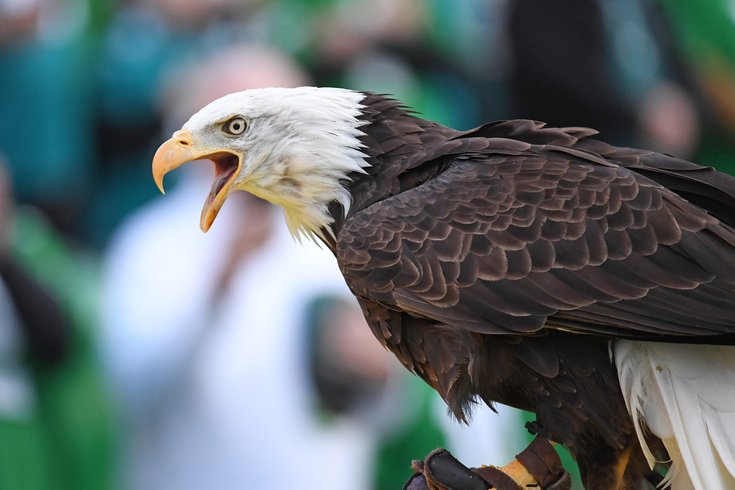 Eric Hartline/Imagn Images
A Budweiser Super Bowl commercial features an appearance from rescued bald eagle Lincoln, who regularly flies during performances of the national anthem at Philadelphia Eagles home games. Above, Lincoln appears at Lincoln Financial Field before a game on Nov. 3, 2024.
On Super Bowl Sunday, millions of people watching the big game will see a Budweiser commercial that portrays an adorable friendship between a bald eagle and a horse as they grow up together on a scenic farm.
The beer ad, soundtracked by Lynyrd Skynyrd's "Free Bird," celebrates Budweiser's 150th anniversary by pairing the brand's Clydesdale mascot with a national symbol for America's 250th birthday. The commercial builds up to a stunning shot of the eagle spreading its wings while perched atop the horse's back — briefly resembling a pegasus — before the bird breaks into flight.
MORE: For many couples, McGillin's is 'more than just a bar.' It's where their love stories began
"You crying?" a farmer asks his drinking buddy as they watch together in awe.
"Sun's in my eyes," the other farmer answers.
Lincoln, the name of the adult bald eagle in the ad, is the same majestic bird who soars in front of thousands of Eagles fans at Lincoln Financial Field when the national anthem is performed before the team's home games. His appearances in South Philly began two seasons ago, when he replaced longtime predecessor Challenger, the first bald eagle ever trained to free-fly over stadium events.
Lincoln and Challenger are both in the care of the American Eagle Foundation, the nation's largest bald eagle sanctuary in Kodak, Tennessee, where more than 40 rescued birds that can't survive in the wild receive medical care and training.
In the early 2000s, Lincoln was brought to AEF as part of a breeding program. The species, endangered in the United States until 2007, was just beginning to emerge from decades of decline caused by pesticide contamination, habitat loss, illegal hunting and lead poisoning. AEF tried twice to release Lincoln into the wild, but he failed to thrive both times — once in Indiana and then in Michigan.
"He was found both times severely malnourished. His natural hunting instinct never kicked in," Jessica Hall, AEF's CEO, said of Lincoln's journey. "One time, he was found eating fried chicken out of a trash can. The next time, a lady was feeding him bacon in her backyard and she called her local wildlife agency."
AEF is a publicly funded nonprofit with a small staff of about 15 trainers. They work to give eagles enriching lives after their wilderness instincts falter. Some birds come in because they've been shot. Some have been struck by wind turbines or got trapped in fishing line. Others, like Challenger, blew out of their nests as eaglets and became "imprinted" by human rescuers before they learned how to be birds.
Just because an eagle can't survive in the wild doesn't mean it can't be of service to the species.
"If we see that a bald eagle is showing behaviors of trust and building relationships with their caregivers, and they're not necessarily scared of humans, then we might say to ourselves, 'OK, this might be an eagle that can be trained to be an educational ambassador,'" Hall said.
Training a bald eagle is a delicate process. AEF uses an "ABC" model — antecedents, behavior and consequences — to familiarize trainers and eagles with different environments and cues. The birds are keenly aware of light, sound and sharp movements that become signals for whether they will follow the lead of trainers in potentially stressful scenarios.
Lincoln the Eagle (Wild Card Version) is everything🤩🦅 pic.twitter.com/rDMPxPP8gf
— Philadelphia Eagles (@Eagles) January 12, 2025
"When we train a bird, we do it with trust-based, positive reinforcement and bird-first behavior," Hall said. "We don't force a bird to do anything. If we go into its room that morning and they don't want to step up onto the glove, then we don't force them. We'll go back and try again later. Over time, it builds a really significant bond between the bird and the trainer."
Training often involves sitting with an eagle for long periods of time in an aviary while it eats, preens and bathes. The bird gets used to the look and smell of a trainer, who gradually introduces new stimuli to see how the eagle responds. Lincoln, now 27, practically begged to be a star from a young age.
"He's a talker. He's really engaging. When his trainers come around, he just talks and chirps," Hall said. "He interacts with them in a way similar to how a toddler tries to communicate in gibberish sometimes, but you know they're trying to tell you something."
Five years after Challenger's retirement in 2019, AEF renewed its relationship with the Eagles by giving Lincoln his big break. For most home games, the trainers make the nine-hour drive from Tennessee with occasional stops to let Lincoln spread his wings.
Before each flight, the Eagles play a video at the Linc to teach fans about the organization. Lincoln's flight path on game days is totally unscripted, and he wears a GPS tracker on his leg just in case he decides to venture out of the building.
"That's his choice to do so, but he trusts his trainer so much," Hall said. "He knows that with his trainer lies safety, comfort, food, medical care — that's home to him. That's his person, so he chooses to come down. When he lands on his trainer's arm, he likes to throw his head back and do this kind of victory call. It's just the cutest thing."
Despite AEF's intensive training, there are occasional mishaps. Challenger, whose résumé includes flying at U.S. presidential inaugurations and World Series games, once mistook Seattle Mariners pitcher James Paxton for his trainer during the national anthem at a game in 2018.
"Our handlers, when they stand to catch a bird, they have an arm behind their back," Hall said. "Paxton was on the pitcher's mound with an arm behind his back, and so Challenger probably thought for a second it was the stance his handler uses. ... (Paxton) was such a champ. He didn't bat Challenger away. He bent over very carefully and gently, and Challenger went to the ground. We actually have a bobblehead that someone created of that moment."
When Budweiser called AEF over the summer to inquire about Lincoln's availability for a Super Bowl ad, Hall said she jumped at the opportunity.
The ad was shot in California by Emmy Award-winning commercial director Henry-Alex Rubin, who worked with Budweiser two years ago on another Super Bowl spot that featured a group of Clydesdales pulling a horse carriage full of kegs.
This year's commercial was made without using any artificial intelligence, a Budweiser spokesperson told Ad Age, and Lincoln proved more than comfortable getting along with his equine co-star. He delivered a performance that made his trainers proud.
"We worked very closely with the Clydesdale's team to build trust, and because they were animal trainers, there was just already that bond," Hall said. "Working with them was a dream for us. We just practiced and made sure all safety measures were in place. It was just symbiotic."
Hall didn't know Budweiser planned to use "Free Bird" — her late father's favorite song — until she saw the final cut. Unlike the farmer in the ad, she readily admits it brought tears to her eyes.
AEF has seen an increase in the number of birds referred to its sanctuary as bald eagle populations continue to rebound. Hall believes the commercial will help raise awareness about the work her team does and strengthen the nation's connection with one of its most powerful symbols, other than beer.
"We're just hopeful that people will see it and wonder about the eagle, and then come find us and want to support our cause," she said.