




November 03, 2026
 Benny Sieu/Imagn Images via Reuters Connect
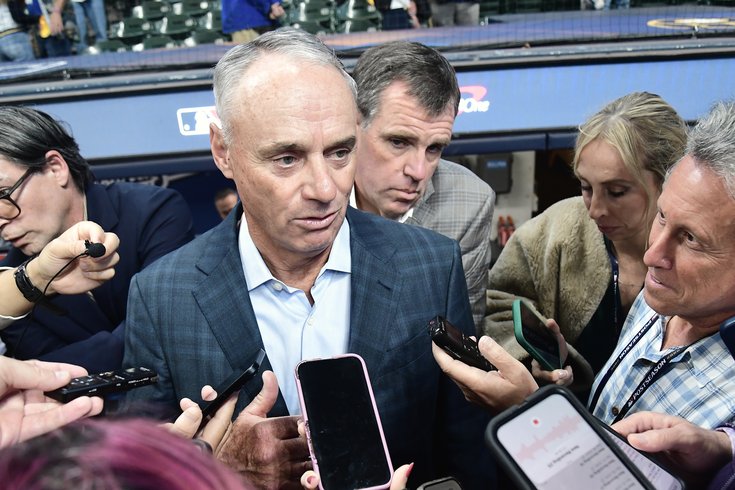
MLB Commissioner Rob Manfried could oversee a major work-stoppage this spring.
The World Series is over (congrats to the small-market Brewers) and baseball's offseason is here.
Before you know it, free agents will start signing deals, desperate to get all the money they can before the uncertainty of the upcoming baseball labor negotiations, with the MLB Players Association dueling with the owners to restructure (or not) the way baseball spends money.
Phillies fans have a few particular interests amid around a dozen issues the two sides are slated to work on, with a likely lockout looming when the current CBA expires on December 1.
What are the issues at hand, and what should Philly sports fans be hoping for as negotiations are expected to potentially drag on well into 2027?
Here's a simplified Philly-centric rooting guide for fans who are hoping the Phillies have the best chance to contend and win next season, whenever this nonsense finally wraps up (for more details in general here's a handy resource):
This one is the easiest to understand and the one that's most likely to blow up the entire offseason — and maybe the 2027 regular season. For decades, MLB's owners have wanted a salary cap, like the ones in the other three major sports. The players, understandably, want to maintain their ability to earn as much money as a team is willing to pay them.
The proposed salary cap from the latest owner's proposal is $245.3 million. The Phillies are currently expected to have a $293 million payroll next season and that's before addressing their free agent needs.
Sure, it would be nice to curb the Dodgers' spending spree. But the Brewers beat them and won it all with less than half the payroll. The luxury tax needs some tweaking but status quo is what big market teams can take the most advantage of.
Phillies' rooting interest: No salary cap, a luxury tax that is higher than it is right now (so the Phillies can spend more).
Last year, the Marlins spent just over $84 million on all their players. Add together the salaries of Zack Wheeler, Kyle Schwarber and Bryce Harper last year, and their 2026 income exceeded the entire payroll of their division rivals from Miami. The proposal on the table starts with a $171.2 million salary floor, which 12 teams are currently under.
Not only that, but the Phillies are currently giving the Marlins money, as part of the current revenue sharing agreement that distributes revenue to smaller market teams.
This system is in extreme need of reformation. Contending teams are essentially supporting ownership groups of teams that don't feel like trying to win. They still make money. How is that fair?
Phillies' rooting interest: A salary cap floor.
It currently takes players six full years of MLB participation to reach free agency. This is essentially why you rarely see a free agent under the age of 30. A proposal is on the table to change that to five years, giving players a chance to hit the open market earlier in their primes — but obviously this would penalize teams that develop talent.
It's a tough issue for Phillies fans because it seems like the best thing for the players is to lower this limit, but the best thing for teams is to keep it in place.
Phillies' rooting interest: Neither outcome is worse for Philly.
The player's union wants to pay younger players more, and they want to nearly double the minimum MLB salary (from $780k to $1.5 million). In theory, teams are clearly opposed to this, and the Phillies would automatically be forced to pay more money to young players like Andrew Painter or Justin Crawford.
However, the broader economics of baseball could stand to benefit from this. It creates less of an advantage for the organizations, like the AL pennant-winning Rays, who develop their own young talent and can keep their salaries very low. It also would potentially lower some of the fantastical spending for teams like the Dodgers, who are able to supplement their $100 million contracts with players earning a tiny fraction of that.
Phillies' rooting interest: A minimum wage raise can help.
The owners want to create a maximum contract length of five years, with a six year extension available for players who re-sign with their current teams. The Phillies have in recent years offered a 10-year-deal to Bryce Harper and 13-year-deal to Trea Turner.
Fans no doubt are feeling some remorse for those deals, as Turner was awful last year. But regardless, it's the length of these deals that arguably gave the Phillies the opportunity to outbid other teams unwilling to make the longterm commitment.
Phillies' rooting interest: No contract maximum.
There are several changes on the table but the main one is the owners looking to take the draft from 20 to 12 rounds, and eliminate high school eligibility. They're also proposing the addition of an international draft.
The Phillies haven't been the best at scouting and drafting lately, so giving them more bullets to bring in young players is probably preferred here. The owners also want to implement a new international draft that evens the field for players with advantages overseas. The Phillies have been among the worst teams in the majors in scouting and developing Latin American players (though they certainly hope to buck that trend with the huge deal they gave teenage signee Francisco Renteria).
Phillies' rooting interest: Maintain most of the current MLB Draft rules.
Under current MLB rules, a team with a soon-to-be free agent can offer that free agent a one-year deal (worth $20 million), and force a potential new team to pony up a very good draft pick to the surrendering team as compensation. It muddies the waters in free agency and both sides seem keen on ending it.
Phillies' rooting interest: End the qualifying offer.
The owners are proposing a shortened 154-game schedule, eliminating eight regular season games. They are also proposing lengthening the Divisional Series of the postseason from five games to seven games. The Phillies will certainly support the longer series, as their elite pitching staff makes them a team built for a longer series (in contrast to the volatility of a shorter one).
But fans probably don't want to waive goodbye to chances to see their beloved team at home (and with more scarcity, potentially more expensive tickets). It should be worth mentioning that the season would need to either start sooner or end later for a longer postseason.
Phillies' rooting interest: No on less regular season games, yes on postseason change.
Both sides have proposals here, and some kind of compromise is likely the desired outcome:
MLB Owners proposed in August:
• Requiring teams to set weekly rosters each Monday
• Increasing the maximum number of pitchers from 13 to 14
• Changing the 10-day and 15-day IL to lists to one-week and two-week lists
• Replacing the 60-day injured list with a 12-week injured list.
• Reducing optional assignments from five to four per season.
• Changing Rule 5 Draft eligibility.
• Creating two offseason quiet periods during which free-agent signings would be restricted.
The players have some different ideas:
• Expanding active rosters from 26 to 28 for the first 15 days of the season.
• Reducing optional assignments from five to three.
• Allowing earlier placement on the 60-day IL.
• Protecting service time and salary for pitchers optioned to the minors after meeting performance thresholds.
• Giving players access to club-collected, non-proprietary performance data and video.
Phillies' rooting interest: A compromise that prioritizes player health and team flexibility.
This one is pretty straight forward. There is no reason a player should potentially have the ability to drop a fly ball or strike out on purpose to win a bet. And fans shouldn't be down their throats if they fail to reach an over/under. Prop bets shouldn't be eligible for betting. Players also want the opportunity to benefit from endorsing gambling outlets, like the league already does.
Phillies' rooting interest: No on prop bets, yes on endorsements.
This one is complex and strewn with legalese but the issues are in the fine print. The owners want a 50-50 revenue split like the one the NHL has but there are disputes over what counts as revenue, what the owners can deduct and the use of escrow accounts.
Phillies' rooting interest: An equitable split for both sides.
SIGN UP HERE to receive the PhillyVoice Sports newsletter
Follow Evan on Twitter:@evan_macy
Like us on Facebook: PhillyVoice Sports