



April 23, 2026
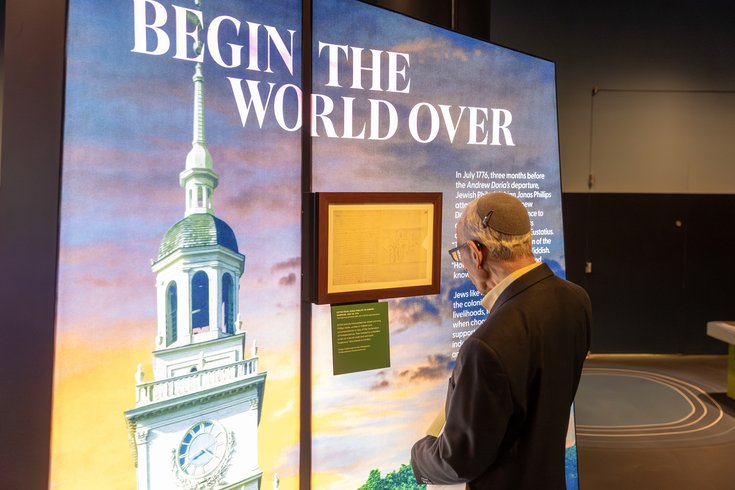 Provided image/Weitzman Museum
The Weitzman Museum is marking America's 250th birthday with 'The First Salute,' a new exhibit on the influential Caribbean island of Sint Eustatius. Jewish merchants who lived there helped smuggle munitions to the Continental Army.
The first nation to officially recognize the United States of America was not France, Poland or Spain. It was the Netherlands, by way of a small Caribbean island that supplied the rebelling colonists with gunpowder and arms through the revolution.
MORE: A Pierre Robert mural is coming to Center City, but its exact site is undetermined
Sint Eustatius is the focus of a new semiquincentennial exhibit at the Weitzman National Museum of American Jewish History. "The First Salute," opening Thursday, explores the Dutch-controlled island's contributions to the U.S. war for independence, and its population of Jewish merchants who smuggled supplies across the Atlantic.
The exhibit's title refers to a pivotal moment in the Revolutionary War. Just months after the United States declared independence, a ship flying the Grand Union Flag — the forerunner to the Stars and Stripes — sailed from Gloucester, New Jersey, to Sint Eustatius. The vessel had traveled into the Caribbean in search of munitions and carried a copy of the Declaration of Independence. As it approached the shore of Sint Eustatius on Nov. 16, 1776, it fired off 13 cannons to signify the 13 colonies. The Dutch governor of the island responded by ordering an 11-cannon salute. In doing so, he formally acknowledged the fledgling nation.
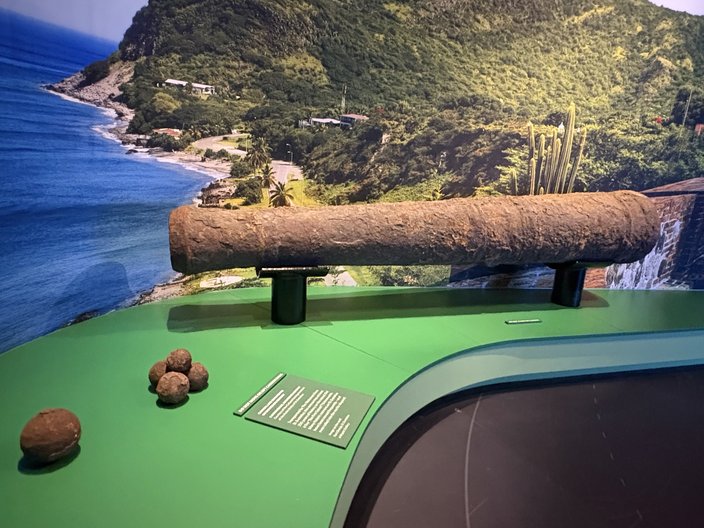
An antique cannon from the island — which may or may not have blasted some of those shots, the records are unclear — stands at one end of the exhibit's main room. As visitors move further into the space, they'll find a perfume bottle and bricks from Honen Dalim, a synagogue established on the island in 1739. Jewish immigrants settled in Sint Eustatius and elsewhere in the Americas after Spain and Portugal expelled them from their homes in the late 15th century. They found religious liberty in Sint Eustatius, and economic opportunity through its bustling duty-free port. Thousands of ships carrying sugar, coffee, tobacco, spices and enslaved Africans visited the island each year.
A cannon from Sint Eustatius is displayed in the 'First Salute' exhibit at the Weitzman Museum.
Jewish merchants helped arm the American cause by smuggling gunpowder and weapons from Sint Eustatius to the colonies, often disguising the cargo as tea or rice. The Weitzman Museum exhibit includes a pitcher belonging to Moses Myers, a Jewish immigrant who participated in covert gunrunning with his cousin Samuel, and portraits of Barnard and Michael Gratz. The merchant brothers, who immigrated from Poland to Philadelphia prior to the war, had business connections in the Caribbean. Michael's name appears in a ledger, also on display, documenting the commercial network that financed the revolution.
"One of the great contributions of this exhibit at this particular moment is it serves as a reminder: Jews were actually here in 1776," Jonathan Sarna, one of the Weitzman Museum's founding historians, said at a Wednesday news conference.
The collaboration cost the residents of Sint Eustatius. The British admiral George Rodney led a fleet of 13 ships with 3,000 men onto the island on Feb. 3, 1781. Looting homes and imprisoning Jewish men, they sought to punish residents for their American assistance. But while the redcoats were tearing down Honen Dalim, a French fleet slipped by undetected. It traveled north to blockade Yorktown, helping George Washington force a British surrender and end the war.
"Had it not been for this infamous island, the American Revolution could not possibly have subsisted," Rodney wrote.
The current governor of Sint Eustatius, Alida Francis, invoked these words Wednesday as evidence that the Dutch municipality "was not a footnote in American story." The island worked with the museum on the exhibit, loaning items for display through April 2027, when "The First Salute" closes.
"In a world marked by tension and division, this history offers a powerful reminder: liberty was not won alone," Francis said. "It was built across oceans, across cultures, across faiths and across communities. It was built through connection, cooperation, courage and sacrifice.
"Today, 250 years later, we honor not just an island, but an idea — that even the smallest place can help shape the course of history, that even the quietest voices can echo across centuries and that the bonds between peoples, nations and communities can endure, inspire and guide us still."
Follow Kristin & PhillyVoice on Twitter: @kristin_hunt
| @thePhillyVoice
Like us on Facebook: PhillyVoice
Have a news tip? Let us know.