



June 30, 2026
 Gary A. Vasquez/IMAGN IMAGES via Reuters Connect
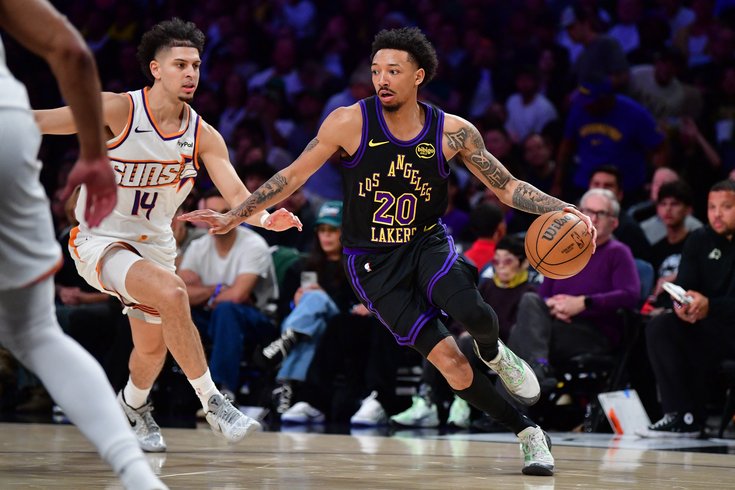
Could Nick Smith Jr. give the Sixers a cost-effective backcourt boost?
Would the 2025-26 Sixers season have even gotten off the ground without Dominick Barlow and Jabari Walker?
Barlow, a starter in 59 of his 71 appearances in his debut campaign in Philadelphia, was a stabilizing force at power forward. His offensive rebounding, versatile defense, heady cutting and strong fit with Joel Embiid made him a vital component of the Sixers' resurgent season. For months, he was backed up by Walker, a player head coach Nick Nurse routinely referred to as the Sixers' best rebounder. Nurse liked to comment that Walker never had a bad game, but pivoted away from him later in the season. The Sixers' issues on the glass only heightened.
Barlow and Walker, of course, were both two-way players when last season began. They both played well enough to earn standard contracts in February with conditional salaries for the 2026-27 season, and each project to remain with the Sixers heading into next season – Barlow as a rotation regular; Walker as a depth piece.
The Sixers declined to tender a two-way qualifying offer to Tyrese Martin, a source told PhillyVoice on Monday, which likely sets the team up to turn over all three of its two-way spots from the end of last season. Ahead of the start of free agency, which players set to hit the open market could be the Sixers' next two-way success stories?
In order to be the next Barlow or Walker, a player must be in a fairly similar career context.
Barlow and Walker each had three years of NBA experience under their belts, with enough flashes to still be considered prospects, but not enough to earn standard deals elsewhere. Barlow played 96 games and 1,203 minutes across his first three NBA seasons, which he split between the San Antonio Spurs and Atlanta Hawks. Walker's case was a major surprise at the time given he spent three years on the Portland Trail Blazers' standard roster and played on a regular basis; he had logged 188 appearances and over 3,000 minutes.
Even before making the progress they did as Sixers, each of Barlow and Walker had discernible, NBA-level abilities. There was a vision for how they could impact games at the NBA level on a more consistent basis. For Barlow, it was offensive rebounding and an unusual blend of size, mobility and feel. For Walker, it was his bruising proficiency on the glass and an improving three-point shot.
Upon reaching free agency, Barlow had just turned 22 years old and Walker was about to turn 23 years old. They were both unrestricted free agents, so even if their incumbent teams thought they were worthwhile two-way signings the players had full autonomy to leave if they felt Philadelphia was a better environment to succeed in.
The goal with the following candidates: meeting as many of these qualifications as possible.
MORE: Asking a salary cap expert about Sixers' free agents, key trade assets
• Nick Smith Jr.: Smith is not lacking in experience for a potential two-way signee; over the course of three seasons with the Charlotte Hornets and Los Angeles Lakers he has logged nearly 2,500 minutes across 141 games. A first-round pick in 2023, Smith was waived by the Hornets after two seasons – despite averaging 9.9 points, 2.4 assists and 2.1 rebounds per game at 20 years old as a sophomore. He was the victim of a roster crunch, and almost immediately landed with the Lakers on a two-way deal.
On the very last day of the 2025-26 season, Los Angeles converted Smith to a standard deal to make him available for the playoffs. Smith was wildly inefficient in Charlotte; with the Lakers, his two-point efficiency improved markedly. That was critical, as Smith does not also provide particularly inspiring playmaking for a 6-foot-2, 185-pound guard. Smith's combination of inside-the-arc inefficiency and shaky shot creation made it hard for him to impact winning.
Nick Smith Jr. vs the KIngs:
— Laker Performances (@LALPerformance) December 29, 2025
-21PTS
-3REB
-1AST
-75TS% pic.twitter.com/ZPWODFxA2X
If Smith can continue doing a better job of picking his spots on two-point attempts as he enters his age-22 season, he will have a real chance to provide an offensive spark for an NBA bench. His true shooting percentage neared the league average last season after two years of being considerably substandard, and that was powered by three-point volume. Smith's NBA-ready skill: for his career, he is a 37.4 percent shooter from long range on a whopping 10.7 attempts per 100 possessions.
• Kobe Brown: Brown was thrown into the Ivica Zubac trade, ending his stint of two-plus years with the Los Angeles Clippers and giving him an end-of-season tryout with the Indiana Pacers. Brown is a 6-foot-7, 250-pound forward with 145 games and just over 1,600 minutes under his belt.
Get out of his way! Kobe Brown posterized TWO DEFENDERS at one time. 🤯✈️ #GLeagueAlum | @sandiego_clips pic.twitter.com/F6Dm2G2fb8
— NBA G League (@nbagleague) November 26, 2025
After shooting a combined 20-for-74 (27.0 percent) from beyond the arc in two seasons in which he rarely played (666 total minutes), Brown logged nearly 1,000 minutes in 2025-26 and shot 52-for-139 (37.4 percent) on three-point tries. His play in Indiana was particularly intriguing; the 26-year-old averaged 9.4 points, 4.9 rebounds and 2.0 assists per game on a makeshift roster after being traded.
The Pacers have a two-way competition of sorts already in the making, so if Indiana does not view Brown as a player worthy of a standard roster spot he could very well be on the move. If the Sixers buy Brown's recent three-point shooting leap, they could bet on a player with his size and strength panning out.
• Jalen Wilson: Wilson was drafted by the Brooklyn Nets near the end of the 2023 NBA Draft and, as a rookie, earned a promotion from two-way deal to standard contract. He just played out that entire deal, and now enters unrestricted free agency as a veteran of 176 games and 3,554 minutes.
The case for Wilson, 25, would be tied to his extensive NBA experience – he will never be overwhelmed if thrown into a game, which for a two-way player is valuable in itself. The case against him: despite having logged all of those minutes, Wilson has yet to exhibit a surefire, signature skill which he can bank on translating into any team context. He is an okay shooter, a solid athlete and a decent rebounder. But he is not clearly impressive in any of those areas.
• Andre Jackson Jr.: Jackson, meanwhile, is a top-flight athlete, the likes of which the Sixers have not had many of in recent years:
ANDRE JACKSON JR MY GOODNESS. 🤯🤯🤯
— Hoop Central (@TheHoopCentral) March 13, 2024
pic.twitter.com/BGEZ52fY7a
At 6-foot-6 and 209 pounds – plus a wingspan of nearly 6-foot-10 – Jackson has become a very strong defender against guards and wings alike in his three years (172 games, 1,970 minutes) with the Milwaukee Bucks.
The issue: Jackson has still not proven he can shoot. After shooting 29.3 percent on low volume from beyond the arc in three seasons at UConn, Jackson has made 34.1 percent of his long-range tries at the NBA on even lower volume. Jackson has only attempted 1.1 three-point shots per game and made just 59.7 percent of his free throws as a professional, both signs that he cannot be trusted and does not need to be defended on the perimeter. Perhaps the Sixers see a reason to believe he could make an unexpected leap, but signing Jackson would likely be a statement that his defensive and athleticism are pluses meaningful enough to make his shooting woes worth dealing with.
• Dillon Jones: Two years ago, Jones was a rookie first-round pick riding the bench for the Oklahoma City Thunder. He got a ring out of it. Then he was traded in a salary dump and waived by the Washington Wizards. In January, he inked a two-way deal with the New York Knicks. He got a ring out of it. Jones is a two-time champion two seasons into his career. Maybe the Sixers should sign Jones just to test the limits of this.
Jones, a sturdy 6-foot-5, 235-pound wing entering his age-25 season, has not had much opportunity to display his skills in the NBA. He has only accumulated 591 minutes across 61 games. Where the majority of his game action has come over the last two years is the G League, where he has played well over 1,500 minutes, averaging 14.8 points per game, 6.7 rebounds, 5.7 assists and 1.4 steals per game. The assists are particularly compelling there; if Jones panned out as a strong wing with secondary ball-handling skills he would be a rather unique player.
• Jett Howard: A former high-school foe of Barlow, Howard is the son of Juwan. He was a lottery pick three years ago, but in 133 games and nearly 1,500 minutes with the Orlando Magic could never break through. A 6-foot-8 wing entering his age-23 season, Howard has the pre-NBA pedigree, but not the professional production.
Jett Howard ankle breaker + triple pic.twitter.com/ISFbdJ3six
— The Magic Way (@MagicFilmRoom) October 13, 2025
As a freshman at Michigan, Howard shot 36.8 percent from three-point territory on significant volume (7.3 attempts per game, 13.6 attempts per 100 possessions) while also making exactly 80 percent of his free throws. He shot 62-for-211 (29.4 percent) from beyond the arc across his first two NBA seasons, had his fourth-year team option declined, then shot 54-for-145 (37.2 percent) on three-point looks in 2025-26.
• Caleb Love: Love is a restricted free agent this summer, but after a strong rookie year on a two-way deal with Portland it is unclear whether or not he will be prioritized by the Trail Blazers. After trading for Ja Morant – adding him to a backcourt which already includes Jrue Holiday, Scoot Henderson and the soon-to-return Damian Lillard – it is not as if a 6-foot-3, 212-pound guard like Love is filling a need there moving forward, especially with two two-way spots already occupied.
Love, whose 25th birthday is in September, was a real contributor during portions of his rookie season. Love made 49 appearances last season, averaging 20.7 minutes, 10.4 points, 2.5 assists and 2.3 rebounds.
The calling card for Love is clear: three-point shooting. He attempted 13.8 long-range attempts per 100 possessions, and if he has a future in the NBA it will be as a marksman. He has a pure stroke:
Big shot from Caleb Love pic.twitter.com/0L8HF2FIzJ
— Steve Jones (@stevejones20) November 22, 2025
Love only shot 31.8 percent from beyond the arc for the season; even at his gigantic volume that will not be good enough. But he is a better shooter than that figure would indicate, and on a Sixers team that finished last season in the bottom third of the league in three-point volume and accuracy, Love might be a sensible fit.
2026 SIXERS FREE AGENCY PRIMER
SALARY CAP DETAILS | TRADE TARGETS | FREE AGENTS