



June 26, 2026
Colleen Claggett/for PhillyVoice
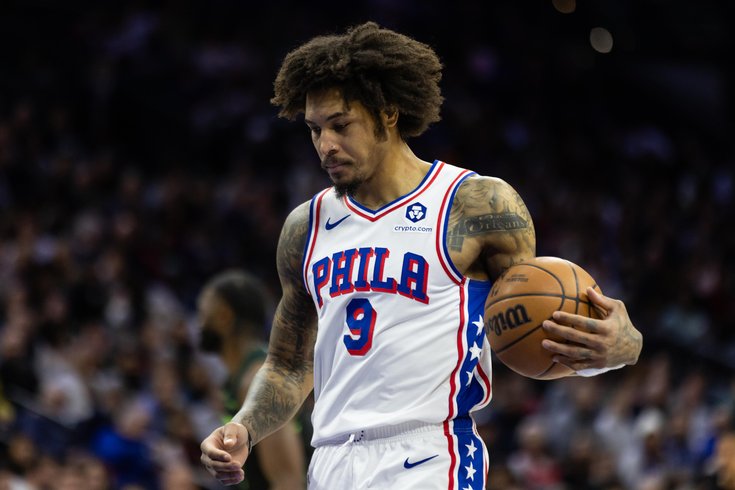
Kelly Oubre Jr. has spent three years in Philadelphia. Is there more to come?
Welcome to the first section of our annual Sixers free agency primer, which this year is split into three equally critical parts.
Here in the opening chapter: where the Sixers are roster-wise as free agency begins, the makeup of their cap sheet moving forward, an FAQ of sorts covering all things tied to the league's complex salary cap and breakdowns of all Sixers free agents and players with team options for 2026-27 in their contracts.
To understand what a team's potential pathways are in an offseason, one must understand where the organization is starting out. That is what this piece of the primer is for.
Later on in the primer: a detailed breakdown of the Sixers' trade assets and candidates, plus dozens and dozens of potential targets around the league, then the main event: a rundown of every free agent with even a somewhat sensible fit in Philadelphia, also ranging from impact starters to end-of-bench reserves.
To read the remainder of this year's primer – from trade possibilities to the main event of free agency – see the links below and at the bottom of this story.
2026 SIXERS FREE AGENCY PRIMER
SALARY CAP DETAILS | TRADE TARGETS | FREE AGENTS

Here is where the Sixers' roster stands entering free agency:
| Roster spot | Player | 2026-27 | 2027-28 | 2028-29 | 2029-30 |
| 1 | Joel Embiid | $57,985,752 | $62,624,612 | $67,263,472 (player option) | UFA |
| 2 | Paul George | $54,126,380 | $56,586,670 (player option) | UFA | |
| 3 | Tyrese Maxey | $40,770,520 | $43,582,280 | $46,394,040 | UFA |
| 4 | VJ Edgecombe | $11,663,880 | $12,219,840 (team option) | $15,445,878 (team option) | RFA |
| 5 | Labaron Philon Jr. (projected salaries) | $3,597,960 | $3,777,600 | $3,957,600 (team option) | $6,510,252 (team option) |
| 6 | Jabari Walker | $2,584,539 ($250,000 guaranteed until Jan. 10) | UFA | ||
| 7 | Justin Edwards | $2,411,090 | $2,616,754 (team option) | UFA | |
| 8 | Adem Bona | $2,296,271 (non-guaranteed until July 7) | $2,486,995 (team option; non-guaranteed) | UFA | |
| 9 | Johni Broome | $2,150,917 | $2,525,901 (non-guaranteed) | $2,735,698 (team option; non-guaranteed) | UFA |
The Sixers could have as many as nine players enter free agency on Tuesday, but the free-agent statuses of those players will vary. There are three different distinctions of free agents, part of a system known as "Bird Rights."
The three categories and their ensuing restrictions are as follows:
| Non-Bird | Early Bird | Full Bird |
| • Players to have switched teams via free agency in the last year • Can be offered up to 120 percent of their salary from the previous season | • Players to have not switched teams via free agency in the last two years • Can be offered up to 175 percent of their salary from the previous season | • Players to have not switched teams via free agency for at least three years • Can be offered up to the maximum salary regardless of cap space situation |
The NBA's salary cap has become increasingly challenging for casual fans to keep track of since the league's new collective bargaining agreement went into effect, and that is largely due to the introduction of a second apron and a series of limitations placed on teams that surpass either apron.
The Sixers will enter the offseason under the first apron, but close enough to it that they will have a hard time staying under that threshold without having a worse roster as a result. They will likely enter the season above the luxury tax threshold, but not by so much that there would not be a path to – yet again – ducking under the tax line at the trade deadline:
| Category | Sixers entering free agency |
| First apron room | $22,910,558 |
| Second apron room | $35,584,558 |
| Luxury tax room | $14,321,558 |
The Sixers should not have any issues staying under the second apron, though, so the focus here will be restrictions facing first-apron teams. If the Sixers plan to exceed the first apron at any point during the 2026-27 season, they must abide by all of the following rules:
• Cannot acquire more salary than sending out in trade
• Cannot acquire player via sign-and-trade
• Cannot use non-taxpayer's mid-level exception (projected maximum value: four years, $64.7 million), only taxpayer's mid-level exception (projected maximum value: two years, $12.4 million)
• Cannot use bi-annual exception (projected maximum value: two years, $11.2 million)
• Cannot use trade exceptions created in previous season
If the Sixers performed any of these actions before surpassing the first apron, they would not be allowed to exceed that threshold for the remainder of the league year under any circumstances. That is called being "hard-capped."
Dominick Barlow ($3,415,000): Barlow was one of the true revelations of the 2025-26 season; in his age-22 season he went from signing a two-way contract to starting in 59 of his 71 appearances and cementing himself as a rotation-caliber big thanks to stellar offensive rebounding, defensive versatility and impressive feel.
When the Sixers signed Barlow to a standard contract in February, it gave him a considerable in-season raise and included this team option for 2026-27. The Sixers could follow the path they went down a year ago with Justin Edwards, whose own standard deal included a team option. The Sixers built that in for security, but ultimately executed their plan to decline the option and sign a long-term deal.
If the Sixers end up declining Barlow's option to lock him in for more years of cost-effective production, his 2026-27 salary could start at up to $4,098,000 with annual raises of up to five percent. A three-year deal with maximum raises would end up being worth just under $13 million; a four-year deal could be worth up to $17.6 million.
Barring something very much unforeseen, Barlow will be back with the Sixers next season. The question is whether he will be doing so as a soon-to-be free agent, or in the first year of a new long-term deal.
Trendon Watford ($2,801,346): Players whose team options are picked up can immediately be traded, and that is probably the most likely scenario in which Watford's option is accepted by the Sixers.
Otherwise, look for them to follow a path that they went down with Eric Gordon last year: Gordon had a player option for a five-percent raise above the previous season's veteran's minimum salary and declined the option to immediately re-up on a new, one-year minimum. Given the annual increases of the NBA's salary cap, this was mutually beneficial, saving the Sixers some money against the salary cap, luxury tax and aprons and earning Gordon more money.
If the Sixers decline Watford's option and then immediately sign him to another minimum contract, they will save around $350,000 against the cap, tax and aprons. Watford will earn an extra $50,000 or so. The only drawback for the Sixers: instead of immediately being trade-eligible, Watford would be locked into a roster spot until the middle of the season.
Ultimately, the Sixers should either use Watford's team option to facilitate a trade, decline the option and re-sign the point forward on another minimum pact or let him walk. Simply accepting the option to bring him back is the least sensible option in front of them.
Dalen Terry ($2,584,539; non-guaranteed): Terry only joined the standard roster in Philadelphia days before the season ended; he was an emergency signing after veteran guard Cam Payne suffered an injury that was going to sideline him for the foreseeable future. But Terry was absolutely well-liked in the locker room and at times impressed with his intensity as a perimeter defender.
Terry's team option containing a non-guaranteed salary means there is no downside to the Sixers accepting the option and potentially bringing Terry into training camp. If at some point they need to clear more space below an apron, Terry would then become an easy casualty.
Quentin Grimes (unrestricted, Full Bird): Grimes was the Sixers' free-agency priority last summer, but did not sign a contract until October. He missed training camp and the first two games of the preseason due to a bitter stalemate which prompted his agent to publicly blast Sixers management, and prompted Grimes to seek new representation.
With no market due to a lack of cap space in the NBA last summer, Grimes accepted his $8.7 million qualifying offer. Instead of securing a significant long-term deal, he was forced to bet on himself, setting up a trip to unrestricted free agency shortly after turning 26 years old. He had an up-and-down season, with a particularly disappointing playoff run that only included a few standout moments.
Quentin Grimes played one of his best two-way games as a member of the Sixers in their Game 5 win in Boston on Tuesday. They probably would not have won the game without Grimes, whose emotion on the court leveled up, too: pic.twitter.com/ffn093RjcZ
— Adam Aaronson's clips (@SixersAdamClips) April 29, 2026
Grimes' status as a Full Bird free agent and the Jared McCain trade should improve his chances of sticking around pretty dramatically. But between his miserable experience with the Sixers last summer and the clear fact that he is blocked by Tyrese Maxey and VJ Edgecombe moving forward, perhaps Grimes will want out.
Kelly Oubre Jr. (unrestricted, Full Bird): Oubre, who will turn 31 years old in December, had arguably the best three-point shooting season of his NBA career in 2025-26, knocking down 36.0 percent of his long-range tries. That will help him as he tries to – finally – secure a long-term commitment from a team. Oubre has spent three years with the Sixers; in each one he has been a prospective free agent.
Nick Nurse started Kelly Oubre Jr. over Dominick Barlow in the Sixers' overtime win over Houston on Thursday, and Oubre continued his red-hot stretch, scoring 26 points (10-14 FG, 4-5 3P).
— Adam Aaronson's clips (@SixersAdamClips) January 23, 2026
All 10 of Oubre's baskets: pic.twitter.com/7AaN7croaB
What is the veteran swingman looking for this summer?
"Somewhere where I'm loved. Just somewhere where my family can be comfortable. I have a family now, so it's not like I'm thinking for myself and [wanting to be] able to do spontaneous stuff. I just want my kids to have somewhere that they can call home," Oubre said after the Sixers' season-ending loss on May 10. "I'm going to go out there, I'm going to grind, I'm going to put my hard hat on and go to work, but what I do is for my family. And I just want them to be able to just be stable somewhere and to not have to worry about anything when it comes to their lives being uprooted and figuring out things on the fly. I want my kids to grow in a stable environment in a place where they are wanted... I'm ready for whatever."
Andre Drummond (unrestricted, Early Bird): It did not always seem like Drummond would make it through the entirety of his two-year, $10 million contract with the Sixers before being traded by the organization for the second time – but that he did. Drummond was not the Sixers' best backup center for the majority of the regular season, but he was early and late – particularly in the postseason, when youngster Adem Bona struggled.
Tyrese Maxey gets blitzed; Andre Drummond and Dominick Barlow do exactly what they were supposed to do: pic.twitter.com/DkhDxixsXM
— Adam Aaronson's clips (@SixersAdamClips) April 16, 2026
Should the Sixers utilize Drummond's Early Bird rights, they can issue him a starting salary of up to $8,750,000 on what would have to be a contract of at least two years. It should not cost that much to retain his services, though; if Drummond does not sign for a veteran's minimum salary this summer he will not make much more than that.
Kyle Lowry (unrestricted, Full Bird): Most believe that Lowry, 40, is set to retire after an outstanding 20-year NBA career. At the end of the 2024-25 season, Lowry proclaimed that he wanted to spend one more year in the league, playing for his hometown team. He did that.
Lowry has been an incredibly valuable presence for the Sixers and their young players; his impact on Maxey has been particularly meaningful. If he reversed course and opted to spend another year as a glorified assistant coach, he would certainly do so on a veteran's minimum salary once again.
MarJon Beauchamp (unrestricted, non-Bird): Beauchamp closed out the season as one of the Sixers' two-way players, but with four NBA seasons under his belt he is no longer eligible for a two-way deal.
It will be a challenge for Beauchamp to earn a standard contract with his lack of NBA production, but he should be a strong candidate for an Exhibit 10 contract, whether it is with the Sixers or another team. Those deals are non-guaranteed minimums that incentivize the player to stay with the team's affiliate in the G League should they get waived.
Tyrese Martin (restricted, non-Bird): Martin also finished the season on a two-way deal, but because he only has three years of NBA service, he could end up being a two-way contract again next season.
If the Sixers want the Allentown native back in the fold as one of their three two-way players next season, they will likely be able to do so. Martin is a restricted free agent, which means the Sixers can match any offer sheet he signs with another team.
It is not out of the question that Martin fetches an inexpensive standard contract; he has a decent bit of experience with a somewhat compelling makeup. But it seems more likely that he will once again be working to earn a conversion from two-way contract to standard deal, which six players have done with the Sixers in just the last three years alone.
2026 SIXERS FREE AGENCY PRIMER
SALARY CAP DETAILS | TRADE TARGETS | FREE AGENTS