





August 04, 2026
 @east.coast.shredderz/@macjohnson1/Instagram
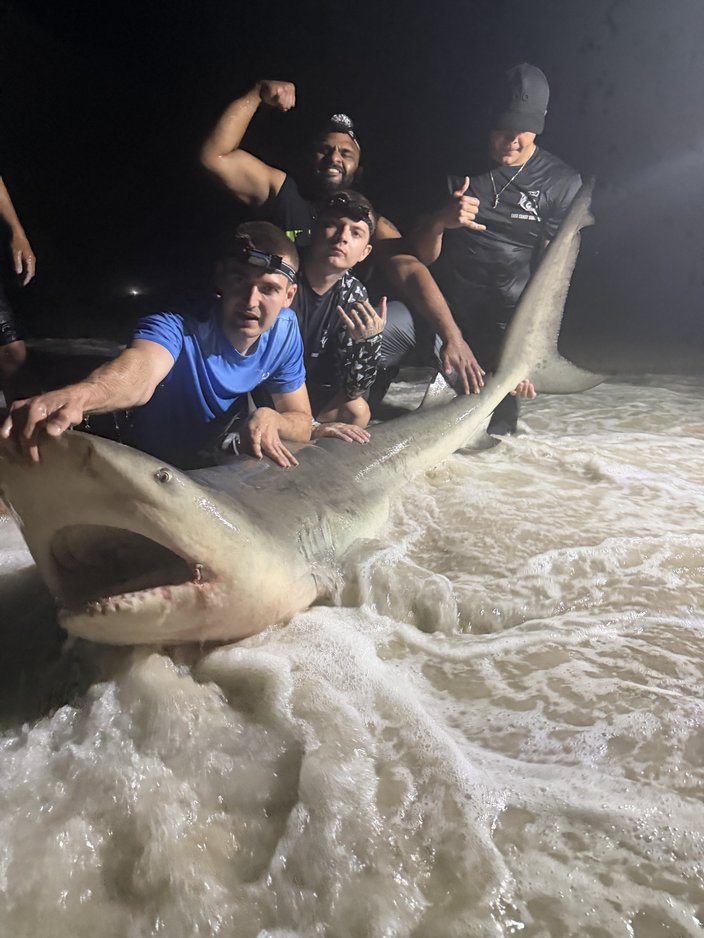
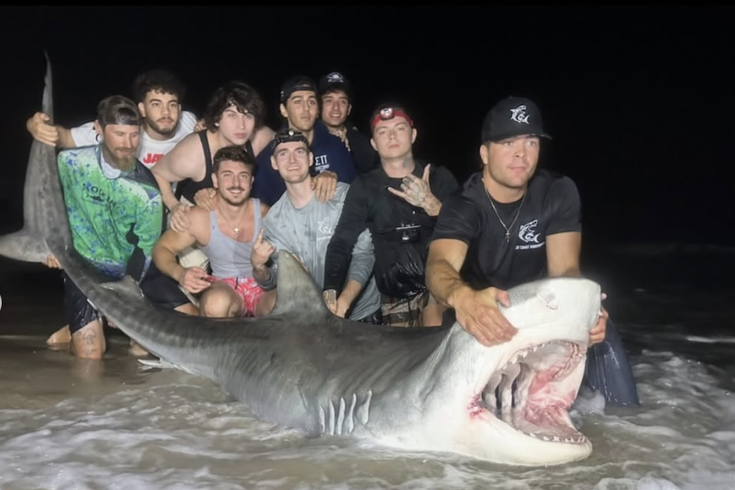
Anglers pose alongside the tiger shark they caught from the beach in Manasquan, New Jersey on July 27. The species is a rare sight at the Jersey Shore, where land-based shark fishing is a growing sport aided by the expanding ranges of some species.
A group of shark anglers in New Jersey reeled in a tiger shark last week during a charter trip along the coast of Manasquan, possibly offering clues about the species' expanding range in the Mid-Atlantic region.
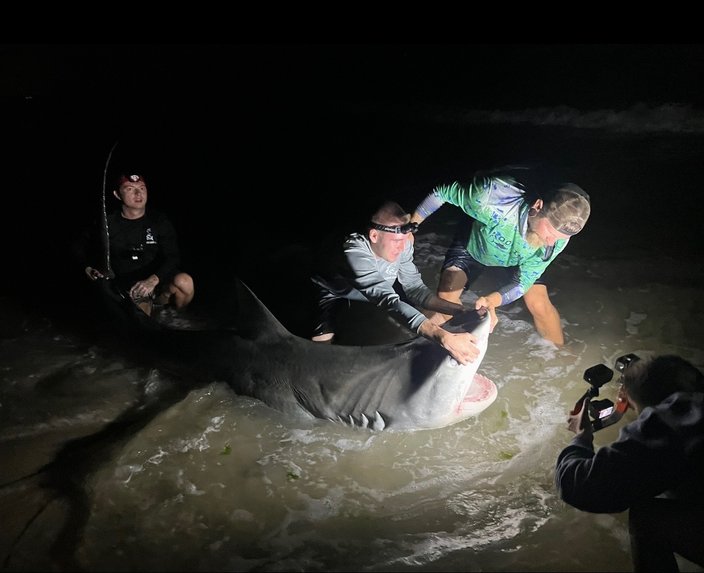
The rare catch was made July 27 from the beach in Monmouth County, where the group used a heavy duty rig to reel the male tiger shark in from about 400 meters off shore.
"For a tiger shark to come this far north, I mean, we've all been in the game for a while, and we've never heard of a tiger shark being caught from New Jersey," said Kenny Rosenblatt, a member of the shark fishing charter East Coast Shredderz. "Especially one of that size."
Tiger sharks — not to be confused with smaller sand tiger sharks — are present in large parts of the Atlantic and Pacific oceans and are among the world's largest shark species. Sometimes called the "trash cans of the sea," they have voracious diets and can be aggressive with humans depending on the nature of the encounter. They grow to 10-14 feet, with large adults weighing upwards of 1,400 pounds.
Rosenblatt and the rest of the crew were not able to measure their tiger shark, but they estimate it was up to 12 feet long and weighed 700 to 800 pounds. The shark only was on shore for about a minute to get pictures before it was released.
"You just have to kind of guide them," Rosenblatt said. "Get them past the first couple waves and then on their way they go."
In the United States, tiger sharks are most commonly found in the warm coastal waters of Florida, the Gulf of Mexico and around the Hawaiian islands. They've also become more common off the coast of the Carolinas. Their presence in New Jersey is relatively unusual compared to other species. Shark anglers as far north as Massachusetts caught a juvenile tiger shark late last month, too.
"While it is not typical to see tiger sharks off New Jersey, the entire ocean is their home and climate change and ocean warming are opening up their preferred range," said Brooke Flammang, a professor at the New Jersey Institute of Technology who specializes in shark research. "They follow the food, and changes in ocean temperature are affecting everything from plankton to whales and in between."
East Coast Shredderz regularly collaborates with experienced shark anglers up and down the Atlantic, where the sport's popularity is growing. Shark fishing is more established in the southern states, but New Jersey has become a hotspot in recent years.
"Something's definitely changing in these New Jersey waters," Rosenblatt said. "It's definitely warmer. It's definitely more clear. There have been more tropical fish spotted, like smaller fish that you would maybe see more in the southern states."
Summer is typically when a range of shark species migrate north and are spotted in the Mid-Atlantic. Rosenblatt usually catches a mix of sandbar sharks, spinner sharks, sand tigers, blacktip and brown sharks, but he said this year has brought some surprises.
"There's been a lot of bull sharks, so that's been the new phenomenon," he said. "Everyone's calling them the Jersey bull. Last year, I was one of very few people to actually get a Jersey bull. This year, there's probably been about 15 of us that got Jersey bulls."
During another trip on Sunday night, Rosenblatt and his friends caught a bull shark in Seaside Park that measured 7 feet, 8 inches long.
Land-based shark fishing group East Coast Shredderz showcase a bull shark caught at the Jersey Shore on Sunday, Aug. 2.
Rosenblatt started shark fishing about five years ago. His interest grew deeper when he realized the sport needed better gear to handle big sharks and a better public image won by demonstrating responsible practices.
Many of the species anglers catch, including tiger sharks, are protected under federal Atlantic Highly Migratory Species rules and state marine guidelines. Laws are more firmly established in southern states, but there remain gray areas in New Jersey for anglers who fish from the shore.
"You've got to leave them in the wash," Rosenblatt said. "You can't pull them all the way up on the sand."
On the night of the tiger shark catch, Rosenblatt was joined by fellow shark fishermen Mac Johnson, Kurtis Walrath and Rosenblatt's friend Jake. Johnson primarily fishes off the coast of South Carolina, where he's caught tiger sharks in the past. The others are based in New Jersey. The crew was accompanied by a group of people who had booked a charter.
"We'll take people out on the beach, charge them a couple bucks, and we use all of our own gear and explain the situation of how we do it and the proper way to to deal with a fish of that size," Rosenblatt said.
The tiger shark was caught off the beach in Manasquan on July 28.
The crew detailed their custom-built rig in an article published last week by the fishing magazine On the Water. Rosenblatt's East Coast Shredderz provided the 30-foot leader with 25 feet of 1200-pound monofilament connected to a 5-foot, 900-pound cable. The sting ray bait was flown off shore using a drone and then dropped into the water. The full group took turns reeling in the shark for 30 seconds to a minute at a time.
"It's better to bring the fish in faster that way. You pass it to the next guy, and then he goes at it for a little bit, and you just keep kind of hammering him in," Rosenblatt said.
East Coast Shredderz typically schedules charter trips in South Jersey, traveling the beaches from Point Pleasant south to Cape May. They also do some trips in the Carolinas. Rosenblatt said he only fishes for sharks at night or in the morning when beaches are clear of people, unlike some amateur anglers who reel them in on crowded shores. The hobby's rapid growth and social media clout have made it controversial, leading states like Massachusetts to tighten regulations on land-based shark fishing.
"It's not shark fishing thats the problem. It's people not doing it properly," Rosenblatt said. "What I'm trying to show everyone is there's a proper way to do it."
Flammang said the tiger shark's slender taper toward the tail suggests it's a subadult shark. She praised the crew's handling of the animal and the rules surrounding its capture.
"The very specific details the anglers gave about their gear and care of the animal showed that they are cognizant and respectful of these guidelines, which is really important for the survival of these amazing creatures," Flammang said.
Great white sharks and other species have been observed off New Jersey's coast with more frequency over the past decade, led by research organizations like Ocearch that tag sharks to track their movements. Rosenblatt said he was recently approached by a tagging company interested in working with East Coast Shredderz.
"That would be pretty cool to try to give them some some more data," Rosenblatt said.