




August 04, 2026
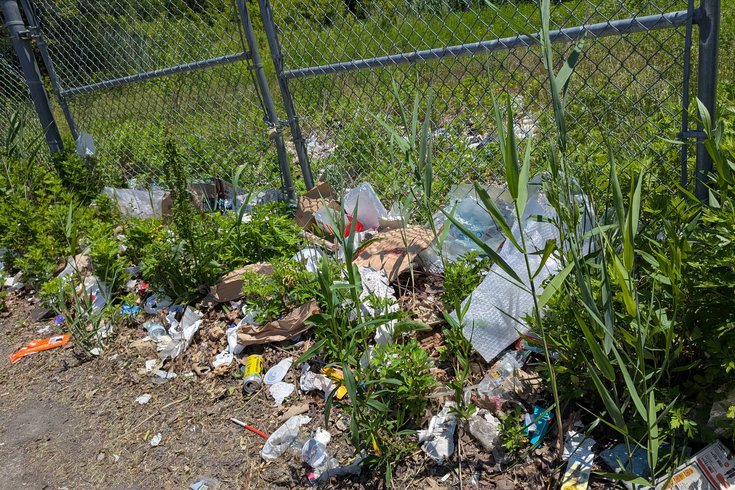 Provided Image/Clean Philadelphia Now
An illegal dumping site at Mario Lanza Boulevard is being tracked on a new mapping system by Trash Academy's Clean Philadelphia Now campaign.
In an attempt to curb Philadelphia's illegal dumping problem, advocates with Trash Academy have created interactive maps that chart areas where the issue persists. But co-founder Shari Hersh said the online maps are not necessarily meant to spur cleanup efforts.
"Cleaning has, unfortunately, no impact on ending dumping," she said. "We need systems change to end dumping. Our goal is to end dumping — not accept it, not end it in most of the city, but all over the city."
Trash Academy, an organization that advocates for waste reduction and environmental justice, began mapping dumpsites about two years ago to track the progress of city-sponsored cleanups and make lawmakers better informed of the issue's prevalence within the communities they represent.
When the project began, Trash Academy held community events to field complaints about dumping and input from residents, and the organization continues to seek information from residents about illegal dumping in their neighborhoods. This, Hersh said, allows Trash Academy to better track the perpetual dumping cycle and, hopefully, hold the city accountable to its promises to eradicate the issue.
"Our one and only goal is to end (illegal dumping)," Hersh said. "And to do that, we have to show that it's still happening."
One of the maps shows 50 sites that have been charted by Trash Academy members or reported at the community listening sessions the organization has held throughout the city. On the map, each site is marked by a red dot often accompanied by a brief description, address and photo.
Residents can report dumpsites near their homes by using a form that asks them to include the site's approximate address, a photo and a brief description.
"Tell us about the dumping site, what's going on there?" Hersh said. "We collect their stories and are actually uploading it to a digital system so that ultimately there is an inventory of these sites. We're going to do the entire calendar year and then we'll do it again next year and see where we are."
Trash Academy has received more than 75 submissions from residents and organizations in neighborhoods like Eastwick, Hunting Park, Germantown and Kensington — which experience some of the heaviest blight. One entry for a "legacy dumpsite," a site that has to be continuously cleaned, also includes a request for the city to address residents' concerns.
"Approximately one year ago, I submitted a report regarding a fenced-in lot that is being used for illegal dumping," reads an anonymous submission about a dumpsite at 8100-8116 Mario Lanza Blvd. "Although I received a response stating that violations had not been corrected and that the City was preparing to take enforcement action, the condition of the property remains unchanged."
The maps on Trash Academy's website also track the amount of 311 reports the city receives about illegal dumping, the status of each case and the city's average response times to complaints in various neighborhoods.
"The dedication of the people who keep calling (the city) and trying to get it addressed is incredible," Hersh said. "It's years of them dealing with it and it's offensive, it's upsetting."
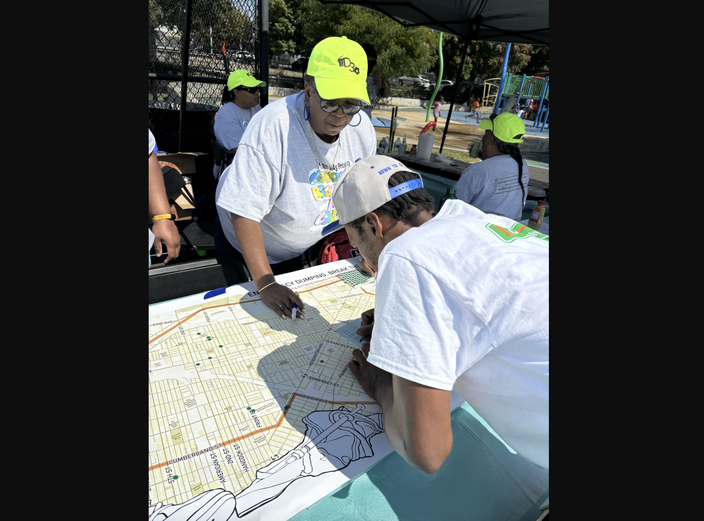
Lois Williams, co-director of Trash Academy, maps illegal dumping sites at Collazo park in 2024.
Trash Academy began physically charting dumping sites in 2024 when Mayor Cherelle Parker launched her Clean and Green initiative after taking office. Over 13 weeks, Parker's initiative held cleanups to remove trash, abandoned cars and dumping sites in every neighborhood. But it was not enough to purge the city streets of dumpsites.
"There is just so much recalcitrant dumping that is resistant to being cleaned up," Hersh said. "So, we doubled down on our mapping, because we know these are hard sites and we want to deal with them. Because they're very real, and very hard on the people who live adjacent to them."
For the online maps, Trash Academy worked with a data scientist from Drexel University and an independent coder to cohesively present the information displayed on the maps. Though the information is not updated in real time (some entries can take a week or two to appear), Hersh said there is enough data available to recognize destructive patterns in waste management.
"The complexity of the differences in dumpsites is really incredible," Hersh said. "There are so many different drivers of dumping and so many different situations. It's not simple, it's complicated."
The city's Office of Clean and Green Initiatives is responsible for overseeing Parker's goals to clean up the city. An illegal dumping task force, formed last year, has assigned sanitation crews to each council district. The implementation of twice-a-week trash pickup in certain neighborhoods also has been touted as a solution.
Keisha McCarty, assistant director of communications and public relations with the Office of Clean and Green Initiatives said the city has closed 31 illegal dumping cases this year that resulted in $1.8 million in judgements.
The city also has sought to better enforce its laws against dumping in recent years. More than 400 surveillance cameras have been installed at common dumping sites, and a 2022 law increased fines for illegal dumping to $5,000 per item transported by car and $2,000 per item transported on foot. Before that, fines for illegal dumping were about $500.
"Illegal dumping cameras play a significant role in our efforts to catch dumpers and enforce illegal dumping laws," McCarty said in an email. "The City uses the video from the cameras to catch and identify dumpers and provide as evidence when taking them to court."
Parker's new budget reserved $190 million for the Office of Clean and Green Initiatives. A 2020 study found the city spends about $48 million every year on programs targeting illegal dumping and persistent litter. About 75% of that spending goes toward cleanup efforts.
Advocates like Hersh are pushing for a more comprehensive response that includes education and outreach, prevention, enforcement and abatement. By focusing on the most common sources of illegal dumping, like construction and demolition services, Trash Academy advocates say the cycle of "dump-clean-dump" can end.
"There's been a huge increase in enforcement in the past year, (but) prevention, not so much," Hersh said. "Right now, there is no mechanism for small loads of construction and demolition waste to be managed."
Advocates have called on the city to implement a citywide compost pickup service and ensure that all residents have access to trash bins and places to store them.
Trash Academy has pushed for a citywide voucher program that offers a discounted rate to developers who agree to bring their waste to a recycling facility, rather than a landfill or illegal dumping site. Hersh said the organization wants to see a similar program be included as part of Parker's Project H.O.M.E. initiative, which aims to build tens of thousands of new housing units in Philadelphia.
"This is a way that's not punitive, it's motivational," Hersh said. "Do it right and learn how to do it right."
Hersh said the new online maps may be the first step toward ending illegal dumping. In the future, Trash Academy wants to include information about the material contents of the litter masses, integrate the information with the Office of Sustainability's Environmental Justice tool, which identifies communities disproportionately impacted by environmental hazards, and send updated information to city council members to let them know what's happening in their districts.
"We have to show the mayor and show everyone that this is still a really big problem in some areas," Hersh said.