


April 20, 2026
 Bob DeChiara/Imagn Images
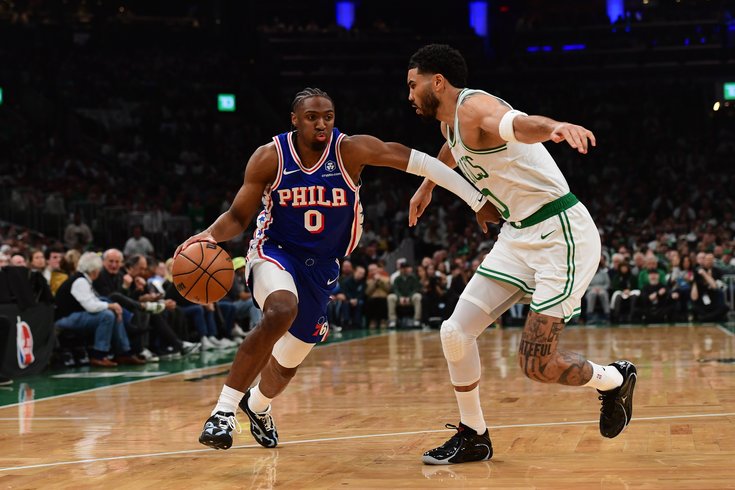
It can only get better for the Sixers after their Game 1 demolition at the hands of Jayson Tatum and the Boston Celtics.
About 52 hours will separate Celtics fans' mocking chants of "WE WANT BOSTON" at TD Garden, as their team completed a wire-to-wire trouncing of the Sixers in Sunday afternoon's first-round series-opening game, with Tuesday night's Game 2. The Sixers must use those hours better than the ones in between Wednesday's Play-In Tournament victory and the calamity that was Game 1.
The Sixers looked completely lost on Sunday. They were overmatched from a talent perspective, but also outmatched in terms of coaching. In a series their aim is merely to make things tough for Boston and see where it goes from there, they handed the Celtics the easiest playoff win imaginable.
As the road team always says in an NBA playoff series, though, you just have to win one of the first two. (At least, that is what they say after losing Game 1.) But the Sixers' effort Sunday did not inspire confidence. Sixers head coach Nick Nurse and his staff have plenty of work to do to ensure the Celtics do not blow the Sixers out yet again.
As always, kicking off the week with 5 Sixers thoughts, focused on what went wrong in Game 1 and potential fixes ahead of Game 2.
There is no way around it: the Sixers' lack of commitment to the finer things was inexcusable. Frankly, it was not just the subtle details they failed to execute on. It was much more than that, and it started right away. The Sixers made several costly gaffes in the opening minutes of the game, setting a horrid tone for the game and the series:
A comedy of errors from the Sixers in the opening minutes of Game 1 in Boston: pic.twitter.com/H9uw4sPMvj
— Adam Aaronson's clips (@SixersAdamClips) April 19, 2026
The Sixers experienced horrid lapses in communication, inexplicable breakdowns and oftentimes looked unaware of the strengths of the players they were facing. Sam Hauser, for example, was routinely left open beyond the arc in the half-court. Here, the Sixers failed to match up with him properly in transition:
The Sixers do not match up properly, gifting Sam Hauser yet another great look for three: pic.twitter.com/rweN5UQfhg
— Adam Aaronson's clips (@SixersAdamClips) April 20, 2026
If there was any period when the Sixers had life on Sunday, it was early in the third quarter. They trimmed Boston's lead to 15 points before a slew of miscues sunk them permanently:
More unforced errors from the Sixers derailed any chance of a third-quarter comeback in Game 1 in Boston: pic.twitter.com/Cs1n2J6vbD
— Adam Aaronson's clips (@SixersAdamClips) April 19, 2026
There is no way around it: given the talent discrepancy working against the Sixers in this series, they have zero margin for error to make mistakes like these if they even want to be remotely competitive. Boston is loaded and limits unforced errors as well as any team in the NBA. The Sixers, who have been plagued by nonsensical plays all season long, have largely failed to beat elite teams because of it.
MORE: Sixers-Celtics Game 1 takeaways
Ever since Maxey returned from injury earlier than anticipated, he has not been the same shooter. Last season, Maxey suffered a very similar injury to his right fifth finger. His shooting numbers took a nosedive. The impact has perhaps not been quite as pronounced statistically this time around, but it has been noticeable.
Maxey shot only 31.6 percent from three-point range after returning for the final nine games of the season. His volume also went down considerably. He has been open in media availabilities about the trials and tribulations that come with trying to shoot with a splint wrapped around one of the fingers on his shooting hand. Maxey has not been as accurate, but more specifically, he has had trouble finding comfort as a pull-up three-point shooter.
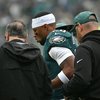
In a general sense, Maxey's ability to stop on a dime and fire away from anywhere on the floor is his most significant driver of offensive value. Defenses fearing Maxey's brilliance as a pull-up shooter is what sets up his dribble-drive game to also be elite. Maxey, who appeared to be in pain in the first quarter of Game 1 after taking a hit to his injured finger, which has already happened several times since his return, did not look comfortable shooting off the dribble instinctually. It almost looked like he had to muster the bandwidth to find those shots.
This is all without acknowledging just how significant of an ask it is for Maxey to lead the Sixers to any wins in this series. The Celtics have more high-caliber options to defend him than any other team in the Eastern Conference if not the NBA, he has no ability to lean on two-man actions with Joel Embiid or Embiid's gravity and he is going up against a brilliant coach who knows if his team shuts down Maxey it will cruise to a series victory.
Can the Sixers weaponize Maxey off the ball a bit more and set up spot-up shooting chances that might be more comfortable for him to take? Can VJ Edgecombe or Paul George do enough with the ball – in terms of self-creation and playmaking for others – that Boston does not feel as inclined to load up against Maxey to such a degree?
There is no path to a close series that does not include the best playoff run of Maxey's life. That does not look likely given the way he is hamstrung by injury and circumstance.
For a significant stretch of Game 1, Nurse's offense turned into the same thing over and over: the Sixers would set a screen, force the Celtics to switch and then attack one-on-one. Typically, it was Maxey with the ball in his hands. It was not a smart method to unlock an ailing player.
What was more troubling: the Sixers were oftentimes not even generating advantageous matchups before pursuing those isolation opportunities. Part of what makes the Celtics great is their lack of weak links on the defensive end of the floor; it is hard to find a player on Boston's roster capable of being hunted.
The Sixers will not win a game in this series without a collective scoring effort. Maxey can be the lead man – he probably has to be – but at least one of Edgecombe and George must show up. Additionally, the pairing of Quentin Grimes and Kelly Oubre Jr. must give the Sixers healthy jolts of offense.
Oubre was brutal on Sunday; his defensive resistance against Jayson Tatum and Jaylen Brown was extremely limited and he missed all five of his three-point looks despite being left open:
Kelly Oubre Jr. shot 0-5 on three-point attempts in the Sixers' Game 1 loss in Boston on Sunday, and the looks he got were excellent: pic.twitter.com/B58Q6mUzUp
— Adam Aaronson's clips (@SixersAdamClips) April 20, 2026
For now, this whole operation is reliant on Oubre, who just finished the best three-point shooting season of his three-year Sixers tenure, performing and being defended like a respectable long-range marksman. If he continues to struggle with open looks, Celtics head coach Joe Mazzulla will leave him open and dare him to beat them. Oubre, always full of confidence, will keep shooting. But if he does not make those looks, Grimes will have to take some of his minutes to prevent Boston from largely ignoring anyone on the perimeter.
MORE: Matt Cord reflects on 28-year run as Sixers' PA announcer
Nurse started Adem Bona over Andre Drummond on Sunday. It made sense in one respect: this season, Bona was a better player than Drummond. But it is not that simple.
Boston starts Neemias Queta, a bruising big without any jump-shooting utility. Off the bench, they have two stretch fives in Nikola Vučević and Luka Garza. Bona, a playoff rookie and an undersized center, profiles as a bad option against the much stronger Queta, but a viable option against Vučević and Garza. When the Celtics are going to a five-out offense, the Sixers can utilize Bona's terrific athleticism and mobility.
Drummond, meanwhile, has the theoretical muscle to hang with Queta, though he was on the wrong side of a lopsided battle in March. Whether or not he can handle Queta remains to be seen, but Drummond most certainly cannot defend in space, which the Vučević and Garza assignments both require.
Both Bona and Drummond had disastrous games; neither one looked reliable in a playoff series against a team as good as the Celtics. Bona was probably worse, and that is why Drummond started in the second half. As Nurse has continually reiterated, the Sixers will need both of them to contribute.
The most obvious way to help prompt a turnaround at center: starting Drummond, matching him up with Queta, and utilizing Bona against Vučević and Garza. Both players will still have to outperform expectations, but it is easier to imagine even one of Bona or Drummond finding some semblance of a spark if they can hone in on these specific assignments.
This tweak is rather simple. The Sixers only made four three-point attempts, missing quite a few open looks from beyond the arc in addition to a jarring number of layups:
All the Sixers' missed layups in Game 1. pic.twitter.com/Xz8XNUAkOW
— NBC Sports Philadelphia (@NBCSPhilly) April 19, 2026
It was evident from the outset on Sunday that the Sixers were victims of bad luck and unfortunate variance in certain respects. But it does not excuse what was an unacceptable performance in terms of focus and execution.
MORE: What major changes can Sixers make this summer?