

May 28, 2026
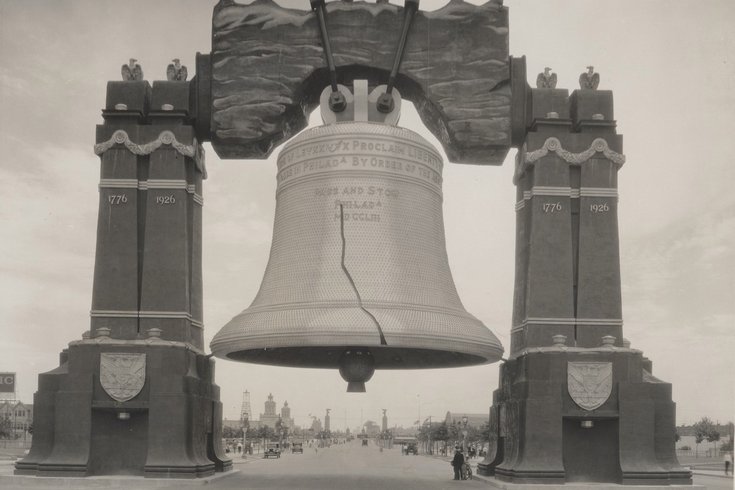 Courtesy Image/Free Library of Philadelphia, Print and Picture Collection
To celebrate the nation's 150th anniversary, Philadelphia leaders held a largely unsuccessful World's Fair-style celebration in South Philadelphia. The fairgrounds included a Liberty Bell replica (above) made up of 26,000 light bulbs over what's now Marconi Plaza.
When researching his book on the 1926 world's fair in Philadelphia, historian Thomas Keels said he found almost no records from city government about the celebration of America's 150th birthday. Given the event's resounding failure, Keels believes officials at the time either destroyed the paperwork or never kept it in the first place.
"I think there was a conscious effort on the part of the city government to bury the fair because it was such a fiasco (and) exposed the corruption that was endemic to the city government," said Keels, author of "Sesqui!: Greed, Graft, and the Forgotten World's Fair of 1926."
For the sesquicentennial, nicknamed the 'sesqui,' Philadelphia decided to host a six-month world's fair, an international showcase of new technology and cultural creations that was popular at the time. Plagued by political corruption, a planned Ku Klux Klan march and torrential rainstorms, the event was a debacle. What was expected to draw up to 50 million visitors only saw around 5 million in the end.
Ahead of this summer's semiquincentennial celebrations to honor the 250th anniversary of the signing of the Declaration of Independence, here's a look at how Philadelphia marked the country's 150th birthday.
Unlike its present-day Democratic majority, the city 100 years ago was ruled by a Republican political machine, historian Francis Ryan said. Many of the laws leaned conservative, including one that made it illegal to play baseball on Sundays, but the city was notoriously known for ignoring the federal prohibition against alcohol.
"It was a time of a lot of excess in a lot of different ways," Ryan said. "There's a lot of dancing, a lot of drinking, a lot of partying, but there's also excess in terms of poverty and unemployment. So there are a lot of contradictions in that period that I think a lot of Philadelphia today would find interesting."
The population, which sat at around 1 million people, was packed into South Philly since the entire northeast side of the city from Oxford Circle to the county line hadn't been developed yet. Unlike New York City, which saw large amounts of tenement housing, most people in Philly lived in rowhouses on narrow streets and many owned their own homes.
The city got increasingly more diverse. From 1900 until 1920, approximately 71,000 Black migrants moved from the South to Philadelphia to find work, Ryan said. It wasn't an easy feat, though. The largest industry in the city was textiles with about 40,000-50,000 jobs, but Black workers held only about 300 of those due to segregation.
Planning for the sesqui started off with John Wanamaker, the founder of the department store chain bearing his name. In 1916, he was 78 and the lone survivor of the finance committee for the centennial celebration of 1876. Wanamaker was largely responsible for that event's financial success, and he wanted to bring it into the new era, Keels said.
"He thought that 1926 would be a great time to celebrate the 150th anniversary of the Declaration of Independence, partially because Europe was involved in a brutally murderous world war at the time," Keels said. "So he thought that America really needed to hold the torch high and celebrate democracy, and he thought that it would be a way to help rejuvenate his hometown of Philadelphia."
However, Wanamaker died in December 1922. While some thought the sesquicentennial celebration would die with him, U.S. Rep. William S. Vare took the torch. Keels said the move was partially a political one because Vare thought the celebration would provide a "nice, patriotic backdrop" for his run for U.S. Senate.
Wanamaker initially proposed a six-month world's fair on the new Fairmount Parkway, now known as the Benjamin Franklin Parkway. New neoclassical buildings that lined the fairgrounds were meant to be the new headquarters for civic and cultural institutions following the event, Keels said.
But when Vare took over, he moved the plan to an empty, swampy space in South Philadelphia. As a result, the sesqui planners spent almost its entire budget to bring in 2 million cubic feet of landfill to bolster the soil before they could even start building structures, effectively bankrupting it before it began, Keels said. Some officials proposed postponing it until 1927, but Vare insisted on holding the original date due to his campaign.
"This was simply proof of that, writ large, one man could basically kidnap a world's fair and have an entire city government do his bidding," Keels said.
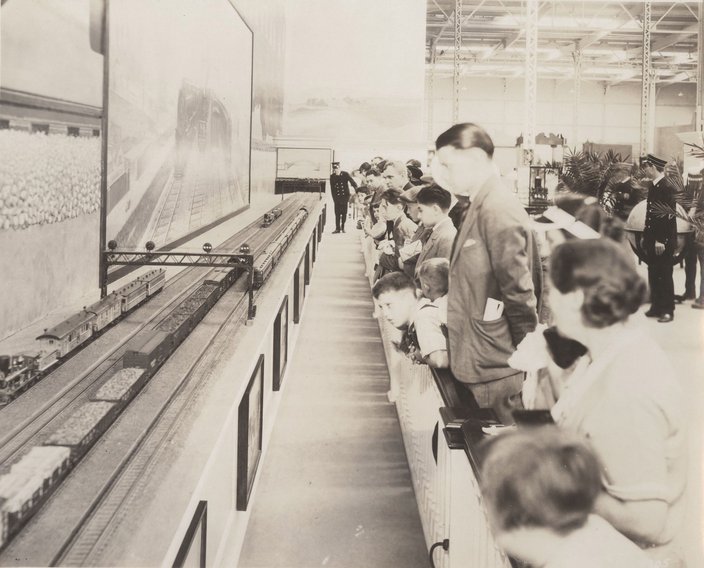
Attendees observe the Pennsylvania Rail Road exhibit at the 1926 sesquicentennial celebration. The event, though a significant milestone for the country, was considered a failure.
Still, by opening day on May 31, crews managed to put together a series of large buildings with piles of consumer goods, which Keels said made it feel "like a giant Costco more than a world's fair." The fair grounds also included a giant Liberty Bell made up of 26,000 light bulbs over Oregon Plaza (now Marconi Plaza) and a "Forum of the Founders" with 13 towers representing the 13 colonies, as well as a hospital, fire station and working post office, according the Encyclopedia of Greater Philadelphia. But many of the buildings remained under construction into July, more than a month after the fair opened.
To help bring in people, Mayor Freeland Kendrick arranged for the Shriners to host their annual convention in Philadelphia. He dedicated the first three days of the fair to that event, but attendees found that their scheduled parades and gatherings were the only activities on the schedule. They also had to move through mud as the sidewalks hadn't yet been laid, and the only way to get the area was a single trolley line on South Broad Street connecting the fairgrounds to Center City, Keels said.
"After three days, 250,000 Shriners go back home across the United States and Canada and tell their friends, 'Don't bother, this is a complete and total flop,'" Keels said.
The weather didn't help, either. The fair started off with a torrential rainstorm on opening day, and only 250 people were reported to have entered the event in its first hour. Throughout the summer, rain damaged the displays and kept away visitors.
"Most of the buildings leaked, and much damage was reported from various sections of the 1,000-acre project," a July 4, 1926, New York Times article read.
In the 1920s, the Ku Klux Klan was in the midst of a resurgence. Just one year before the sesquicentennial, 30,000 members of the white supremacists group marched down Pennsylvania Avenue in Washington, D.C., clad in white robes. In 1926, they planned to replicate that at the world's fair, marching down Broad Street from City Hall to the fairgrounds and burning a cross at Edgewood Lake.
With the sesquicentennial's shabby financial situation, city leaders allowed the Klan to carry out plans. They saw it as extra attendees, and event planner A. L. Sutton was rumored to be a Klan member or sympathizer, Keels said.
As a result, religious leaders across the country protested the KKK's involvement, including writing public condemnations of the decision. Isaac Landman, an editor at American Hebrew magazine, sent a letter to Kendrick on June 22 which said that the Klan's principles "are deemed un-American by a large proportion of our citizenry and on the very face of them nullify the Declaration of Independence and the principles therein proclaimed upon which American democracy has been founded." Amid the backlash, Kendrick banned the Klan from the fair on June 23.
Though that protest was successful, the world's fair was extremely segregated against the city's Black population. Keels said there was supposed to be a hostess house on the grounds for Black visitors to congregate, but he's never been able to find it on any maps. Black attendees and residents were also not allowed to go to any other restaurants on the fairgrounds, march in the opening day and Veterans Day parades or join the sesquicentennial chorus.
"The record on civil rights for the fair was truly pathetic, even by the standards of America in the 1920s," Keels said.
While most of the fair was a failure, one faction was able to bring some success to the event. The sesquicentennial Women's Committee was a group of socially and financially prominent women "who basically did whatever they wanted to, and they could sort of tell Mr. Vare and his machine to go to hell if they wanted to," Keels said.
Their exhibit, titled the High Street of 1776, was a re-creation of 22 Colonial-era buildings, including the President's House, Ben Franklin's print shop, the Graff House where Thomas Jefferson wrote the Declaration of Independence and William Penn's Slate Roof House. Each home looked like a small museum, with staff wearing costumes and furnishing sponsored by corporate partners including Philadelphia department stores. Each facility also had shady gardens in the back where fair visitors could rest, and the exhibit included puppet shows for children as well as a reenactment of George Washington's farewell address to the Continental Army. It was the only exhibit at the fair that turned a profit, Keels said.
A map of the 1926 sesquicentennial fair, which hosted a number of exhibitioners. Courtesy Image/Free Library of Philadelphia, Map Collection
According to a thesis on the Women's Committee in the archives of the University of Pennsylvania Library, a newspaper editorial from Dec. 8, 1926, in the Philadelphia Record said, "If the men of Philadelphia had undertaken to serve their city with half of the zeal, enterprise and efficiency manifested by the women of this group during the Sesqui period there would be a different story to tell of the celebration of the nation's birthday."
That success likely had lasting implications. According to Keels, one of the women involved in the event was Frances Wister, who later founded the Philadelphia Society for the Preservation of Landmarks. Keels also noted that the Rockefeller family made a decision to restore Colonial Williamsburg in late 1926 after the High Street exhibit had made national headlines, meaning it could have been a source of inspiration for the project.
Some remnants of the 1926 event can still be seen today. In Fairmount Park, the Japanese government donated 1,600 cherry blossom trees in honor of the sesquicentennial. And on the fairgrounds in what is now FDR Park, Sweden's Prince Bertil laid the cornerstone for the American Swedish Historical Museum in the summer of 1926, although it wouldn't be complete until 1928.
The sesquicentennial also laid the grounds for the eventual Sports Complex in South Philadelphia, Keels said. Another reason the area was selected was because there was enough space for a city stadium that could seat 100,000.
Largely, though, the sesquicentennial was considered a failure. Vare ultimately won the 1926 election, but he never took office due to charges of political corruption. And for residents at the time it left a gaping financial hole. In the early 1900s, Philadelphia was already spending a lot of its funds on high-profile projects like the Art Museum, the Free Library and the subways. The failure of the sesquicentennial only added to its debt, and unemployment was already at 10% in April 1929, months before the stock market crash that sparked the Great Depression.
"This fair helped to usher Philadelphia into the Depression almost a year before the rest of the nation," Keels said. "It really undermined Philadelphia's finances at a time when they were going to become incredibly vulnerable."
Another lingering ramification was the mark it left on Philadelphia's national and international status. Unlike the bicentennial in 1976, where there were smaller celebrations around the country, Philadelphia was the centerpiece of the nation's anniversary in 1926. Thus, its failure was a high-profile one.
"It was still a major American city, it had a concentration of wealth that, by today's standards, would be amazing. It was a far wealthier, far more influential city than it is today, and so when it stumbled so badly, it really hurt the city's profile," Keels said. "The sesqui became known as the flop heard 'round the world, and it hurt Philadelphia's reputation immensely."