


May 26, 2026
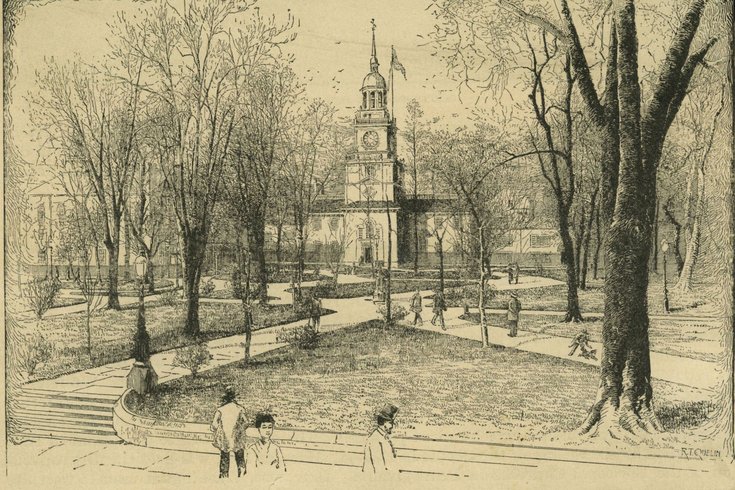 Courtesy/Free Library of Philadelphia, Print and Picture Collection
For the 1826 jubilee, Philadelphia started to look back on some of its forgotten roots in the American Revolution. Above, an image of Independence Square, which was renamed in the 1820s.
Just a few decades after the signing of the Declaration of Independence, Philadelphia was facing a changing landscape ahead of the country's 50th birthday in 1826.
In the early 1800s, the city was attempting to maintain relevance as the country moved its political center to Washington, D.C., and New York overtook it as the largest port hub. As Philly was trying to establish itself in this new America, a visit by a Revolutionary War hero and a new government program asking veterans to recount their wartime experience made residents start to appreciate the city's foundation.
Ahead of this summer's semiquincentennial celebrations to honor the 250th anniversary of the signing of the Declaration of Independence, here's a look at how Philadelphia marked the country's 50th birthday.
In the 50 years after the American Revolution, Philadelphia underwent significant changes. According to the 1820 census, about 63,000 people called the city home. That number climbed to 83,000 in 1830. Industrialization was beginning to grow, and new neighborhoods such as Frankford, Spring Garden and Manayunk were formed.
The 1820s brought the establishment of Fairmount Water Works, the founding of the Franklin Institute, the construction of the Chesapeake and Delaware Canal and the Schuylkill Canal, and the revival of William Penn's five public squares, four of which were renamed to Franklin, Logan, Rittenhouse and Washington. The bridges over the Schyulkill River were also being built at the time, although they wouldn't be completed until 1838, according to the Encyclopedia of Greater Philadelphia.
At the time, Morgan Lloyd, the programming coordinator for the African American Museum in Philadelphia, said the city's Black population was very prominent. Thousands of people of color lived throughout the city limits, especially in the area around Society Hill. Many Black businesses, schools and churches, including West Philadelphia Baptist, were founded, and the area around Washington Square was often referred to as the colored Creole quarter, she said.
"In the 1820s, Philadelphia's Black population was bustling and blooming, kind of like a city within a city," Lloyd said. "It was a really rich period where it was a mixture of historically free people of color, to people who were escaping on the Underground Railroad as well as a very large Caribbean immigrant population."
Although it was a space meant to be safe for Black Americans, it could still be dangerous for residents, as the Fugitive Slave Acts were still in place. That meant that if anyone claimed to recognize a formerly enslaved person, they could take them to court and send them to the Southern United States if they won the case. Lloyd said people were sometimes outright abducted, and often the descriptions of escaped enslaved people were very vague, meaning free Black people were sometimes falsely recognized.
The period also saw the growth of the African colonization movement in Philadelphia, which called for resettling Black Americans to West Africa, a place where many had never been.
Throughout this period of change, commemorating historic events and preserving historic sites fell to the wayside because the city was focused on moving forward through waning relevancy, said Jeffrey Hyson, assistant professor at Saint Joseph's University. The nation's capital had moved to Washington, D.C., in 1790. In 1799, Lancaster became the state's capital, although that moved to Harrisburg in 1812. Simultaneously, New York City took over as the top port with the establishment of the Erie Canal. By 1830, Baltimore would overtake Philadelphia as the second-most populous city in the country.
"Philly hadn't exactly forgotten about the Declaration of Independence in the 50 years since 1776, but it also had really been moving forward into a new identity," Hyson said.
However, that would all start to change leading up to the jubilee, especially with the return of one prominent war veteran.
One of the most significant events of the time was the return of Marquis de Lafayette, the Revolutionary War hero who went on to aid the French Revolution in Europe. In 1824, he toured all 24 states in the United States, including a stop in Philadelphia where he was greeted with a large parade which passed by Independence Hall.
His visit inspired officials to begin reviving the building, which was then called the State House, after it had fallen into disrepair. In planning Lafayette's return, residents first started calling the first-floor chamber the Hall of Independence, which eventually morphed into Independence Hall and spanned to the whole building. The nearby park was renamed Independence Square.
Hyson said the visit reflected a burdening movement to memorialize the American Revolution.
"That helps to spark a greater sense of commemoration and preservation after he leaves" Hyson said. "That recognition of wanting to preserve the memory of the revolution also inspires the creation of the Historical Society of Pennsylvania in 1824."
A few years later, that Philadelphia City Council would pass an order in 1828 to restore the steeple at Independence Hall and make it resemble the original one.
That preservation mindset was also inspired by a national change for veterans. In 1818 and 1820, the first of the American Revolution Pension Acts was put in place, which allowed Continental Army veterans to receive payments from the federal government. But in order to qualify, they had to submit applications about their service, Hyson said.
"When they apply for these pensions, they have to explain 'This is what I did, this was my service,'" Hyson said. "These narratives of Revolutionary War service become more widely circulated and that helps to recall what a hard fight it was."
After Lafayette's visit, July 4 anniversaries included sermons, speeches and recitations of the Declaration of Independence, Hyson said. So the 1826 Independence Day likely didn't look too different from previous years, although there are very few accounts of it in the city.
A sermon delivered in Philadelphia that day by George Potts, a native of the city and pastor at the First Presbyterian Church in Natchez, Mississippi, noted this need to preserve the memory of the Revolutionary War.
"To God, and to our forefathers, we owe our grateful remembrances, of that outpouring of blood, those hard fought battles, those dearly earned victories, those toils and dangers, — in consequences of which, we are what we are, this day, — a nation, whose privileges are so numerous, so stable, and so universally diffused, that, like bread and water, many of them have come to be considered among the necessities of life, least valued, because most common," Potts said, according to a printing of the speech.
Still, not everyone was interested in celebrating. Lloyd noted that many Black Philadelphians, some of whom had been freed from slavery for generations, had taken part in the Revolutionary War on the side of the Patriots. But they were then denied citizenship in the nation's founding documents, and nothing had changed 50 years later.
"Black people inherently would have to observe at some point this moment, which for the United States is a big celebration, but there is also a very interesting contradiction that did exist at the same time," Lloyd said. "We are looking at many Black people who were revolutionaries in the war. There are many Black people who are exceptionally proud to be here on United States soil, and some of them are part of the founding families of this nation, because some families have been around since 1619. Yet they are not considered fully in the celebration or in citizenship, and that irony really had to sting."
Nationally, the country was met with a particularly symbolic end. After over a decade of political disputes and estrangement, Founding Fathers Thomas Jefferson and John Adams had rekindled their relationship and became pen pals in their final years. After declining to attend the national anniversary in Washington, D.C., both died on July 4, 1826, Jefferson at age 83 in Virginia and Adams at age 90 in Massachusetts. Because news traveled slowly, Adams' last words were reported to be "Jefferson still lives," although he had actually passed a few hours earlier.
Their demise was thought to be the end of the era of the Founding Fathers, and many newspapers printed commemorations and many places across the country held eulogies, according to the Library of Congress. At the time, people across the nation speculated that it happened more than just by chance.
"You can imagine just how symbolic and powerful that coincidence must have seemed, and it must not have seemed like a coincidence," Hyson said. "It must have seemed something that was almost divinely appointed or it was a testament to the significance and and world historical importance of the declaration and the American Revolution."