




May 26, 2026
 Scott Wachter/Imagn Images
Perhaps Sixers fans would rather never see the team deal with the Oklahoma City Thunder again, but there is an interesting draft deal that could make sense.
As the Sixers prepare for yet another crucial offseason – beginning with the hiring of a new lead basketball operations executive – there are four NBA teams still playing high-level basketball games.
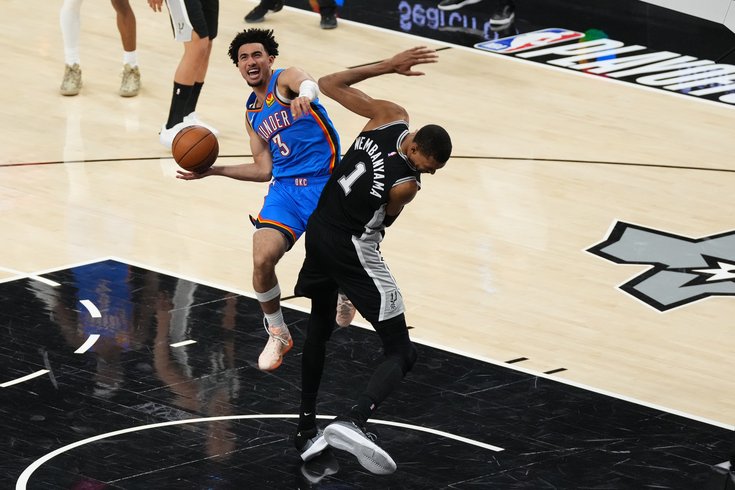
Of course, one of those is the Oklahoma City Thunder, with former Sixers first-round pick Jared McCain suddenly an essential piece as injuries have piled up.
Not shockingly, McCain's continued emergence for the defending champions has caused continued frustration around these parts. At some point in time, Sixers fans might get over this. That has not happened yet.
Before once again revisiting the McCain trade, this week's Sixers mailbag features an interesting idea about what could be the next trade between the Sixers and Thunder:
From @Fanimal_: Any chance we offer a future Clippers pick to OKC for No. 12 overall?
If the Sixers manage to make a deal for a lottery pick in the 2026 NBA Draft, Oklahoma City's first of two first-rounders at No. 12 overall feels like the obvious landing spot.
The entire current Thunder roster is under team control for 2026-27 already. In addition to the Los Angeles Clippers' 2026 first-round pick at No. 12, Oklahoma City owns the Sixers' first-rounder at No. 17 overall. To land McCain, they gave the Sixers three second-round picks and the Houston Rockets' 2026 first-rounder, which landed at No. 22 overall.
Oklahoma City has made a habit of entering drafts with multiple first-rounders and not enough roster spots to utilize them all, then kicking the can down the road by trading present first-rounders for future ones. They are in position to do the same thing this summer, and it is unclear if there is an asset they could get with more theoretical upside than the Clippers' unprotected 2028 first-rounder which the Sixers added in the James Harden trade.
Ever since the Sixers acquired the Clippers' 2028 unprotected pick (and a top-three protected right to swap in 2029), ideas have piled up. How could the Sixers reroute those assets for the sake of bolstering their roster? If they hold onto them and the Clippers continue to lose their footing in the Western Conference, how high could the Sixers end up picking?
So, this idea is different. It is interesting.
Unless Oklahoma City is in love with a prospect available at No. 12 and certain to be off the board by No. 17 – the Thunder also have many second-rounders which could be packaged with their second first-rounder to move a few spots up on the board if needed – it feels like an obvious move for them to make. Maybe that should be a red flag on the Sixers' end. But it would be their best chance to add a significantly meaningful long-term piece to Tyrese Maxey and VJ Edgecombe before the summer of 2028, when Paul George's contract is off the books, Maxey and Joel Embiid have one year left on their respective contracts and Edgecombe is eligible for his rookie-scale extension.
The Sixers could consider making a proposal of this sort, and they would surely try to get even higher than No. 12. But Oklahoma City is the only team with a clear incentive to back out of the 2026 NBA Draft if an elite prospect does not fall into its lap. The Thunder have spent much of this decade rooting for Clippers losses because of the massive haul of picks they landed for George in 2019. They will do so again next year; the final outstanding asset from that deal is that Oklahoma City has the right to swap first-rounders with the Clippers in 2027. The Thunder could extend this experience one additional season by acquiring the 2028 pick the Sixers own.
What might hold this up: nobody knows how to value future first-rounders right now, especially ones without protections. Draft lottery reform is coming, and the NBA's current proposals involve extreme flattening of odds. There will be a lot of randomness at play when the NBA Draft Lottery comes around each year. Nobody should be surprised if trades involving future first-rounders become even less common moving forward than they have been in recent years.
MORE: Daryl Morey's last draft pick, looking ahead to 2026 NBA Draft, more
From @brugada_bros: In hindsight, seeing how the Sixers performed in the playoffs, do you think trading McCain was the right thing to do?
The framing of this question seems to imply that the primary drawback of trading McCain was not having him for the stretch run of the 2025-26 regular season and the ensuing postseason. Even though it felt as if head coach Nick Nurse had a McCain-sized hole in his rotation for months, that implication is not accurate.
Remember, McCain had only just started to find himself during his last few games with the team, but had fluctuated between the fringes of Nurse's rotation and firmly out of the mix. He was assigned to the G League multiple times.
Given that the Sixers had Quentin Grimes on an expiring contract this past season, it could be argued that McCain's absence will never be felt less than it was in 2025-26.
The Sixers unquestionably could have used McCain late in the season and during the playoffs. He has been better than Grimes in the playoffs. And, unlike the 25-year-old free-agent-to-be, the 21-year-old McCain is under contract for two more seasons, during which he is only owed $11.2 million.
McCain being on the Sixers in April and May would not have changed the outcome of either playoff series the team participated in. McCain being on the Sixers in June and July, though, would have changed their offseason outlook a decent bit.
Grimes and Kelly Oubre Jr., two of the Sixers' core rotation pieces, are headed for unrestricted free agency. Depending on where those two markets end up, the Sixers might only end up being able to keep one while staying within striking distance of the luxury tax threshold. The Sixers have little avenue to upgrade from Grimes or Oubre in free agency while keeping the other, so either player departing would likely lead to a fairly significant hole forming in their rotation.
Had the Sixers kept McCain, there would be a third guard already in place, though the Sixers would not have any picks in the 2026 NBA Draft and their collection of future second-rounders would not be quite as plentiful. The Sixers traded McCain not because of the presence of Grimes, but because Maxey and Edgecombe are locked into starting roles for many years to come.
Proponents of the McCain deal – as quiet as they are – would argue that, since McCain could never become a long-term starter in Philadelphia, the strong return the Sixers netted for him will prove more valuable to the organization than the player would have been. Those outraged to not have McCain in the fold might feel even more strongly now than they did in February.
Neither side, however, should be impacted by the results of the playoffs, either for the Sixers or the player they traded away. The McCain deal was always about the years ahead, not the months ahead.
SIXERS YEAR-IN-REVIEW
Joel Embiid | Tyrese Maxey | Paul George | Andre Drummond | Quentin Grimes | VJ Edgecombe | Dominick Barlow