




May 22, 2026
 Trevor Ruszkowski/Imagn Images
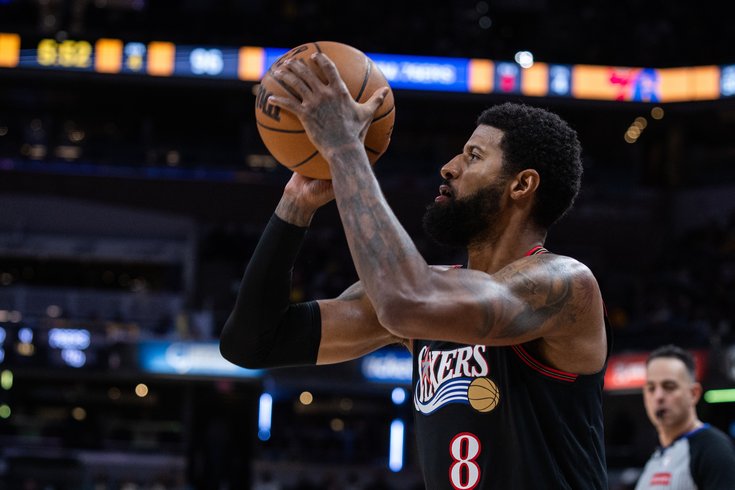
Paul George's second season in Philadelphia was certainly a mixed bag.
Now that the 2025-26 Sixers season is complete after a thrilling first-round series comeback and a jarring second-round sweep, it is time to reflect on the year that was.
Welcome to Sixers year-in-review, where each player's campaign will be analyzed with a combination of statistics, film and reporting.
Up next: Paul George, who for months looked primed for his second disappointing campaign in as many seasons in Philadelphia. Then came a 25-game suspension for violating the NBA's drug policy, which sank his approval rating locally. But upon returning for the final 10 games of the regular season, George looked like a different player. He finally looked truly healthy and found some of the explosion he had been missing since the start of the 2024-25 season.
George played a brilliant two-way series in the first round, helping the Sixers complete a 3-1 comeback against the Boston Celtics with terrific shot-making and outstanding defense. Like just about everyone on the team, he tailed off during the Sixers' second-round sweep at the hands of the New York Knicks. But given how nightmarish his first year-plus with the Sixers was, he ended his second season with the team on an incredibly high note.
SIXERS YEAR-IN-REVIEW
Joel Embiid | Tyrese Maxey | Paul George
George can still muster star-level scoring performances.
George played 41 games in his first season with the Sixers. Only one time did he exceed 30 points. He was much better early on in 2025-26, but the star-level scoring outbursts remained far and few between. The primary issue through George's first year and change in Philadelphia: he struggled to get by defenders off the dribble. As talented of a shot-maker as George is, defenses were able to sit on his pull-up jumpers, making them less efficient.
Then came George's shocking 25-game suspension, and an ensuing seven-week period in which an injury-prone player had nothing to do but work on his body. George said before making his return that the time off was exactly what he needed from a physical perspective.
Many rolled their eyes at that comment, but when George returned he looked like a new player from a mobility perspective. It was still a far cry from the peak of his powers, but he had enough blow-by ability to keep defenders more honest. He also got hot as a jump-shooter. It all coalesced into a beautiful picture; across the final 10 games of the season George averaged 21.0 points while shooting 47.2 percent from the field and 41.5 percent from long range on 8.2 three-point attempts per game.
Paul George put on a defensive clinic early, then got hot as a scorer, then made the three biggest plays of the game all in a row to cap off the Sixers' win in Charlotte on Saturday night. He finished with 26 points, 13 rebounds and four steals.
— Adam Aaronson's clips (@SixersAdamClips) March 29, 2026
Full highlight reel: pic.twitter.com/uVko3nDin1
George was not necessarily getting to the rim at will, but he was self-creating shots at the basket at a far more efficient clip. It was just enough to set defenders up for the pull-up jumpers George loves, and his shot-making skill – still elite for a wing of his size – was ignited.
MORE: Trading Tyrese Maxey to start over would be crazy... right?
Percentage of George's shot attempts within three feet of the basket during the playoffs: 5.6.
Then came the playoffs. George was incredible against Boston, but it was largely powered by outright ridiculous shot-making. George upping his three-point volume considerably was a welcomed pivot – George acknowledged that was a specific focus of his, and the Sixers needed it against the Celtics – but even before his production tailed off against the Knicks, far too many of his two-point attempts were jumpers.
In the second round, George had a few hot starts to games. Whether it was fatigue or the inevitable regression stemming from his challenging shot diet kicking in, George consistently grew less productive as games went on.
Paul George got off to another hot start on Friday, shooting 6-9 from the field in the first quarter. He shot 0-9 for the remainder of the night as the Sixers dropped Game 3 to New York.
— Adam Aaronson's clips (@SixersAdamClips) May 9, 2026
All 18 of George's shot attempts: pic.twitter.com/M4wTe3uS4e
Even as he dazzled with shooting displays few wings in the NBA could ever dream of replicating, it became clear that even after his burst got a bit better after his suspension, George was far too reliant on jumpers and did not have enough reliable downhill driving in his game.
The good news: George is acutely aware of the problem. It is his primary focus heading into the summer, he said:
George on why he is optimistic about his health and skills moving forward and what he wants to work on this summer, May 10:
"This summer, the rehabbing phase is kind of behind me. So I can have a real summer of improving. I feel like it's been stagnant the last couple years because of a surgery here or a surgery there, the past couple of summers. So this summer should be a better summer in terms of working on my game... I think it's just figuring out if I can get that explosiveness back. I thought it limited me a lot this year with the ability to be explosive going to the basket, which I've been, my entire career, not having to heavily rely on my jump shot – the jump shot kind of being the jab to set up the drive to the rim, and I just felt like that wasn't there this year. So I think just trying to find and see if there is that explosion, that'll be my challenge for the summer."
MORE: How Daryl Morey's Sixers tenure reached its end
Did George's post-suspension surge make him a viable trade asset?
Daryl Morey is gone after running Sixers basketball operations for six years. But Nick Nurse is returning to Philadelphia for his fourth season as head coach, and it seems exceedingly likely that Nurse is going to coach a team eerily similar to the one that won 45 regular-season games and went out with a whimper against New York.
It remains to be seen who will be running basketball operations by the time the offseason's transaction cycle is underway. But the most dramatic lever that person has any chance of pulling would be finding a taker on the final two years of George's contract, worth approximately $110 million.
The Sixers would almost certainly not replace George with a player better than him; the point of the deal would have less to do with the top of the Sixers' roster and more with its midsection. This team clearly does not have the requisite depth to make a truly deep playoff run. And it is quite arguable that their only way to acquire it would be taking George and his 2026-27 salary of more than $54 million and break that up into two or three players whose combined salaries are roughly equal.
Had George's viability as a trade asset been discussed in January, it would have been an open-and-shut case: the Sixers would need to part with valuable assets just to get his deal off their books. But after what he did down the stretch of the regular season and particularly what he pulled off against Boston, it is far from an impossibility that another team in the NBA sees him as a worthwhile two-year investment. George will be on one of the largest expiring contracts in NBA history this time next year; any team that acquires him is not necessarily locked into George being on its roster for two more years.
It does not definitively make the Sixers a meaningfully better team (it could end up not making them a better team at all), but breaking up George's massive salary slot into multiple quality contributors is the surest way the Sixers could make their team meaningfully different. That alone makes it worth considering – if other teams in the league now see George as a player worth acquiring.
MORE: Five takeaways from Josh Harris/Bob Myers press conference