




May 20, 2026
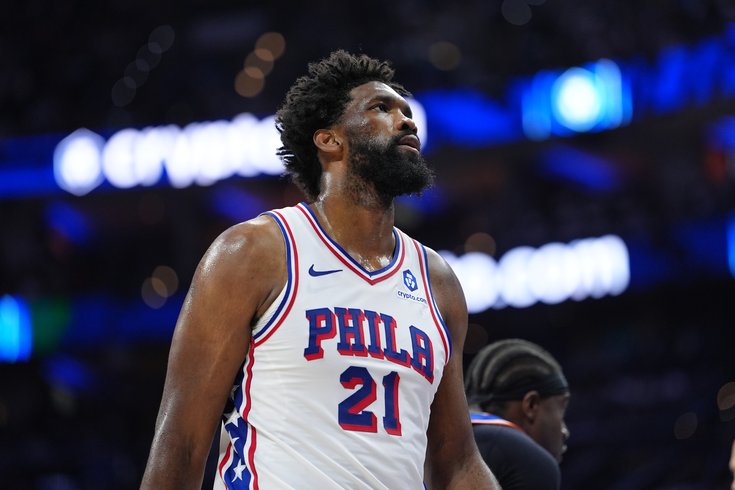 Kyle Ross/Imagn Images
What should be made of Joel Embiid's 10th season as an active NBA player?
Now that the 2025-26 Sixers season is complete after a thrilling first-round series comeback and a jarring second-round sweep, it is time to reflect on the year that was.
Welcome to Sixers year-in-review, where each player's campaign will be analyzed with a combination of statistics, film and reporting.
Up first: Joel Embiid, whose nightmarish 2024-25 season set expectations lower than ever. He experienced a whirlwind in his 10th season as an active NBA player, from a rough starting point to sensational highs, crushing health issues, a shocking playoff emergence and an ensuing collapse.
Embiid played like a superstar again – at times. He was frequently absent due to injuries, but the issues surrounding his left knee seemed to go away. He showed how he could lead the Sixers in a high-level playoff atmosphere, but then ran out of gas. It was, in every respect, a mixed bag. What should be made of it all?
SIXERS YEAR-IN-REVIEW
Embiid still has superstar-caliber production in him.
It might not always be there – and it might not be sustainable for an entire season or playoff run – but heading into this season, it was difficult to imagine Embiid, given the enormity of his health issues in recent years and the fact that he looked like a shell of himself in 2024-25, ever being an unquestionably dominant force again.
For the first few months of this season, it still seemed unlikely. Embiid's minutes were limited. He was not playing more than one game in any three-day stretch. The training wheels were still on as the former NBA MVP and his team tried to manage his left knee. But then came January.
From Dec. 30 to Feb. 2, Embiid played in 16 of 19 games, with all three absences being planned as parts of back-to-backs. He logged 34.2 minutes per game during that stretch, averaging 29.6 points, 8.3 rebounds and 4.7 assists. Defenses were once again completely at Embiid's mercy in a way other NBA teams likely never expected to be again.
Late in the regular season, Embiid had shaken off a lengthy absence due to an oblique injury and seemed to be rounding into form heading into the postseason. Then came a sudden diagnosis of appendicitis, ending his regular season. It did not even take Embiid three weeks to get back on the court after his emergency appendectomy. After one game in which he was clearly getting his feet under him, Embiid submitted the best stretch of playoff basketball of his career.
Trailing 3-1 to the Boston Celtics in the first round, Embiid averaged 28.7 points, 8.7 rebounds and 7.3 assists across three consecutive Sixers wins, completely tormenting Boston by playing with not just force but precision as well. He was methodical carving up the Celtics' defense, capping off the 14th-ever 3-1 series comeback in NBA history with 34 points, 12 rebounds and six assists in a Game 7 victory. But then came the second round.
Embiid and the Sixers were swept by the New York Knicks; Embiid missed the second game as he dealt with injuries to his hip and ankle. When he played, he no longer looked like a player with the ability to bend the game at his will. He ran out of gas, and so did his team.
There is still plenty of doubt pertaining to Embiid's ability to lead a team through four playoff rounds, and the smart money would be placed on that never happening. But he can still reach tremendous heights in a pinch, or even for a month. That is the most meaningful revelation from Embiid's season.
MORE: Trading Tyrese Maxey to start over would be a crazy idea... right?
Percentage of Embiid's shot attempts within 10 feet of from the basket: 37.3.
Embiid, at his absolute best, was unguardable because of his unparalleled blend of physicality and shooting touch. Defenses could not forfeit a clean look at a mid-range jumper, because arguably no player in the NBA was more effective in that area, but they could also not sit on his pull-ups, because he would bully his way to the rim and draw fouls at will.
In recent years, however, Embiid has become considerably more reliant on longer jumpers, whether it be deeper two-point shots or three-point looks. Take a look at the percentages of Embiid's shots inside of 10 feet away from the basket in his NBA career and notice the considerable decline since his MVP season in 2022-23:
| Year | Joel Embiid 0-10 ft. frequency |
| 2016-17 | 51.5 |
| 2017-18 | 46.9 |
| 2018-19 | 55.4 |
| 2019-20 | 45.0 |
| 2020-21 | 44.6 |
| 2021-22 | 44.7 |
| 2022-23 | 46.5 |
| 2023-24 | 41.3 |
| 2024-25 | 38.8 |
| 2025-26 | 37.3 |
It was always evident that Embiid's game could age gracefully because he is such a terrific shooter inside the arc, and that remains the case. But his reliance on longer jumpers has been more pronounced and more accelerated than expected. He is getting fewer easy baskets now than ever, which is not entirely optimal for someone whose body has endured such immense wear and tear.
Embiid on why he believes his 2025-26 season was a success, May 10:
"I know we lost, and I know that's not the mentality to have, but for me, this was a success. I came into this year not knowing where I was going to be, how long I was going to play, if I was even going to play, based on how the knee was the last two years. I came in just hoping for the best. And I feel like we're in a position where we figured out the knee. [It] hasn't been an issue. And if it wasn't for the oblique or some of the other stuff that I had it could've been different as far as how many games I would've played. But we came into the season thinking that there was not much left, based on the last two years. And now I'm sitting here not even worrying about my knee. And even after all the stuff that's happened, people falling on it, obviously you're going to have setbacks as you go along, but the setbacks have been so much different than it's been in the past. So I hate losing, but I thought I was done. That’s the best way to put it. And then I found something – we found something, as a group to figure it out what it takes and what we have to do to make sure we’re in, quite frankly, a better position next year to play a lot of games."
MORE: How Daryl Morey's Sixers tenure reached its end after six seasons
Is Embiid truly going to be more available moving forward?
Some version of this will always be the main question when it comes to Embiid. His game, while not flawless, is elite. His combination of skill and feel suggests that should remain the case. But there is always some sort of ailment plaguing Embiid and preventing him from being consistently available.
Among Embiid's injured body parts in 2025-26: left knee, right knee, hip, oblique, ankle and even the aforementioned appendix issue. But in reality, all of the focus entering the season was on the left knee, which appeared to be the site of chronic damage that could derail Embiid's historic career. As the season went on, though, Embiid's left knee rarely appeared on injury reports and he rarely seemed to be grabbing at it.
Embiid credited Sixers Vice President of Athlete Care Simon Rice for his continued work looking to find a solution for Embiid's reoccurring issues. Sixers fans flooded Embiid's knee surgeon from last summer, Jonathan Glashow, with messages of appreciation; Glashow was frequently around the Sixers during the season.
As Embiid professed in the quote above, his hope is that his left knee continues to be calm and he gets better luck elsewhere, allowing him to finally be on the floor with some semblance of consistency. He has not played more than 39 games in any of the last three regular seasons... and that is exactly why most people will scoff at Embiid's optimism. There is only way to find out whether or not he is onto something.
MORE: Candidates to replace Daryl Morey as Sixers' lead front-office executive