


May 13, 2026
Nine days before he was no longer in charge of the Sixers' basketball operations, Daryl Morey made the rounds through the visiting locker room and its nearby hallway at TD Garden in Boston. Hugs and high fives were exchanged between Morey and the players who had seemingly just paid off a challenging pair of seasons by finally putting into practice the vision Morey had during the 2024 offseason.
The Sixers had just become the 14th team in NBA history to overcome a 3-1 series deficit by stringing together three consecutive outstanding performances to beat the 56-win Celtics. For the first time in his career, Joel Embiid had beaten an elite team in a playoff series. It would not have happened if not for the star power Morey accumulated two summers prior, teaming Embiid with Paul George and Tyrese Maxey.
Embiid, after a trying two seasons, played like an MVP, exerting tremendous force and overpowering the Celtics. Maxey, primed for his first All-NBA nod in his sixth season, busted every Boston coverage and scored the two biggest baskets of the series to close it out. George, whose first year-plus in Philadelphia was disastrous, returned from a suspension and looked like a star again, knocking down ridiculous jumpers time and time again while guarding the Celtics' best players.
For Morey, it was justification. His beliefs about roster construction were unquestionably true 10 years ago: that a team cannot win without a truly elite player, that assembling as strong a group of high-end talent as possible was paramount, and that the importance of depth was overstated. But times have changed. Under the NBA's new salary cap environment, many teams have gone back to prioritizing depth and gone away from the three-star model that used to dominate team-building. As the Sixers floundered, it became easier to argue that Morey, once considerably ahead of the times, had fallen behind them. But his plan, for those three games, could not have worked any better.
Over the course of the two seasons during which his job security deteriorated, Morey provided an infamous quote after each trade deadline. Both contributed to his approval rating among Sixers fans rapidly declining.
During the 2024-25 season – the only losing campaign in his 19-year career as a lead executive in the NBA – Morey spoke to reporters, with his team sitting at 20-30 in the hours after the deadline had passed. The season was well on its way to being a major disappointment, after George's arrival was supposed to ensure the team returned to championship contention. He said the team had been built with a championship in mind. And then...
"I know you have to squint a little," Morey said, "but we feel like this group can still do that."
The Sixers had 32 games left on their schedule at that time. Between Morey's "squint" comment and the end of the season, they went 4-28.
It was not long after the trade deadline that it became obvious the Sixers were going to pivot to a prolonged tanking effort. Their first-round pick was headed to the Oklahoma City Thunder – unless it fell in the top six. The Sixers pulled out all of the stops to prevent Morey's first trade in Philadelphia – dumping Al Horford's contract on Oklahoma City in 2020 and getting Danny Green back at the price of a distant first-round pick – from costing them a lottery pick in 2025.
Thanks to a combination of serious tanking efforts and luck of the draw, the Sixers ended up with the No. 3 overall pick last summer. Morey landed on VJ Edgecombe as his choice despite Maxey having a potential long-term backcourt mate in Jared McCain. The Sixers were always going to take the best player available, regardless of fit, but between Maxey, McCain and deadline acquisition Quentin Grimes – whose scoring surge in the final weeks of the season was one of the lone silver linings from 2024-25 – there was some roster imbalance.
McCain, the No. 16 overall pick in 2024, was remarkable in the opening weeks of his career. Then a torn meniscus ended his rookie year in December. The favorite to win the Rookie of the Year Award when he went down, McCain captivated Sixers fans with his shooting, his unorthodox off-the-dribble scoring and his personality. McCain's infectious positive energy made him beloved in the city and locker room.
Everybody stuck by McCain amid his sophomore struggles; he was not moving well as he tried to figure out how to play with a brace or sleeve on his surgically repaired knee. In the weeks leading up to the 2026 trade deadline, he was starting to look like himself again. But moving forward, he rightfully profiled as, at best, a sixth man behind Maxey and Edgecombe. That duo represented the backcourt of the future for the organization.
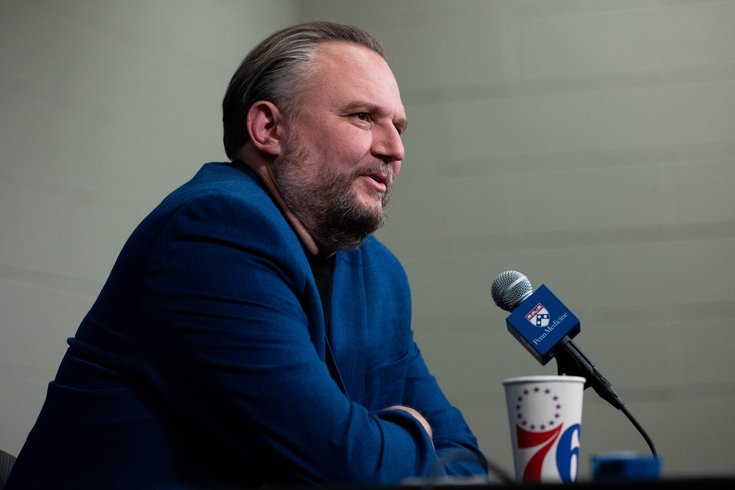
So, at the same podium he sat at when he made the "squint" comment a year earlier, Morey fielded questions about why he had shipped McCain to Oklahoma City for a 2026 first-round pick – projected to slot into the latter half of the round – and three second-round picks. He had traded McCain in the midst of a season that was clearly below his standard. Then, for the first time in six trade deadlines in Philadelphia, Morey failed to trade for a single player signed to an NBA contract. The Sixers entered the deadline with shaky depth and emerged from it with an even smaller group of rotation-caliber players.
"I'm quite confident," Morey said, "we sold high."
Morey's thought process, whether the McCain trade works out or not, was sound: if McCain floundered on head coach Nick Nurse's bench for the remainder of the season, there was no chance the Sixers would have fetched such a return for him. A high-ranking Sixers official recently pointed out how few players selected in that region of the board in McCain's draft would still net their team such a return. But that does not mean the trade had to be made.
As McCain has found his form and become a meaningful contributor for the defending champions, the "sold high" comment has taken on a life of its own and been mocked routinely. The connection that Sixers fans felt to McCain has intensified the frustration a great deal. McCain's wide smile and refreshing honesty made him a fan favorite. People were excited to watch his career unfold the way they did with Maxey. The Sixers marketed McCain heavily; he was very much presented as a long-term piece.
The Sixers own the No. 22 overall pick in the 2026 NBA Draft now; even with Morey gone, there is pressure to execute with that selection to ensure the McCain trade is not remembered even more harshly.
McCain's likability added to the sting of a trade that Sixers fans still resent, but so did the fact that Morey did not replace him adequately. The roster spot previously occupied by McCain went to veteran guard Cam Payne, signed by the Sixers out of Serbia. When Payne suffered a late-season injury, the Sixers waived him and signed two-way wing Dalen Terry to a standard contract. It was an unproductive use of the roster spot.
Morey commented after the deadline that there were no "needle-movers" traded to contenders in the Eastern Conference. Some took that as a shot at James Harden, who went from the Los Angeles Clippers to the Cleveland Cavaliers in a surprise swap for Darius Garland. Morey was adamant that his front office worked hard to try to bolster the roster; even in the immediate aftermath of George's suspension, the Sixers had the ability to capitalize on the momentum Embiid generated with a brilliant January.
Morey said that the team traded McCain for the package of picks slightly in advance of the deadline to give itself an opportunity to repurpose them in another trade that improved the roster.
"Nothing materialized," Morey said. "...I do want folks to know that this team, we think, can make a deep playoff run as one of the top few teams in the East. We feel like that's still the case going forward."
Morey later added: "I'd say we were trying to add to the team, and we didn't find a deal that made sense, that we thought could move the needle on our ability to win this year."
While the Sixers have not necessarily coveted depth to the same degree as other teams in the NBA in recent years, it was clear in February that their crop of role players was not up to par. They could have used another guard; in March, the Sixers were forced to play 39-year-old Kyle Lowry for an extended period due to injuries piling up. They could have used a playable wing; Justin Edwards' growth stopped and started throughout the season, and he failed to secure a surefire rotation role. They could have used an additional big they could trust; Andre Drummond and Adem Bona were erratic behind Embiid.
In the end, the Sixers' attempts to backfill McCain's roster spot with a rotation-caliber piece were fruitless, but they did take place. A source with knowledge of the team's strategy entering the deadline indicated the focus was on adding cost-effective role players with multiple years of control.
The Sixers, the source said, offered the Chicago Bulls multiple second-round picks for reserve big man Jalen Smith; Chicago held onto him. Their primary target, PhillyVoice learned, was Aaron Wiggins, one of Oklahoma City's many trusted reserves. There was hope that the talks with the Thunder about McCain could lead to a deal also involving Wiggins – the Sixers would have needed to send out multiple other players in the process – but ultimately the deal ended up centering around McCain, with Wiggins staying put in Oklahoma City, where he has recently fallen out of the rotation thanks in part to McCain's arrival.
The Sixers' efforts to land two other targets, Houston Rockets forward Tari Eason and Saddiq Bey of the New Orleans Pelicans, also did not lead to a deal (neither player was traded).
Among other players the source said the Sixers made runs at, unsuccessfully: Naji Marshall of the Dallas Mavericks, Donte DiVincenzo of the Minnesota Timberwolves, Brandon Podziemski of the Golden State Warriors and Ryan Dunn of the Phoenix Suns. None of those players were moved.
Minnesota made perhaps the most impactful deal in the Western Conference by acquiring guard Ayo Dosunmu from Chicago. While the Sixers liked Dosunmu’s fit, he was not a prioritized target because of his status as a soon-to-be unrestricted free agent.
One player the Sixers liked but did not make a move on quickly enough: Vít Krejčí, a sharpshooting wing on a very cheap, long-term contract. The Atlanta Hawks sent Krejčí to Portland four days before the deadline, receiving two second-round picks from the Trail Blazers. The Sixers, who have an abundance of future second-rounders available to be dealt, were not ready to make a trade with so much time left before the deadline, the source said, adding they likely would have done that deal had it been available a few days later.
Krejčí would certainly not have been a "needle-mover" – he was not a playoff rotation player for Portland – but he would have represented a new lever Nurse could pull. He would have given the Sixers a bit more optionality on the wing and some much-needed three-point shooting. But the Sixers misread Krejčí's market and, in turn, mistimed their efforts to acquire him, the source said. When the deadline came and went without the Sixers adding a single player to their roster, that relatively minor miscue probably stung more than it typically might.
The Sixers' next four games after that triumphant night in Boston went like this: 39-point loss, six-point loss, 14-point loss, 30-point loss. Via a second-round sweep by the New York Knicks, the season was over. Nurse and most of his players conducted exit interviews with reporters on Sunday, in the immediate aftermath of the Sixers' season-ending Game 4 loss.
A Sixers spokesperson said before Sunday's batch of press conferences that Morey's end-of-season media availability had to be delayed because he was already on his way to the NBA Draft Combine in Chicago, which had started earlier that day. But according to The Philadelphia Inquirer, the decision for Morey and the Sixers to part ways was made following a meeting that took place in Philadelphia between the executive and ownership on Tuesday.
And so, a controversial tenure for a controversial executive with a controversial team reached its end. And for all of Morey's successes – getting the franchise back on track after a miserable 2019-20 season which prompted Sixers ownership to aggressively court him, drafting Maxey at No. 21 overall in the 2020 NBA Draft and selecting Edgecombe third in 2025, creating an environment in which Embiid could become an NBA MVP, turning an unhappy Ben Simmons into Harden and turning an unhappy Harden into a strong collection of draft picks – there were failures, too.
The Sixers, infamously, have still not appeared in the Eastern Conference Finals in over two decades. Morey never built a team in Philadelphia that won more than one playoff series. His work on the margins was largely strong, but he also made many untimely blunders, ranging from waiving a young player right before he broke out to swinging and missing with a deadline addition when his team needed a jolt.
The ultimate sins of Morey's tenure both came in the 2024 offseason. His decision to trade Harden for draft picks and expiring contracts enabled the Sixers to enter that summer armed with enough cap space to sign a max contract and slot a third star in between Embiid and Maxey. That became George, who at the time was believed to be the perfect fit. Some had concerns about how an injury-prone player closer to the end of his career than the beginning would hold up over the life of a four-year contract worth more than $200 million. Morey pulled the trigger anyway. Months later, Embiid put pen to paper on a three-year supermax extension.
In the Boston series, Embiid and George showed signs of their previous excellence. But neither player met the moment against New York, and neither has been consistently available in a long time. In two regular seasons together, George has played in 78 games and Embiid has logged only 57 appearances. George is owed just over $110 million over the next two seasons. Embiid's extension is about to kick in, and he will make nearly $200 million over the next three seasons.
George has been a disappointment, and Embiid is widely considered to be playing on the most onerous contract in the NBA. Given the importance of every dollar in today's league, it is just about impossible to realistically imagine another team even entertaining the idea of taking Embiid's deal off the Sixers' books.
Plus, the relationship between Embiid and Morey – once extremely strong – appeared to worsen throughout the season. Over the summer, a long-form profile of Embiid by ESPN included quotes from Embiid about his feeling that the organization has not always protected him. One relevant quote from Embiid within Dotun Akintoye's reporting:
"In those situations, you wish some of the people upstairs kind of had your back and were like, this is not OK," he says. "You're not playing."
Before the deadline, Embiid publicly commented that he hoped the Sixers would add to their team instead of "ducking" the luxury tax. Maneuvering below the luxury tax threshold yet again made for a gripe with ownership, but their lack of in-season additions made for a gripe with Morey.
Then came a day in early April when the Sixers were getting set for a road game against the Washington Wizards. Suddenly, Embiid – who had recently said in a postgame interview that he was dealing with a sickness the Sixers had never listed on their injury reports – was ruled out for the game with an illness. Embiid sent two tweets disputing the reports that he was out:
Must be APRIL FOOLS joke???? Played against Miami in the same conditions and I’m planning to play tonight!!! #SweatItOut https://t.co/EAMq2679u2
— Joel Embiid (@JoelEmbiid) April 1, 2026
I guess they won’t let me play basketball!!
— Joel Embiid (@JoelEmbiid) April 1, 2026
"I was pissed off," Embiid said. "I wanted to play basketball."
Embiid sat the following night on the second leg of a back-to-back. Then he scored 34 points and logged 39 minutes in a loss to Victor Wembanyama and the San Antonio Spurs, even though his unspecified illness had not gone away. Two days later, the Sixers suddenly ruled Embiid out ahead of the most important game remaining on their schedule. His designation: "illness."
Shortly thereafter, the Sixers made an announcement: Embiid had been diagnosed with appendicitis. He was already headed to the hospital for an appendectomy.
After Embiid's shockingly quick return – in time for a Game 4 loss to Boston, putting the Sixers in that 3-1 hole – he was asked about the state of his relationship with Morey and management. He declined to address it, saying his focus was on playoff basketball and trying to help his team win. After the Sixers' elimination, Embiid was posed a similar question. He talked about loving Philadelphia, wanting to win as a member of the Sixers and the need for everybody to be better in order to make it happen. His repeated refusal to acknowledge Morey was telling.
Recency bias is a powerful thing, and Morey will be remembered for how this ended. The Embiid-centric chaos, the final trade deadline – from the McCain deal many fans do not want to get over to the lack of roster reinforcements to replace him – and the burdensome contracts he gave Embiid and George.
Most importantly, Morey will be remembered for the fact that the Sixers never came all that close to winning a championship during his six-year tenure.
Morey still believes that top-end talent trumps depth every time. His fatal flaw in Philadelphia turned out to be the two massive deals he handed out to Embiid and George in 2024. And for an extremely frustrated city now teetering on apathy when it comes to this team, Morey became the symbol of what fans have grown to resent about this era of Sixers basketball.
Now, it will be up to Morey's successor – set to be picked by Bob Myers – to emerge from this difficult spot. That person will not be without resources; the Sixers have plenty of draft picks at their disposal and possess two formidable long-term building blocks in Maxey and Edgecombe. Parts of Morey's track record suggest he was equipped to handle this. Other parts cast doubt upon that notion.
Not even Morey's harshest critics would argue he is solely responsible for the issues plaguing the Sixers – Josh Harris and the rest of Sixers ownership are even less popular than Morey around these parts – but in the end, Morey paid the price for the hole that he dug.
It is now someone else's mess to clean up.