




May 18, 2026

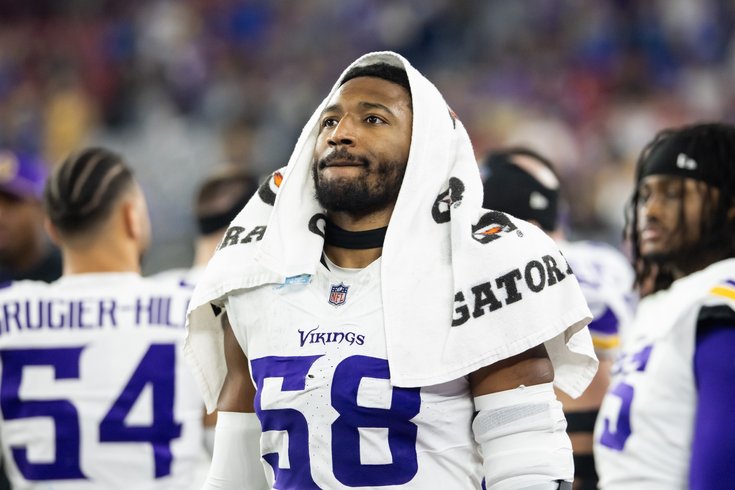 Mark J. Rebilas/Imagn Images
Minnesota Vikings linebacker Jonathan Greenard (58) against the Los Angeles Rams during an NFC wild card game at State Farm Stadium.
The Eagles' group of edge rushers was somewhat remade this offseason.
Returning are third-year pro Jalyx Hunt and fourth-year pro Nolan Smith Jr., who had his fifth-year option picked up by the Eagles.
The rest of the group is made up of newcomers, with the trade for Pro Bowler Jonathan Greenard intended to replace the loss of Jaelen Phillips in free agency, along with depth signings in Arnold Ebiketie and Joe Tryon-Shoyinka. They also used a seventh-round pick on Keyshawn James-Newby, an undersized prospect with 4.3 speed.
The biggest change, of course, is going from Phillips, who gave the Eagles' defense a major boost last season after being acquired at the trade deadline for a third-round pick to Miami, to Greenard, who was acquired from the Vikings in a deal that cost the Eagles two third-round picks and an extension for Greenard.
At the time of the Greenard trade, it was easy to see the deal as Howie Roseman's typically shrewd Plan B to replace an impact edge defender in Phillips, who signed a blockbuster deal with the Panthers worth $30 million annually.
Phillips' departure left the Eagles with a gaping hole on the edge. Getting a Pro Bowl pass rusher with two seasons of at least 12 sacks to replace Phillips when the rest of the free-agent market offered nothing comparable seemed like another Roseman coup.
The Eagles clearly believe their three-man EDGE rotation of Greenard, Hunt and Smith is – at very least – as good as last year's top three of Phillips, Hunt and Smith.
From a stats viewpoint, Greenard and Phillips have some similarities, and both have also dealt with injuries in their careers. But there are also some differences between them.
Let's compare:
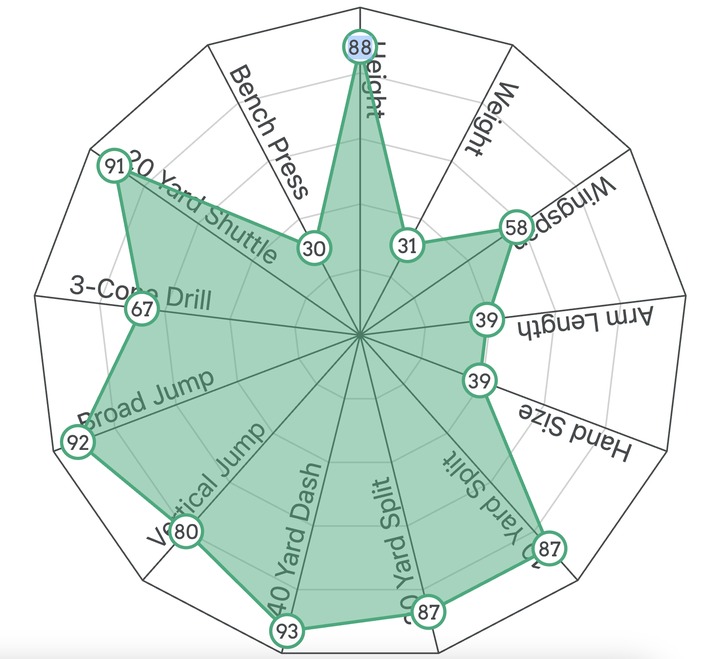
The great thing about Phillips' addition last season at the trade deadline was that he had the perfect size, length and athleticism for the position – 6-foot-5, 260 pounds, and an exceptional athlete coming out of Miami. That's why he was a first-round pick. Phillips is now listed around 266 pounds.
Greenard is a little shorter, and around 263 pounds, but he has longer arms. Unlike Phillips, Greenard didn't test very well at the combine.
Take a look at their spider charts, starting with Phillips:
Here's the one for Greenard:
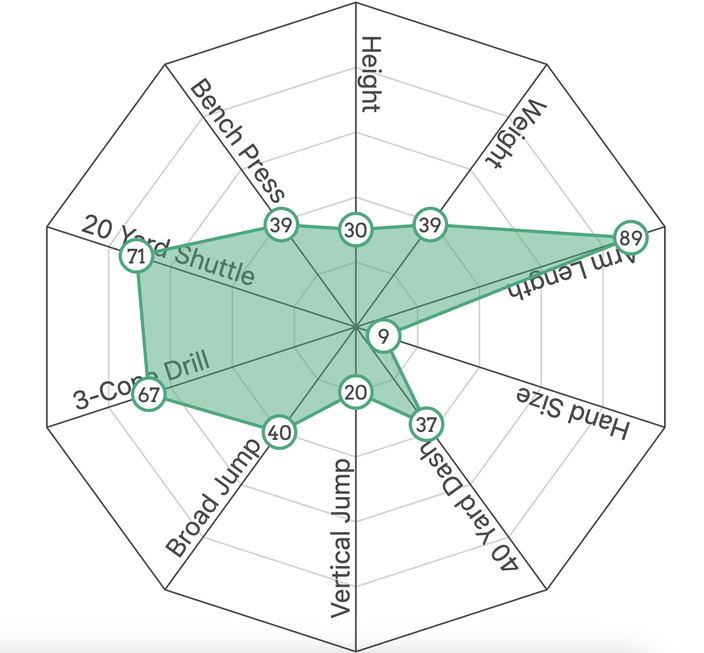
But modest athletic testing hasn't stopped Greenard from becoming one of the NFL's top edge rushers. He's generally known for his speed and quickness off the line of scrimmage.
In 2024, his last full season, Greenard actually had the third-fastest get-off (0.79) for any NFL player with at least 450 pass-rush snaps, per NFL Pro. The only players with a faster get-off were Myles Garrett (0.70) and Trey Hendrickson (0.74), two players the Eagles have shown prior interest in acquiring. Phillips came in at 0.91, a significant difference, although Phillips only played four games that year.
(For those who are analytics illiterate, "get off" is how fast a defender crosses the line of scrimmage after the ball is snapped. It's not a totally meaningful data point, but it's also not completely meaningless).
Phillips' best career get-off time was 0.84, as a rookie. Greenard logged a 0.77 in 2023, the best of his career, and last year registered 0.80 in 12 games.
So despite coming out of Florida with lower athletic testing scores than Phillips and not being known as sudden or twitchy, Greenard has ranked among the NFL's best at getting off the line of scrimmage quickly.
On paper, Greenard looks like a major upgrade over Phillips in pass-rush data. Phillips have never had more than 8.5 sacks in a season and for his career average just 0.44 sacks per game Greenard 38 career sacks – 10 more than Phillips – and averages just under 0.50 sacks per game.
Here are the three best sack seasons for each:
| Phillips | Sacks |
| 2021 | 8.5 |
| 2022 | 7.0 |
| 2023 | 6.5 |
| Greenard | Sacks |
| 2023 | 12.5 |
| 2024 | 12.0 |
| 2021 | 8.0 |
But underlying data suggests that their impacts in the pass rush are almost identical.
Last year, in Phillips' first full season since 2022, he registered a 15.9% pass-rush win rate, tied for fifth-highest in the NFL, per NFL Pro, behnd only Micah Parsons (20.7), Nik Bonnito (20.2), Will Anderson (19.5) and Myles Garrett (16.3). Greenard, again limited to 12 games, wasn't far behind at 15.4% on just 267 pass rushes.
Here are the pressure rates from each player's three best (and healthiest) seasons:
| Phillips | Pressure % |
| 2022 | 16.4% |
| 2025 | 15.9% |
| 2023 (8 G) | 15.2% |
| 2021 | 12.7% |
| Greenard | Pressure % |
| 2023 (15 G) | 16.0% |
| 2025 (12 G) | 15.4 % |
| 2024 | 13.4 % |
| 2021 (12 G) | 11.8% |
When the Eagles acquired Phillips last season, it was also viewed as a boost to the team's run defense, which had struggled at times in the first half of the season.
Data shows the Eagles only improved slightly against the run after acquiring Phillips, which coincided with Nakobe Dean's increased playing time after missing the first five games and not playing more than 60 percent of the snaps until Week 8.
Per PFF, Phillips scored a 59.4 in run defense last year, perhaps due to the body toll from injuries he sustained in 2023 and 2024 that limited him to just 12 games in a two-year span. In 2022 and 2023, his grades were 75.1 and 77.7, respectively.
Greenard scored a 77.8 last year in 12 games, also per PFF, and hasn't scored lower than 69.7 in any of his past four seasons, so there's reason to believe the Eagles are getting an upgrade in run defense.
SIGN UP HERE to receive PhillyVoice's Sports newsletters.
Follow Geoff on Twitter/X: @geoffpmosher
Like us on Facebook: PhillyVoice Sports