


February 17, 2026
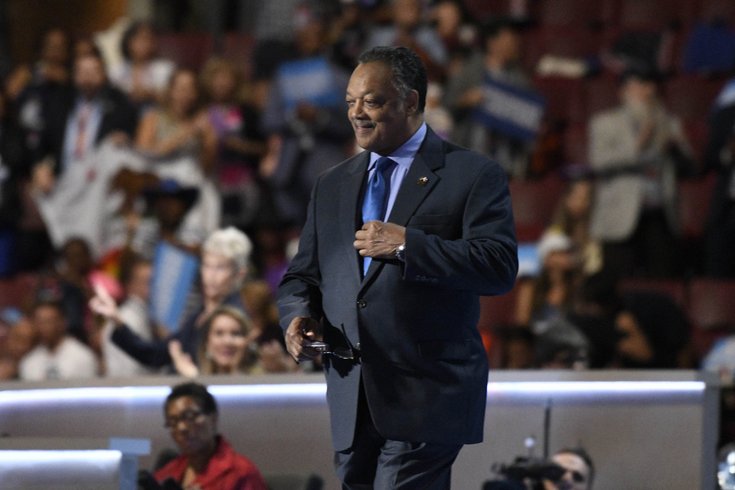 Robert Hanashiro/Imagn Images
The Rev. Jesse Jackson, pictured above at the 2016 Democratic National Convention in Philadelphia, campaigned in the city for W. Wilson Goode in the 1983 Philly mayoral race.
The Rev. Jesse Jackson, the civil rights leader from South Carolina who spent much of his life in Chicago, would seem an unlikely choice to shake up the Philadelphia mayoral race. But he sparked a monthslong media cycle in 1983 when he visited Temple University to endorse W. Wilson Goode, the man who would become the city's first Black mayor.
Jackson, who died Tuesday at the age of 84, had just helped Harold Washington clinch the Democratic nomination in the Chicago mayoral election when he arrived in Philly. Washington pulled an upset over incumbent Jane Byrne and Richard M. Daley, son of six-term mayor Richard J. Daley, in the primary race with the support of Jackson's civil rights group People United to Save Humanity (PUSH). Later that spring, Washington became Chicago's first Black mayor.
Jackson believed a similar path was possible in Philadelphia. Speaking to a crowd of roughly 400 people in the Temple student center that February, he urged Black voters to mobilize for the upcoming election.
"We've got political power, but if we don't use it, we'll lose it," Jackson said.
Calling Goode a candidate with "intelligence" and "integrity," he told the audience that "right here in Philadelphia, nothing stands between you and the political promised land." It was a comment he made before the speech, however, at a conference with Black journalists, that generated the most headlines.
"The overwhelming tendency is that whites vote white, Blacks vote white and there's nobody left to vote Black," Jackson said. "The newest thing going is that we're beginning to vote for ourselves so as to establish some balance of power."
That's not the quote that ran in some newspapers following the event. Many readers saw this version instead:
"Whites vote white, Blacks vote white and there's nobody left to vote Black. Now, the newest thing is to simply vote Black."
These comments did not match subsequent reviews of audio transcript from the news conference, and the papers that printed it issued corrections. But it was natural fodder for Goode's rival for the Democratic nomination.
Frank Rizzo had not been mayor for three years at that point — though not for lack of trying. He had lobbied to change the city charter to allow him to serve a third consecutive term in 1978 as his second neared its end. His campaign had failed, partially due to an inflammatory statement of his own: "vote white."
Rizzo, known for conducting brutal raids of Black and queer communities as police commissioner, seized on an opportunity to stoke racial animus in his 1983 bid. His campaign said it was "very saddened" by Jackson's misquoted remarks and pressed Goode to rebuke them. Goode did, though his disavowal and the corrections to Jackson's comments did little to quell Rizzo.
In the ensuing months, the former mayor called Jackson a "racist" and compared Washington to Al Capone. He also continued to link Jackson to Goode, despite the latter's own distancing from the former.
"His friends I find reprehensible, Jesse Jackson's friends and Wilson Goode's friends," Rizzo reportedly said at a late March news conference. "Jesse Jackson is his friend. He came in town and supported him. Why did Jesse Jackson do that?
"I have photographs of him hugging Yasser Arafat and Col. (Gaddafi) — two lunatics, two terrorists. I wouldn't be found dead in the same room with either one of them."
Jackson had publicly met with Arafat, but Rizzo never furnished those promised photos with Gaddafi; Jackson's staff said they had never spoken. The reverend was a fixation for Rizzo, who also ranted about "carpetbaggers" like Jackson propping up his political rival. He even issued a threat after Jackson led a chant of "we want it all" in Chicago following Washington's primary victory.
"Jesse Jackson is way out of line," Rizzo said. "I saw him on national TV and he said, 'We want it all,' and that frightens me. Nobody gets it all. It's got to be shared. We live in a democracy. ... And when he's spewing his venom, 'We want it all,' my blood boils. And I hope when he tries to take it all I'm around."
These attacks did little to help Rizzo with Philadelphia voters. Goode was polling roughly 20 points ahead of him in April, and though his lead narrowed, he finished the Democratic primary in May with 53% of the vote to Rizzo's 46%. The defeated candidate tried two more times to reclaim the mayor's office — including one more run against Goode in 1987 — to no avail. Rizzo died of a heart attack in the middle of his last campaign in 1991.
As for Goode, he served two consecutive terms and later took a job as Deputy Assistant Secretary of Education for the Clinton administration. When Jackson ran for president in 1984, he endorsed Walter Mondale instead.
Follow Kristin & PhillyVoice on Twitter: @kristin_hunt
| @thePhillyVoice
Like us on Facebook: PhillyVoice
Have a news tip? Let us know.