


July 16, 2026
 Michaela Althouse/PhillyVoice
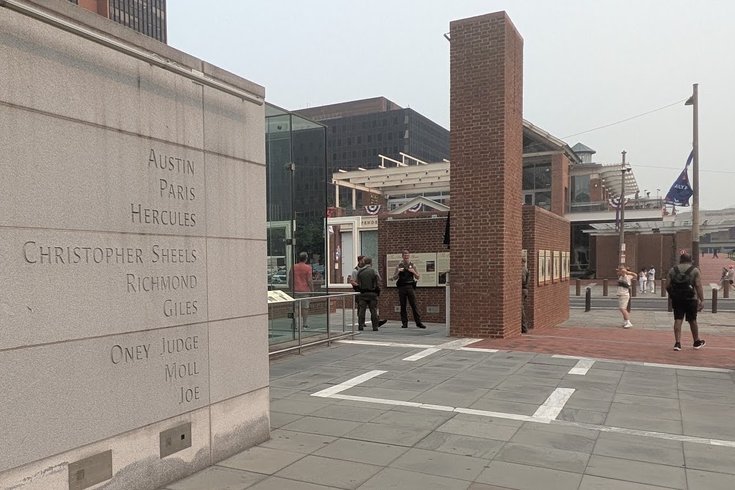
The 11 new panels at the President's House exhibits provide a softer image of George Washington's role in slavery, according to some historians. Above, officers with the National Park Service patrol the site.
In the original exhibits at the President's House, a panel titled "The Dirty Business of Slavery" showed how the number of enslaved Africans in the United States grew by nearly 200,000 from 1790 to 1800. In the new installation, which was erected this week, those same figures can still be found, but the language around them has changed on a panel that's now titled "Presidents Washington and Adams on Slavery."
Earlier this month, the federal government ruled that the Trump administration could put up new displays at the Independence National Historical Park exhibits, which opened in 2010 at Sixth and Market streets as a dedication to the nine people enslaved by George and Martha Washington during his time as president. The decision followed a months-long court dispute over the site's future after the federal government removed 34 panels from the site in accordance with an executive order to eliminate "divisive narratives" from national parks.
Some historians and activists say the 11 new panels that were installed overnight Tuesday into Wednesday morning soften the language around Washington's role in slavery in the country.
"As a George Washington biographer and presidential historian, I see this as a depraved act of historical erasure," New York Times best-selling author Alexis Coe wrote on X earlier this year.
The Interior Department said the new "panels are full of historical context and highlight the momentous events that took place in the President’s House and the other sites at Independence National Historical Park,” according to a statement to the Associated Press.
Some parts of the site remain the same, such as the physical structure, the names of the nine people enslaved by Washington and the bronze footprints documenting Ona Judge's escape. But TV screens that used to feature reenactment videos have been turned off, and officers from the National Park Service were at the site Wednesday and Thursday.
On Wednesday, Philadelphia Mayor Cherelle Parker said she was committed to restoring the original exhibits.
"Overnight, under the cover of darkness, the federal government removed panels at the President's House that told a thorough history of Philadelphia," she said in a statement. "It was allowed to do this by the decision of the federal court, but that it did so at night shows it understands this action is shameful, that it violates community trust. Which it is and which it does."
Another group called Avenging the Ancestors Coalition, which has fought to maintain the site's initial display, said it plans to challenge the latest legal rulings in order to return the original panels.
Here's what has changed, and how it compares to the original panels.
In the new exhibits, Washington is portrayed as a humble military leader who secretly wanted an end to the slave trade.
"Caught between his private doubts about slavery and his public responsibilities as president, George Washington navigated a nation deeply divided over slavery," one panel reads.
Later on, it notes that slaves moved in and out of the household.
"Washington rotated enslaved persons in and out of the state in acknowledgement of a Pennsylvania law requiring slaves to be set free after six months in residence," it says. "Slaves living in the President's House experienced a greater modicum of autonomy than elsewhere in the South, such as to explore the city and sometimes even attend the theater, with Washington buying the tickets."
Mijuel Johnson, a history tour guide with the Black Journey walking tour, told the Inquirer that there's inaccuracy in using a word like "autonomy," noting that "you have no self-governance as a slave."
The original panels offer a different interpretation in a section titled "Washington's Deceit."
"President Washington, when reminded of the Abolition Act, chose to rotate some of his enslaved servants to Virginia to prevent them from claiming their freedom," it states. "His correspondence indicates that he wanted to do this in secret."
Both panels note that Washington freed the people he enslaved upon his death, and that he wanted the people Martha enslaved to be freed upon her death. They both also say Washington signed the Fugitive Slave Act, which allowed for the recapturing of escaped slaves.
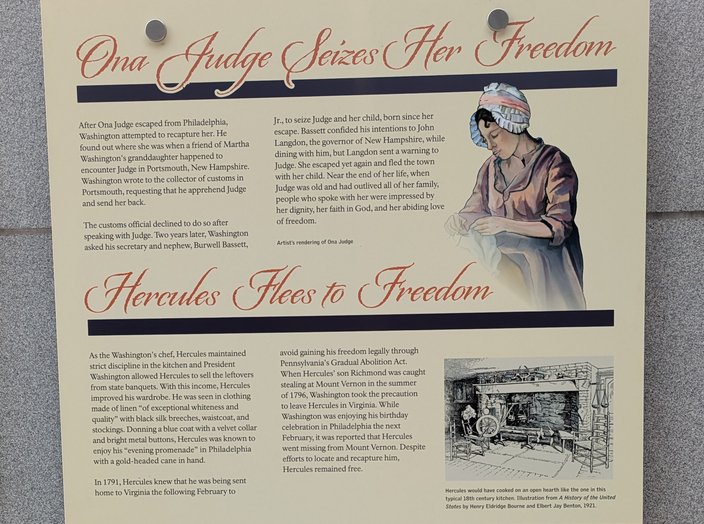
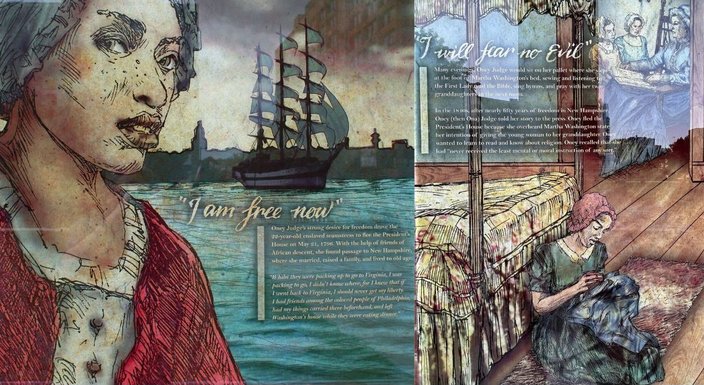
The original exhibits feature the story of Ona Judge, a seamstress who successfully escaped the Washington household, that's told in panels and a short video. One panel features a direct quote from Judge.
"Whilst they were packing up to go to Virginia, I was packing to go, I didn't know where; for I knew that if I went back to Virginia, I should never get my liberty. I had friends among the colored people of Philadelphia, had my things carried there beforehand, and left Washington's house while they were eating dinner," it says.
Judge's name and the story of her escape appear on several panels in the original exhibits. In the new one, she's mentioned in a section about the members of Washington's household, and on half of another panel that also includes the story of Hercules, another enslaved person who escaped the house.
A panel at the new exhibit tells the stories of how Ona Judge and Hercules escaped the President's House.
The original panels, above, featured illustrations about the life and escape of Ona Judge.
Panels with biographies about Abigail Adams, John Adams, Robert Morris, George and Martha Washington and Benedict Arnold were also added to the exhibits.
The original panel titled "The Dirty Business of Slavery" includes information on how the slave trade began, the Three-Fifths Compromise, the types of goods that created a demand for slave labor and Philadelphia's role as a major port city importing some of these goods. It also notes how liberty, which was a key part of the Constitution, was in direct contrast with the enslaved population, and features a timeline of slavery in the United States, from 1619 to 1942.
The new panel, titled "Slavery in the British Colonies," primarily focuses on the abolition movement, noting the Pennsylvania Gradual Abolition Act, Ben Franklin's Anti-Slavery Petitions, Black abolitionists in Pennsylvania and the role of the Quakers. In its paragraphs about the slave trade, the panel primarily notes Britain's role, with lines such as "The British wanted cheap human labor to harvest cash crops," and "British merchants soon began importing enslaved workers from Africa to the colonies."
While the original exhibits were meant to focus on the enslaved Americans in the house, the new one takes a broader view of America's history. Another panel called "Celebrating Independence Throughout the Years" also documents the various anniversary celebrations in the United States, leading up to the bicentennial in 1976. In describing the role of the executive branch, a new panel also notes that the president is the commander in chief and oversees the military.