




November 10, 2026
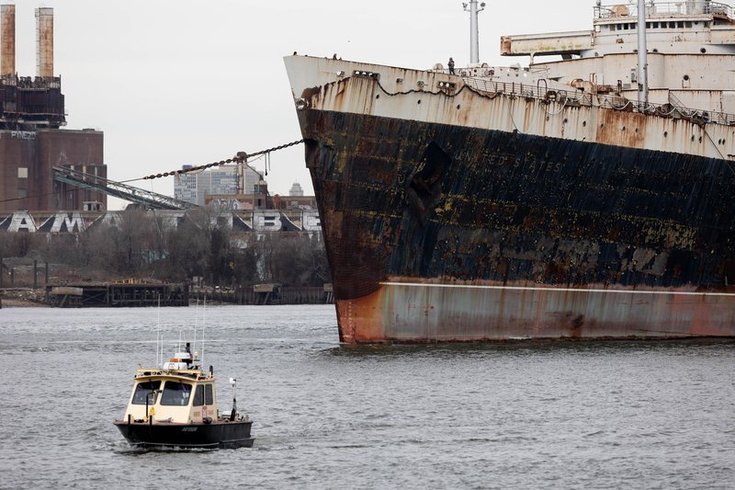 Colleen Claggett/PhillyVoice
The SS United States, shown above in 2025, was known for breaking the transatlantic speed record on its maiden voyage.
As the SS United States prepares for its final journey, it's only natural to think about its maiden voyage — the crossing that won it the transatlantic speed record.
The ocean liner, which spent decades docked in Philadelphia, is set to be sunk Wednesday off the coast of Florida and turned into the world's largest artificial reef. The sinking is happening a day earlier than originally scheduled.
MORE: Early 'Rocky' draft and poster signed by movie's cast are up for auction
The ship's legacy includes transporting movie stars, presidents and other celebrities, and appearing in films. But it also was known for traveling at top speeds.
Built from 1950-1952, the SS United States was constructed with more aluminum than had been used for any previous construction project in history, according to the ship's conservancy. The lightweight metal was meant to reduce its overall weight, allowing it to travel faster than any other vessel. It was designed to transport civilians, but it could be quickly transformed into a military ship, if needed.
The ship's top speed was classified information for a long time, and crews were not allowed to fully test how fast it could go, according to the Statue of Liberty & Ellis Island Foundation. But during a trial on June 10, 1952, the ship recorded a speed of 38.22 knots — about 44 mph.
Five days before the ship's first departure, about 70,000 people gathered in New York City for the ship's unveiling and to catch a glimpse inside. The line to get in stretched 14 blocks, the conservancy says.
Finally, on July 3, 1952, the ship set sail from Ambrose Lightship, the entrance to New York Harbor, helmed by Commodore Harry Manning, a former co-pilot of Amelia Earhart. The departure was timed to coincide with Fourth of July celebrations.
Even before the ship left, many speculated that it would be a record-breaking journey. But Manning said little about that possibility. On its first day out, the SS United States encountered a heavy fog that slowed it a little. Once that cleared, he ordered the crew to increase the engines to full power.
Three days, 10 hours and 40 minutes after departing New York, the SS United States passed Bishop's Rock off the coast of Cornwall, England at 6:16 a.m. British Standard Time on July 7. It marked the fastest any passenger ship had ever crossed the Atlantic Ocean. A few hours later, the ship arrived at the port of Le Havre, France. It traversed the Atlantic at a similar speed on its return voyage to New York, too.
During both the trip to Europe and back, the ship broke the record that had been set by the RMS Queen Mary in 1938. It was the first American ship in 100 years to earn the Blue Riband, which is given to the ship with the fastest transatlantic crossing. It still holds the record for a passenger ship.
That crossing also was meant to be luxurious for passengers. The ship was stocked with 7,935 quarts of ice cream and 500 pounds of caviar for the travelers. Passengers included the likes of comedian Milton Berle, who was on the ship on its trip back to New York City on July 15.
Still, the trip wasn't quite as pleasant for passengers as it could have been, given the weather conditions during the journey from New York to France. Heavy seas, high winds and the fast speed meant most travelers stayed inside or in closed promenades.
"So strong was the wind speed that the adventurous few who did venture out onto the open decks likened facing forward to being punched in the face," the ship's conservancy wrote of the journey. "Miraculously, the dreaded vibration expected on high-speed liners was virtually absent, even when the ship attained her highest-ever service speed of 36 knots."