





November 09, 2026
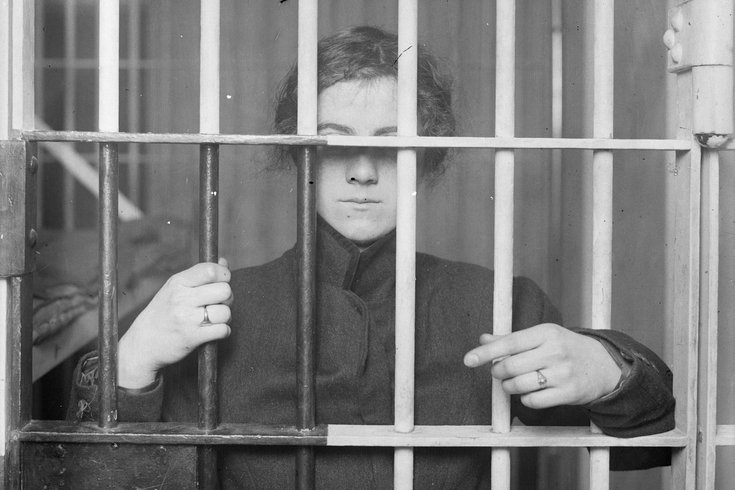 Provided Image/PBS/Denver Public Library
'Crime and Punishment in America' traces the emergence and evolution of penitentiaries, like the Denver institution depicted above. The series airs over four consecutive nights beginning Nov. 16 on PBS.
Perhaps no block in America encapsulates our nation's conflicting views on justice better than the stretch of Sixth Street between Chestnut and Walnut streets. At one end looms the brick facade of Independence Hall, where our country's founders declared freedom from British rule. Down the other is the former site of Walnut Street Prison, one of the earliest correctional institutions in the United States.
As the new PBS docuseries "Crime and Punishment in America" demonstrates, Philadelphia was an incubator for some of the nation's earliest concepts of retribution and rehabilitation. It was here that Founding Fathers like Benjamin Rush took up the philosophical debate of what we owed not just the victims of crimes but the people who committed them. That conversation never really ended, as the Ken Burns-produced series demonstrates over four, two-hour parts airing Nov. 16-19 at 8 p.m.
MORE: Was Rocky Balboa supposed to be a New Yorker?
"We seem to be circling around these questions perpetually without fully resolving them," series director Lynn Novick said.
Prior to the establishment of Walnut Street Prison and its successor, Eastern State Penitentiary, criminal punishment in the United States was much more public. Offenders were placed in stocks where their neighbors could gawk and jeer, and executions were widely attended. The Philadelphia Society for Alleviating the Miseries of Public Prisons, a reform group that counted Rush and Benjamin Franklin as members, pitched what was then a progressive alternative: solitary confinement. A portion of the overrun Walnut Street Jail was converted into a facility with 16 cells to test the potential of this proposal, leading to the launch of Walnut Street Prison in 1790. Eastern State Penitentiary built substantially on the experiment when it opened in 1829 with space for 250 prisoners.
"The reformation of a criminal can never be effected by public punishment," Rush wrote in a 1787 pamphlet. "... Experience proves that public punishments have increased propensities to crimes. A man who has lost his character at a whipping post has nothing left to lose in society. Pain has begotten insensibility to the whip, and shame to infamy."
Even in its day, Eastern State Penitentiary had its critics. Charles Dickens famously called its "rigid, strict and hopeless" system of solitary confinement "cruel and wrong" after his 1842 visit. Yet it was largely seen as a noble example for the rest of the country to follow, and it complemented America's burgeoning police forces.
Though the nation had previously relied on night watchmen and constables to maintain order, the explosion of nativist violence against immigrants in Philadelphia and other major cities in the mid-19th century overwhelmed these underfunded peacekeepers. Formal police departments emerged in response.
Novick, who will appear in conversation with WHYY at a screening Thursday, has been interested in criminal justice for much of her career. She made her solo directorial debut in 2019 with "College Behind Bars," a docuseries about incarcerated men and women trying to earn university degrees. That project was inspired by her first visit to a maximum security prison in 2012 through the Bard Prison Initiative. She was there to discuss "Prohibition," a documentary that Novick co-directed with Burns, and was struck by the classroom discussion.
"I personally was really blown away by the level of discourse that was happening in the classroom and the seriousness of the attention the students paid to the material," she said. "It was just a wonderful experience. And I walked out of there feeling that I needed to know a lot more about what was happening here and how come I didn't know much about it."
Novick divides her new series into four distinct eras. The premiere episode spans the foundation of America through the Reconstruction era. The second installment examines evolving theories on the "criminal type" from 1880-1920, while the third chronicles the rise of gangsters, organized crime and the FBI. The final chapter covers the modern era, from the Attica Prison riot on.
Some of these episodes feature commentary from Philadelphia District Attorney Larry Krasner. The reform-minded prosecutor discusses the harsh sentences for drug offenses that prevailed in 1970s and 1980s, as well as the landmark Supreme Court case of Gideon v. Wainwright. This court battle established the right to a lawyer, even for defendants who cannot afford one, in state and federal cases. But as the docuseries details, overburdened public defenders struggled to access the time and resources of prosecutors or private practices in the aftermath.
"It is inexcusable that we don't pay more — and by more, I mean a lot more — for public defenders and for court-appointed attorneys to handle these incredibly important cases," Krasner says in the third episode. "It cannot just be lip service to an actual right to have substantial assistance when the government wants your things or the government wants your freedom.
"Broke people get screwed."
The history of criminal punishment in America, like most histories, is rife with cycles of progress and backlash. In making this series, Novick strove to illustrate the ever-swinging national pendulum between "a more humane and compassionate approach" and a "more punitive, unforgiving approach." One of the archaic punishments covered in the first half of the documentary, public execution, nearly made a comeback just this year when the Trump administration considered live-streaming the death by firing squad of Nidal Hasan, the perpetrator of the 2009 mass shooting at Fort Hood. The president ultimately abandoned the plan.
Novick doesn't have an answer for why these regressions happen — though she finds Fordham University scholar John Pfaff's theory that fear-inducing events like 9/11 or the COVID-19 pandemic can increase public capacity for harsher laws and more policing "interesting." She simply hopes we can figure it out collectively by looking back.
"We haven't really challenged ourselves as a nation enough, in my opinion, to at least think about the underlying assumptions of why we're doing what we're doing," she said. "And then if you follow the logical chain of questions, you will get to a place of just really hopefully digging deep to think about how we could do better. It sounds very general, but I don't pretend to have a solution. I just think that the history helps us understand the problem a lot better."
Follow Kristin & PhillyVoice on Twitter: @kristin_hunt
| @thePhillyVoice
Like us on Facebook: PhillyVoice
Have a news tip? Let us know.