


October 26, 2026
 @BirdSafePhilly/Instagram
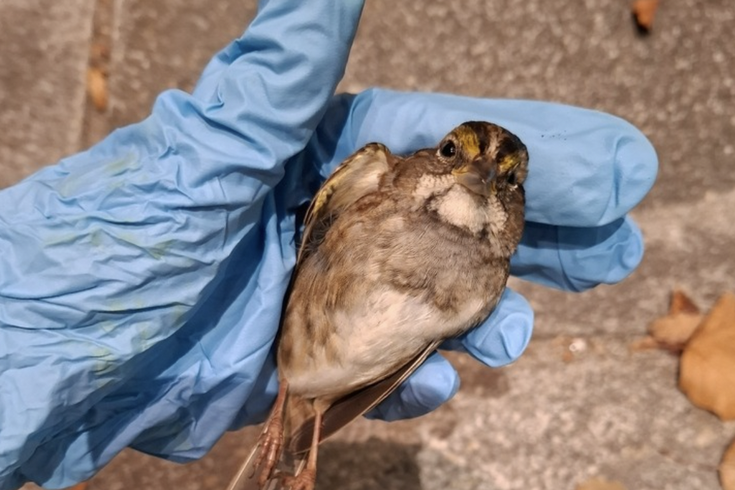
A Bird Safe Philly monitor holds a white-throated sparrow that collided with a building in Philadelphia in October. The volunteer group is among the region's conservation advocates who want more building owners to retrofit their windows and shut off artificial light overnight to protect migratory birds.
Keith Russell still has trouble shaking the memory of walking around to scoop up droves of dead and injured birds that had slammed into buildings on Oct. 2, 2020.
At the peak of their fall migration, more than 1,000 birds crashed into glass windows in a small area of Center City, marking one of the worst documented events of its kind in Philadelphia.
"We personally collected almost 400 birds that day, and we didn't get all the birds," said Russell, who's been the program manager for urban conservation at Audubon Mid-Atlantic since 2006. "That really is very, very disturbing, and it's a lot of work. It's very stressful."
The incident six years ago was a wake-up call for conservationists in the region. Bird advocates banded together to create Bird Safe Philly, an all-volunteer coalition that conducts regular monitoring and clean-ups in the city. Volunteers also work with building owners to encourage retrofitting glass windows to reduce the likelihood of bird strikes, which peak during spring and fall migrations along the Atlantic Flyway.
To date, Bird Safe Philly has recorded 132 different species that have hit buildings in Center City. Strikes can happen both during the day, when the sky's reflection in glass confuses birds, and at night when bright lights and weather conditions affect their visibility in urban environments. The Chicago area had a mass collision event this month that killed or injured more than 1,000 birds, prompting calls for the city to pass a bird-friendly glass ordinance.
Apart from reducing artificial light during migrations, the most effective way to deter collisions is using vinyl dot decals that can be placed on glass windows in a tight pattern most birds are able to recognize and avoid. The Elkins Park Library in Montgomery County retrofitted its windows earlier this year, joining a growing number of community buildings taking similar steps. The job costs anywhere from $1.50 to $10 per square foot, depending on the grade of the materials used, and decals may last anywhere from a few months up to 20 years before they deteriorate.
"Even though our awareness of this is increased and actions are being taken to address this, those actions are not keeping up with the number of buildings that are being created that are going to cause problems for these birds," Russell said. "Why should people care? If you like birds — and most people do — this is an entirely preventable source of mortality that's really driving down the population."
Various sparrow species, ovenbirds, warblers and common yellowthroats are among the species usually found on Philly's streets after collisions.
About 30 Bird Safe Philly volunteers conduct early morning surveys to collect wounded birds in Center City. This time of year, it's fairly common for monitors to find 25 birds or more during a single circuit. During one recent survey, volunteers counted 36 window strikes with 17 different species.
"Monitoring can be incredibly rewarding, but days like these can be hard to process," one Bird Safe Philly volunteer wrote in a Facebook post. "When multiple birds hit the glass in front of you, while you are documenting other window strikes, the tragedy is cutting and overwhelming to witness."
Many of the smaller bird species are left stunned and develop neurological issues. Larger birds are more prone to suffer internal injuries. Bird Safe Philly's drivers take injured birds to the Schuylkill Center Wildlife Clinic in Upper Roxborough, where Russell said the rehabilitation rate is better than 50%. How those birds fare when returned to the wild isn't well-known.
"This is an area of research that has just sort of started up, trying to tag these birds and be able to sort of follow their progress to see where they go and how long they live," Russell said.
Conservationists scored a major victory in 2021 when the city and business leaders formed the "Lights Out Philly" initiative to shut off as much artificial light as possible overnight during peak migration periods. Comcast's two towers, the BNY Mellon Center and One and Two Liberty Place, are among the buildings that voluntarily go dark from midnight to 6 a.m.
Russell said there are plenty of known problematic buildings in the city, but the sheer number of residential and commercial properties in cities is more of a cumulative issue for birds than specific hotspots for collisions. Calling buildings out publicly isn't how Bird Safe Philly envisions progress happening.
"One of our approaches is not to make buildings out to be the villains because the people that are occupying those buildings didn't design that building," Russell said. "The owners may be responsible for that, but this is an issue that needs to really evolve with architects."
As an example of effective deterrence, Bird Safe Philly partnered with Sisters Cities Cafe on Logan Square a few years ago to retrofit their glass. Russell said the business has seen a sharp reduction in collisions since then, and advocates are now doing similar work at libraries and environmental educations centers throughout the region.
"We've got to walk the walk if we're going to talk the talk," Russell said. "We're also trying to work with other building owners — government buildings and municipal buildings — to help them address collision issues."
In February, the National Fish and Wildlife Foundation awarded the Wildlife Management Institute and Bird Safe Philly a $496,100 matching grant for building retrofits, public education and the expansion of the "Lights Out Philly" initiative. Russell said the work is already paying off in places like Independence National Historical Park, where the Liberty Bell Pavilion and First Bank of the United States recently installed bird-friendly glass.
"I think they're important examples of the fact that there is buy-in to this. People are starting to to make changes to the way that their buildings are are operating," Russell said. "We're just hoping with the grant to be able to extend this work outside of the Philly area to the other counties and as we get high-profile buildings done, I think it helps."