




August 20, 2026
 Molly McVety/PhillyVoice
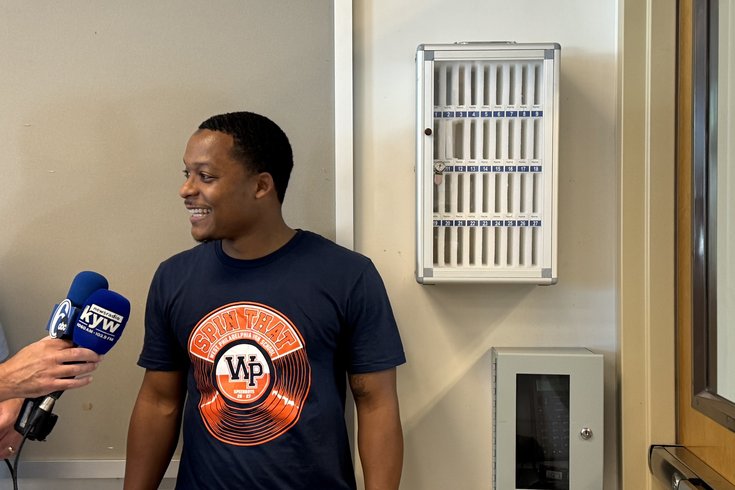
Eugene Letts Jr., climate manager at West Philadelphia High School, says aluminum cellphone compartments, pictured above his left shoulder, have improved student engagement.
The School District of Philadelphia discourages students from using personal electronic devices while inside district buildings. But with over 116,000 students across 249 schools, what works for one student body is not always effective for another.
Principals are given the discretion to determine what's most appropriate for their school’s needs. Administrators are required to collaborate with their local community about individual policies and, in some instances, use discretionary funds to finance solutions that keep students off their phones and focused on learning.
For Megan Wapner, principal of James Rhoads School in Mill Creek, requiring her K-8 students to keep their cellphones in Yondr pouches, magnetically locked personalized pockets, for the entire school day has been a game-changer.
"Prior to not being a cellphone-free school, children were not interacting," she said. "Now, they come in, put (cellphones) in the pouch and keep it there all day. … Now they can really focus on academics, social emotional learning and making meaningful friendships. … We have really seen a difference."
Less than one mile away, administrators of West Philadelphia High School say they have experienced the opposite effect of similar pouches. They recalled instances where students would forcibly break open their bags using methods they found on the internet or bring burner phones to class.
"Children were very anxious when they couldn't see their phones," said Marla Travis, principal of WPHS. “… They'd hold on to the pouch and (the devices) would beep, vibrate and (the students) would be upset for the rest of class."
For her 800 students, Travis instituted a new system at the beginning of the 2025-2026 school year that was inspired by the portable charging stations in the airport.
Before each class, students and teachers deposit their electronic devices inside a small aluminum cabinet installed in each classroom. The cabinet contains numbered styrofoam compartments, each assigned to one student for the year. Rather than confiscating the devices for the whole day, students are allowed to use their devices at lunch and when transitioning to a different class.
"We didn't want to just go away from phones throughout the whole school day because we know how important that is to students," said Eugene Lett Jr., climate manager at WPHS. "We want our kids to have that freedom. We understand the route technology is going … but not during instruction time."
Implementing the policy was not without its "bumps and bruises," Lett said, but within the first few months, the system began to function "like clockwork."
"There's no blasting music in class, no social media, it's strictly focusing on instruction," Lett said. "Kids have to talk now. They're not buried in their phone. They're communicating with their peers and engaging and participating in the lesson."
The high school employs quarterly surveys that evaluate the students’ relationships with their peers and staff members. Since the cabinet system was instituted, responses showed an increase in inter-personal relationships schoolwide, said Brian Camper, climate manager for WPHS.
"The relationships that we have in this building are really, really strong," Camper said. "It's a really good, positive thing with the cellphone policy."
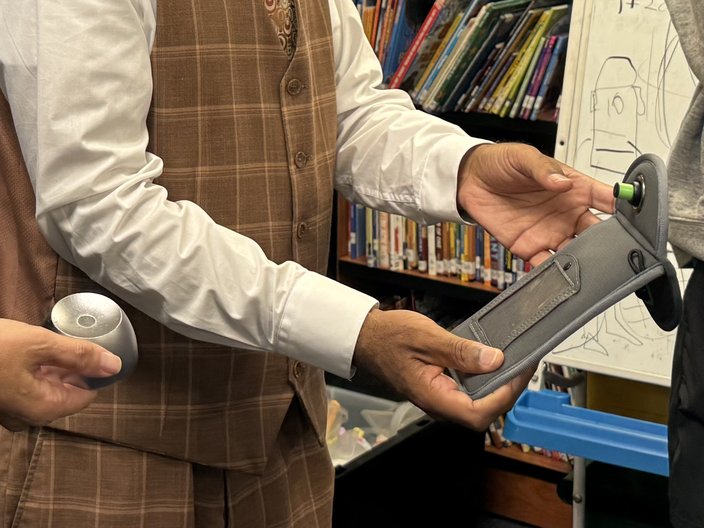
Officials at James Rhoads School demonstrate how to store cellphones in Yondr pouches.
Lamond Muhammed, climate manager at James Rhoads School, said that since Yondr pouches were required four years ago, students have felt safer in school and, in turn, are more engaged in their work. The school first heard of the concept from comedian Kevin Hart, who has asked audience members to put their devices in the pouches to cultivate a phone-free environment for his stand-up shows.
"We thought that was something that would be useful here," Muhammed said. "When I first came here, we had a lot of issues with violence, people recording teachers, recording fights and it was just dangerous. … It's cut down on distractions, cut down on potential group assaults. It's been really helpful."
After in-person restrictions brought on by the COVID-19 pandemic were lifted, Wapner said teachers struggled to engage with their young students, who were accustomed to nearly unfettered screen-time access.
Ian Nickischer, a middle school english language arts teacher at James Rhoads, witnessed the distracting nature of personal devices and said he's seen a noticeable improvement in his kids' behavior since the school instituted a phone-free environment.
"I can't compete with TikTok, I can't compete with Instagram Reels. I'm funny, but not that funny," he said. "Implementing Yondr pouches saw more engagement with the lessons, listening what I have to say, what their classmates have to say. … I know it's helping them learn."
Aside from the noticeable differences inside the classroom, Wapner said some of the most tangible differences have been seen in the lunch room and and on playground.
"Outside at recess, you will see children actually playing, coming together, making new friends, sitting at different tables," she said. "We want them to be present in the moment, even in the cafeteria, study hall, on trips. We want them to experience everything that makes them a whole human being."
While pouches and containers may work for some, not all schools plan to employ the same physical solutions to technology use.
Science Leadership Academy, a high school in Spring Garden, requires all students to store their phones in a designated station at the start of each class, and they may only retrieve devices with teacher permission. Roberto Clemente Middle School in North Philadelphia requires that all devices be powered off and handed to a climate manager or safety officer upon student entry.
Julia R. Masterman School in Spring Garden, which serves grades 5-12, doesn't require students to turn in or store their electronics, but officials say students must fully power off phones and tablets and keep them out of sight during instructional periods or a staff member will confiscate the device.
Monique Braxton, a spokesperson for the School District of Philadelphia, said the district has no plans to adjust its "multi-tiered" approach to the technology policy and has received "no complaints" from principals about their right to choose what's best for their students.
"We recognize the positive effects and challenges of the technological landscape," Braxton said in a statement. "We will continue to evaluate the most high-leverage strategies to accelerate academic achievement. We will also continue to listen and engage in discussions nationally and locally to remain informed on the best, research-based practices regarding electronic devices."
Other than district-wide changes that range from looming school closures to asbestos outbreaks and faulty air conditioning units, one of the more pressing matters for educators is taking place at the state level. Gov. Josh Shapiro (D) has publicly supported a statewide, bell-to-bell cellphone ban, and a bill on the issue passed the House of Representatives in June and will be considered on the Senate floor.
Even with some of the more stringent policies against cellphone use in Philadelphia, most schools — including West Philadelphia High School and James Rhoads — have exceptions for certain situations.
"Phones are a part of everybody's lives, so it might be a class or two where they incorporate their phones, whatever the lesson looks like," Lett said. "We have to be innovators … but we really harp on the teachers explaining this is not the norm.”
For Travis, her main concern with a statewide ban would be on her students' attendance rates.
"Children are very vulnerable and these phones are like their lifeline," she said. "I could see a percentage of children saying, 'Well, if I can't take my phone, I'm not going to school.' That's a problem. We would have to talk more in depth about what that ban would look like, but we have to get our kids to school."
Wapner sings a different tune.
"I'm fully in favor of no cellphones in school," she said. "We've seen such a difference and it has changed the culture. Absolutely."