




October 13, 2026
 Kate Frese/Kate Frese for PhillyVoice
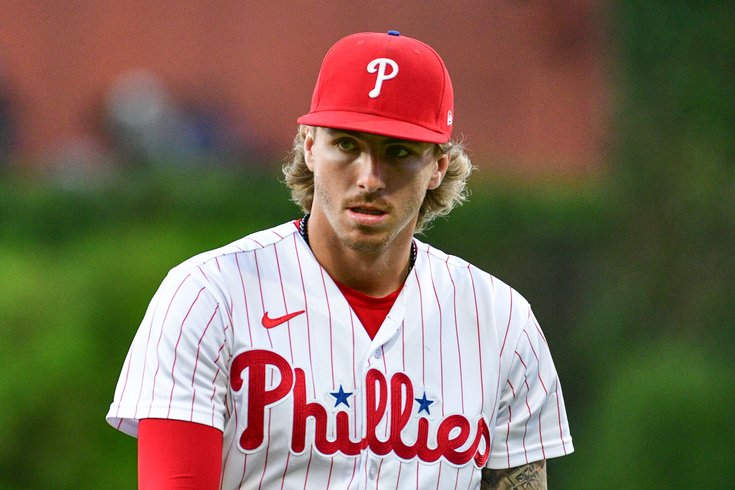
PHILADELPHIA, PA - SEPTEMBER 13: A photo from the Philadelphia Phillies game against the Atlanta Braves on September 13, 2023 at Citizens Bank Park in Philadelphia. (Photo by Kate Frese/PhillyVoice)
There is no risk of the Phillies losing Bryson Stott.
The sure-handed infielder is entering the final year of team control and arbitration will determine his 2027 salary — likely a raise from the $5.9 million he made this past season (projections agree it'll be around $9 million).
So why are we debating whether he should stay?
Philly needs to shake things up. And there are a ton of players on the team's ledger right now with immovable contracts. Stott's can easily be moved. If they want to open up a starting infield spot, and maybe replenish their lowly-rated farm system, a trade of Stott could be on the table.
The question we're aiming to answer here is, should they?
He's a former first-round pick who never truly broke out as a star, but also never embarrassed himself. He's a solid big league starter.
MORE STAY OR GO: Bullpen arms | Alec Bohm | Luis Arráez
Edmundo Sosa | Dave Dombrowski | Don Mattingly
He's their best defensive infielder
Somehow, Stott's mantle still lacks a Gold Glove Award. He just turned 29, so there's still time. Over more than 1,300 innings last season, playing second and third base, Stott had just four errors (a .992 fielding percentage). His .994 fielding percentage over the last five seasons at second base, according to Baseball-Reference, is an all-time MLB record. He brings range and versatility — he is a natural shortstop and can play there too.
He's basically a more reliable, every day version of Edmundo Sosa. He probably could play in the outfield too (but why would they ever sacrifice his infield defense?). On a team that trotted Alec Bohm and Trea Turner out every day, Stott's defense was a huge asset and often times masked the weaknesses on defense at the other infield spots.
He's going to be (relatively) cheap
Sure, the Phillies could trade away Stott and fill his infield role with a star player — Bo Bichette might be available — but the value they'll get for Stott, who probably won't make more than $10 million in 2027, is pretty high.
Turner and Bryce Harper, his double play tandem, remain among the highest paid athletes in the sport. There is no salary cap in baseball, at least not yet, but Stott carries with him the same sort of value an NFL starter would playing on his rookie contract. Because of that, it'll be hard to convince the Phils front office to trade him away.
Is his bat underrated?
The numbers seem average on the surface: a .256/.321/.387 career slash line. But he's a left-handed hitter who isn't an automatic out against left-handed pitching. In fact, in 2026 he actually had a reverse split for a lefty, hitting southpaws .266 and righties .252 (though he did face lefties less frequently).
Stott also employs a very patient approach at the plate that is counter to most of the rest of the lineup. Stott saw 4.14 pitches per plate appearance in 2026, a top 20 number. Interestingly, Stott also had the fifth-highest percentage of strikes taken (34.9%), which implies that he waited for his pitch while avoiding inflated strikeout numbers. His contact percentage, 81.3% was 26th of all hitters in the majors, slightly behind Alec Bohm (and way behind freak of nature contact machine Luis Arráez, who led the league at 92.9%). If Arráez doesn't return, it makes Stott's approach at the plate even more necessary to preserve in the lineup.
He has real trade value
If the Phillies wanted to move a position player, they'd probably have some issues moving a contract like Turner's. For over $27 million a year through 2033, Turner's contract might be seen as a negative asset after his recent play. Most of the Phillies players with monster contracts carry no trade clauses with them anyway.
That's not so for Stott. He's an attractive player, who would actually bring the team a potentially good prospect or two.
Will they extend him?
The above reasoning is even more compelling when you think about the medium to long term. Is Stott in the Phillies' long-term plans? Are they going to give him a long-term deal to keep him in Philly before he becomes a free agent after the 2027 season? If not, they might be well-suited to try and get something for him while they can.
The Phillies chose not to extend or trade Bohm, and he's likely to walk for nothing next month. The Phillies chose to extend Aaron Nola when his free agency arrived a few years ago, and since then his performance has cratered and his $24.5 million salary has become a real problem. Those pitfalls can be avoided if the Phillies are proactive. Trading Stott away is an opportunity for that.
He has very little power
We lamented over this point when we explored Bohm's impending free agency, that Citizens Bank Park should be a home-field advantage and the Phillies need home run hitters to win there. Stott has even less power than Bohm, topping out at 15 home runs back in 2023.
Stott finds himself at the back end of the lineup on most days because his lack of power makes him non-threatening as a bat to protect power hitters Kyle Schwarber and Harper. His RBI and run totals are not impressive, because he's typically just hitting a single or double out of the seven-slot in the batting order with no one on base, and no one to drive him home. He's a lesser version of Arráez, and if the Phillies do bring back the former three-time batting champ, perhaps Stott will or should become expendable.
What do you think? Should they try and trade him?
SIGN UP HERE to receive the PhillyVoice Sports newsletter
Follow Evan on Twitter:@evan_macy
Like us on Facebook: PhillyVoice Sports