




August 04, 2026
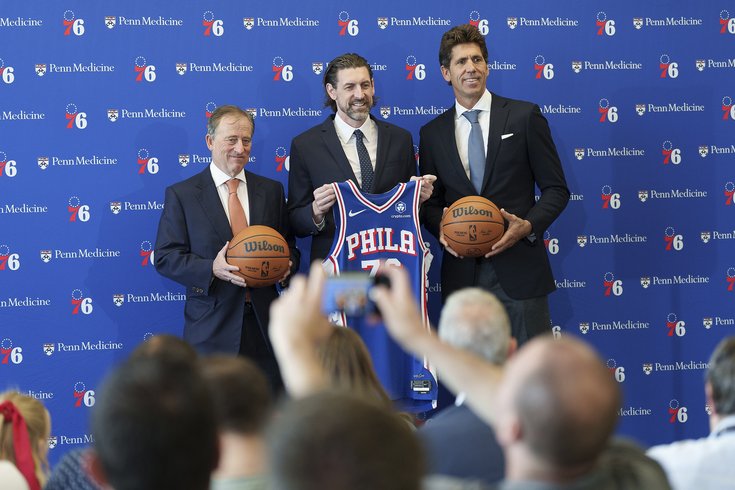
Not that long ago, Sixers President of Basketball Mike Gansey was a relative unknown in Philadelphia. Nobody knew exactly what the Sixers were getting in Daryl Morey's replacement atop the front office.
Two months and change later, Gansey's approval rating has to be among the highest of any figures in Philadelphia sports.
Between his bold beginning – trading for 2024 NBA Finals MVP Jaylen Brown – and that move cracking open the LeBron James door which the Sixers ended up kicking down – Gansey has, in his first transaction cycle as a lead executive in the NBA, turned local apathy into unbridled joy and excitement.
In this week's Sixers mailbag, discussing what could be next for Gansey and explaining one of the unheralded keys of his successful debut summer:
From @MicahLainhart: Do you think there is a move or two via trade that might happen before training camp?
I do not.
First of all, there are only so many Sixers eligible to be traded right now; nearly half of them are set to be starters:
| Sixers eligible to be traded |
| Joel Embiid |
| Jaylen Brown |
| Tyrese Maxey |
| VJ Edgecombe |
| Labaron Philon Jr. |
| Dominick Barlow |
| Jabari Walker |
| Justin Edwards |
| Adem Bona |
Obviously, the first four players listed above are not trade candidates (rumors about a swap of Joel Embiid and Anthony Davis be damned). Rookie Labaron Philon Jr.'s pathway to minutes is a lot less clear now, but that does not change that the Sixers are eager to develop him into a fixture within their guard rotation. There is not much utility to trading any of the four cheaper holdovers from last year's team; all of them provide cost-effective value.
In other words: the fireworks for this summer are complete.
The more interesting question: which players will be the Sixers' trade chips when the trade deadline arrives?
If Anfernee Simons struggles or Philon finds a way to come on strong, the veteran Simons could be useful salary filler. But if Simons thrives and looks like a long-term keeper, the Sixers could pull the plug on Philon early and send him to a team with more opportunity for him. If Ariel Hukporti fails to establish himself as a rotation-caliber big, his $3.4 million salary would be more useful in a trade than the smaller salaries of Jabari Walker, Justin Edwards and Adem Bona.
SIXERS FILM STUDIES
Jaylen Brown's strengths | Jaylen Brown's weaknesses
Anfernee Simons | Dean Wade | Ariel Hukporti
From @JoelHinkieMaxey: Why do they need to leave one roster spot open for flexibility? How hard is it to sign someone and then just waive them if they need that spot? Can’t they sign someone to a non-guaranteed deal?
The Sixers are almost certain to begin the season with 14 players under contract. In recent years, this has been their strategy, too, but they did it for different reasons.
In years past, the Sixers have touted the "flexibility" that comes with leaving a roster spot open going into the season. It offered an easy landing spot for a potential standout two-way player in need of a standard contract or an ability to take in a player via trade without sending any out. Just as importantly, it saved the Sixers money, providing an easier route to ensuring the team was under the luxury tax threshold by the time the trade deadline passed.
This season, the Sixers have a different motivation for leaving a roster spot open.
By using the larger version of the mid-level exception and the bi-annual exception, the Sixers incurred a hard cap at the first apron. That means, for the entire 2026-27 league year, the team cannot exceed that threshold. And, with 14 out of 15 roster spots filled, they have just over $1.8 million in breathing room below that line. That is quite a bit less than the veteran's minimum salary for a player with at least two years of service, about $2.45 million.
In years past, leaving a standard roster spot open offered the Sixers in-season flexibility, whether it was tied to trades, two-way conversions or luxury-tax ducking. This time around, the Sixers going with 14 players offered them offseason flexibility. By not committing another $2.45 million to the 15th roster spot – and instead committing zero dollars to it – the Sixers had enough room under their hard cap to put together the roster they have now.
Every dollar counts, and the Sixers found a way to fit 14 surefire NBA-caliber players under a restrictive hard cap with a bit of wiggle room heading into the season. Had they filled out a full roster – even just by signing a non-guaranteed deal which would have a prorated cap hit – they might not have been able to use their full mid-level exception to sign Dean Wade and Simons, all while having over $150 million tied up in Embiid, Jaylen Brown and Tyrese Maxey.
SIXERS SIGN LEBRON JAMES
James' decision | Projecting Sixers' rotation | James' impact, on and off the court
From @Dilwala_G: What are the merits of the Sixers pushing hard for Nick Richards and salary dumping either Adem Bona or Ariel Hukporti to make room, and which one would you trade? Would waiting until the middle of the season to trade for a center get them as good a player as Richards, and if not, shouldn’t they jump on Richards now?
As covered above, Hukporti is not eligible to be traded. And, for all of the Sixers fans clamoring for Nick Richards over the years, it remains unclear whether or not the Sixers themselves have any fondness for the 28-year-old center.
Again, the Sixers are prepared to enter the season with Bona and Hukporti as their backup centers, and they have until trade season unofficially gets underway in January to determine whether or not that tandem is sufficient. Finding a center as good as Richards in the trade or buyout market should be relatively easy; the fact that he remains unsigned speaks to the fact that he is not viewed as a surefire backup center by NBA teams.
Should the Sixers trade Bona to sign Richards before the season begins? For a number of reasons, that is doubtful. There is little evidence Richards is a better player; he is a superior rebounder but that might be where his advantage over Bona starts and ends.
Even if someone argued that Richards' rebounding and experience alone make him a better fit for this team than Bona, I would both reject that premise and counter that, if that was true, it should not outweigh Bona being nearly six years younger than Richards with an inexpensive team option for next season in his contract. For all of his flaws, Bona could be a long-term piece; Richards will not be.
MORE: Should the Sixers offer Jaylen Brown an extension?