



June 05, 2026
 Klaus-Peter Steitz/Imagn Images
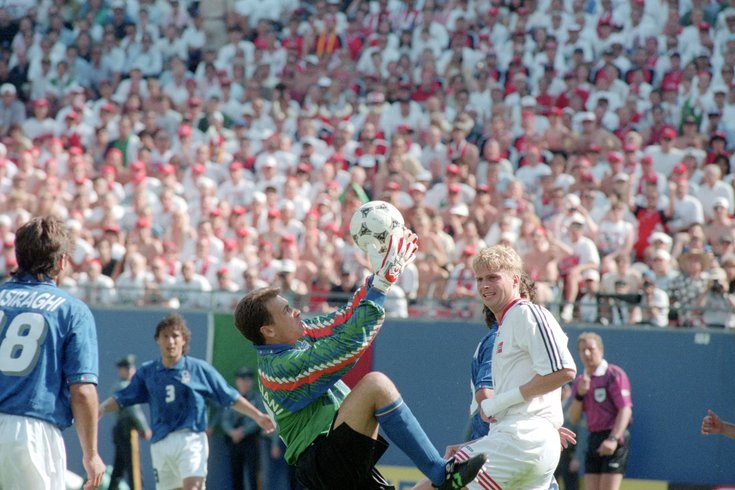
Italy and Norway played at the Giants Stadium in East Rutherford, New Jersey, during the 1994 World Cup. The venue, like Veterans Stadium, had artificial turf, but it was replaced with grass for the tournament.
Philadelphia has spent the past few months frantically assembling pop-ups, installing mini soccer fields and herding cars out of Lemon Hill in preparation for the World Cup.
The nervous energy is understandable. It's the city's first time hosting the international soccer tournament, with six matches scheduled at Lincoln Financial Field this summer. The World Cup has been played on American soil only one other time — in 1994 — and those games set attendance records that remain today.
Philly tried out that year, too. But a combination of fake grass and inconvenient baseball scheduling torched its dreams to be chosen for soccer's showcase event.
Right up until FIFA announced the nine U.S. locations it had selected to host the 1994 World Cup, our fair city was in serious contention. Philadelphia was one of 19 finalists vying for hosting duties, according to contemporaneous press reports, and had even demonstrated its capabilities by hosting two major soccer games. In 1989, the U.S. men's national team defeated the Soviet club Dnepr in front of a crowd of 43,356 people at Franklin Field. The Americans triumphed again over Sheffield Wednesday, an English soccer club, in 1991 at Veterans Stadium, the very venue that Philadelphia was pitching for the World Cup.
The Philadelphia Convention & Visitors Bureau was pushing for three first-round games at the since demolished stadium. Officials believed the arrangement would bring $40 million — in '90s dollars — to the Philly region. Unfortunately, its proposal contained fatal flaws.
The first was the AstroTurf at Veterans Stadium. FIFA has long been a stickler for natural grass and would not allow its teams to play on a fake substitute. Philadelphia still could have saved its bid by temporarily installing real grass over its AstroTurf, but therein lied the even bigger issue.
Veterans Stadium, which housed both the Phillies and Eagles before the construction of Citizens Bank Park and Lincoln Financial Field, was occupied for too much of the summer. The World Cup was scheduled for June 17 to July 17, right in the middle of baseball season. The Phillies could go on a road trip for up to 17 days, but FIFA wanted at least a month blocked off for its games.
"The people in charge of the Philadelphia committee were just wonderful," Alan Rothenberg, the chair of World Cup USA 1994, told the Philadelphia Daily News. "But the question we had is this: Can Veterans Stadium accommodate our scheduling format?"
FIFA ultimately did not book any baseball stadiums for the World Cup. The governing soccer body's final nine picks, announced on March 23, 1992, were RFK Stadium in Washington, D.C.; Soldier Field in Chicago; Giants Stadium in East Rutherford, New Jersey; the Cotton Bowl in Dallas; the Rose Bowl in Pasadena, California; Foxboro Stadium in Foxborough, Massachusetts; the Citrus Bowl in Orlando; the Silverdome in Pontiac, Michigan; and Stanford Stadium in Palo Alto, California.. Two of those had artificial turf, but they went to significant lengths to satisfy FIFA's requirements.
Giants Stadium trucked in $1 million of Bermuda grass from North Carolina to blanket its field. Detroit's planning committee went even further, calling in scientists at Michigan State University to solve its problem at the Silverdome. A team of turf experts, led by MSU professor John Rogers, constructed a 6,600-square-foot dome to replicate the environment underneath the stadium's fiberglass roof. Using their own truck full of grass from California, the group cultivated the sod across 1,850 steel hexagonal trays, all painstakingly assembled inside the venue.
Luckily for Philly this time around, there's an empty football field with real grass available — and no one needs it back until after the city's final game on July 4th.
Follow Kristin & PhillyVoice on Twitter: @kristin_hunt
| @thePhillyVoice
Like us on Facebook: PhillyVoice
Have a news tip? Let us know.