

June 25, 2026
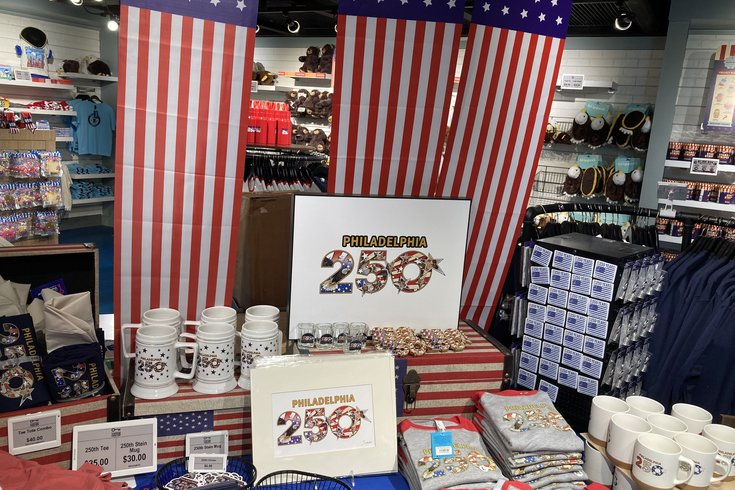 Michael Tanenbaum/PhillyVoice
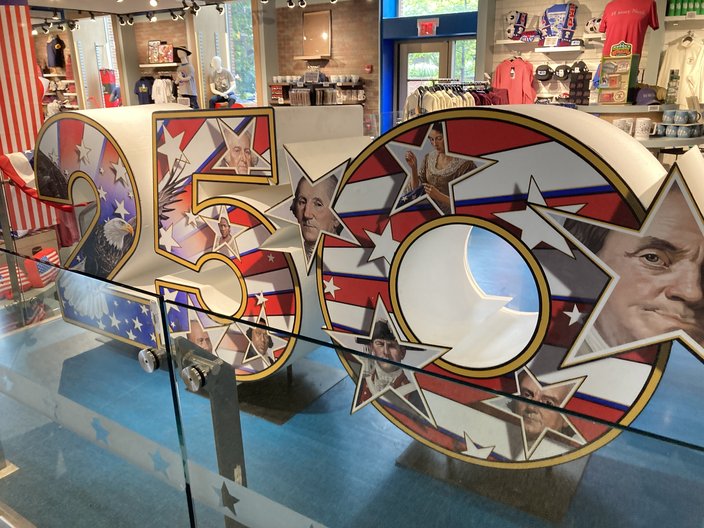
At the Independence Visitor Center in Old City, the gift shop has a collection of merchandise commemorating America's 250th anniversary. Finding collectibles that increase in value isn't easy, based on lessons from the bicentennial in 1976.
When the United States celebrates a milestone anniversary, patriotism and commercialism collide in grand fashion to create a plethora of commemorative knickknacks.
Separating high-value collectibles from mementos — or marked-up junk, to put it plainly — can be tricky for consumers on the hunt for precious souvenirs. And with America's 250th birthday right around the corner, there's no shortage of trinkets and decorative items flooding the market.
MORE: Philly stars in Netflix's 'The American Experiment' alongside Hillary Clinton and Mike Pence
The National Archives Store is selling 49 products, ranging from shot glasses and mugs to a scarf printed with the Declaration of Independence, while the official America 250 Store offers a variety of keychains, pins, coins and Revolution-themed comic books. All kinds of prints, mugs and magnets are available at the Independence Visitor Center in Old City.
Late last year, the U.S. Mint released a series of semiquincentennial designs for the nickel, dime, quarter and half dollar. New uncirculated coin sets and medals will be available at the Mint in the coming month, including a 1-ounce gold Liberty Bell medal made in Philadelphia that will retail for $19,600. The U.S. Postal Service also has a variety of America 250 stamps and special designs available at its historical offices.
Beyond precious metals and items produced in limited amounts, America 250 merch might not be a great play for future fortune.
"My viewpoint, which has held strong and which is proven correct, is when things are produced specifically for the purpose of being a collectible, and when things are even more so being advertised that this is a collectible, the odds of them increasing much in value over time are drastically reduced," said Ken Goldin, the auctioneer better known as the "King of Collectibles" from his Netflix reality series.
Goldin, 60, grew up in South Jersey during a fertile period for savvy collectors. He and his father amassed a trove of sports cards, comic books and other memorabilia before collectible markets for mass-produced items had gained widespread recognition.
"The reason that stuff is so valuable and so desirable is because they were produced to be read and enjoyed, and then mostly thrown away," said Golden, who has sold more than $2 billion worth of collectibles and historical artifacts in his decadeslong career. "Most of them that were not thrown away were kept in bad condition, like with baseball cards."
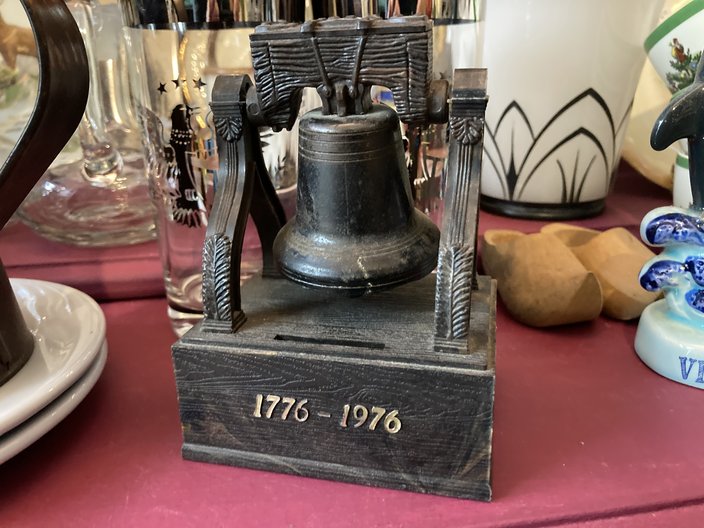
A miniature replica of the Liberty Bell from the bicentennial is for sale at an antique shop in New Jersey.
America celebrated its bicentennial in 1976 during a peak of commercial exuberance, producing an estimated 25,000 different items commemorating the anniversary. An assortment of those items are housed in an archive at Yale University's Beinecke Library, where the late historian Jesse Lemisch's collection shows off a mix of American iconography from the time.
Aside from the usual tchotchkes, Lemisch and his students gathered items that included a novelty bicentennial condom, a bicentennial-themed burger wrapper and sugar packets printed with presidential portraits. The New York Times reported some historians viewed the bicentennial as a formative patriotic moment built on an overflow of cheap goods promoting jingoism. At the University of Central Florida, another "Bicentennial Junk" collection is stocked with special edition magazines, glassware, frisbees and cereal boxes that marked the era.
"Since Schlock was the Bicentennial's most pervasive manifestation and perhaps its most enduring heritage, it almost seems, emotionally speaking, as if there was no Bicentennial at all," Lemisch wrote in a 1976 article for the New Republic.
Goldin said the true value of bicentennial memorabilia today is often inflated by "buy it now" prices on eBay and markups at antique mills and flea markets.
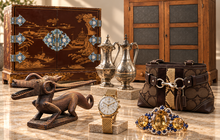
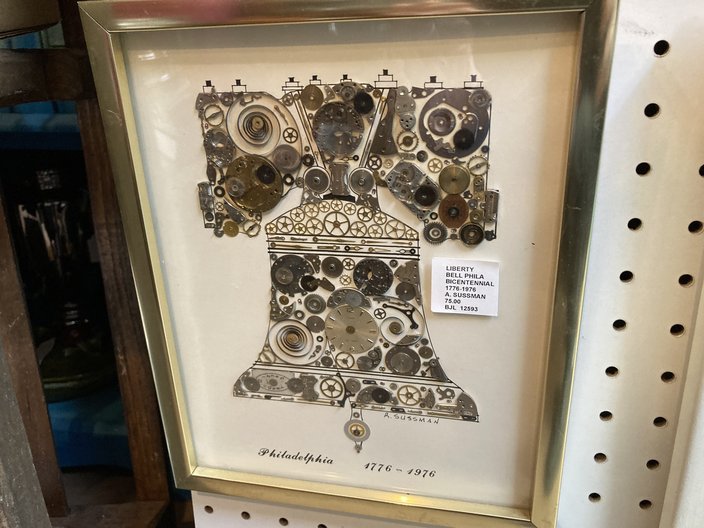
Bicentennial memorabilia is commonly sold at antique mills in the Delaware Valley. Above, a depiction of the Liberty Bell made from gears and wire is shown at a New Jersey antique mill.
"In a true open market auction, where the price starts at $1 and you see where it gets on price realization, you'd be surprised how close to issue price plus inflation a lot of those items are," Goldin said.
A well-preserved Star Wars figurine from 1977 is generally much more valuable, for example, than a bicentennial item made to capitalize on the promise of collectibility.
"Those toys are worth a fortune, and if you have the right ones in mint box condition, it is infinitely more valuable," Goldin said. "If those toys at the time were not advertised as a toy, but they were advertised as a collectible, limited edition, you know, parents would have bought multiples, and they would have kept them in perfect condition."
Semiquincentennial coins could be a decent bet to gain value in the long-run compared to those produced for the bicentennial, most of which have not appreciated significantly. Far fewer people use cash in 2026, making this year's coins less likely to circulate. There are also fewer hobbyist pocket change collectors now compared to 1976, and the U.S. mint's production of fewer total coins across several denominations will make each of them rarer.
"From day one — and this is really unusual in the collecting world — what's produced in 2026 will have more value than the parallel item in 1976," Goldin said. "When the US Mint put them up for sale direct-to-consumer, they sold out in two minutes. There is a large secondary market for that."
Some of the best treasures in 2026 might be hidden in the advertising of the moment. The digital era now produces fewer hard copies of things like printed tickets, mini-billboards and in-store ads, which makes those items more rare. People have become less likely now to spot the value of mundane items as one-off symbols of the occasion worth preserving.
"Let's say there's a collector's plate, and a store has 100 collector's plates," Goldin said. "But let's say the store has an advertising song on something that stands up a cardboard ad. They're only going to have one of those."
Goldin strongly advised against defacing public property or stealing from businesses to obtain memorabilia. A New York City woman learned a hard lesson last week when she went viral for stealing a Knicks-themed trash can during the team's championship parade in Manhattan. She's since been fired from her job at JP Morgan Chase.
A promotional display for the nation's 250th birthday greets customers at the Independence Visitor Center in Old City.
Goldin said people should think outside the box about what they save while celebrating the nation's 250th anniversary. The bicentennial offered some clues about what might gain value.
"If you go to 1976 and ask what would actually be worth money, it's not the stuff that was really mass produced and saved as collectibles," Goldin said. "If you had a poster advertising a parade in Philadelphia on July 4, 1776 with a lot of bicentennial themes, or brochures that were promoting it, that stuff would be worth good money."
Goldin's auction house in New Jersey is marking nation's 250th anniversary with a collection of rare, founding documents and other national memorabilia open for bids. The top bid on a July 1776 Exeter Broadside of the Declaration of Independence, one of only 10 surviving copies, currently sits at $1.15 million.
The semiquincentennial may largely be a bust for collectibility, but Goldin said it might also spark interest among people looking for ways to find a new hobby.
"I feel like we're in the golden age right now of all collectibles, where the entire world, all countries, all nationalities have gravitated toward collectibles," Goldin said. "Not only in one sense to capture the past, but also as an alternative asset and as a store of value, as people feel that currencies keep getting devalued. I've been in this business a very long time. I've seen all the cycles."