



June 05, 2026
 Provided Image/Library of Congress, Motion Picture, Broadcasting, and Recorded Sound Division
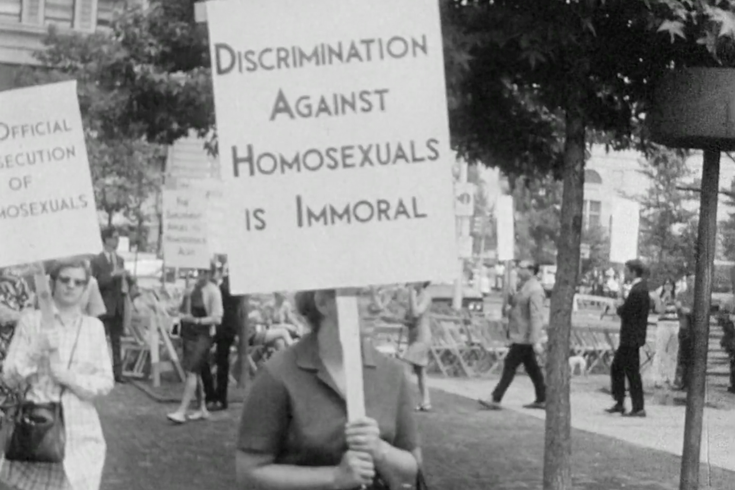
A still from 'The Second Largest Majority,' a documentary short from Lilli Vincenz in 1968, shows demonstrators advocating for gay rights during the fourth Annual Reminder Demonstration in Philadelphia. The term homosexual was commonly used at the time.
Four years before the Stonewall uprising in New York City brought queer liberation to the forefront of national conversation, the first protests for LGBTQ+ rights took place in Philadelphia.
Annual Reminder Demonstrations took place every Independence Day between 1965 and 1969, when demonstrators quietly marched around Independence Hall displaying signs that advocated for the civil rights of gay and lesbian citizens. Media attention on the demonstrations at the time was scarce, but the processions now are viewed as the roots of the Pride movement.
"These people put their necks on the line in a time when they could have lost their jobs, their homes, their friends, their families and in a lot of times, they could and did lose their lives for this movement," said Kristopher Lawrence, director of the Philly Pride Visitor Center. "They had to know that what they were doing was putting their foot down for people in the future that they would never even know."
Gay rights activists Frank Kameny and Barbara Gittings spearheaded the first demonstration in 1965, three months after they led a demonstration in Washington that advocated for the right to work in the federal government. At the time, that was probihibited. Kameney, a World War II veteran and astronomer for the Army Map Service, had been fired in 1957 for being gay.
Also in 1965, a group of gay teenagers staged a sit-in at the Dewey restaurant chain in Center City after being denied service. It was the first protest of its kind in Philadelphia and one of the earliest demonstrations for public accommodation access for LGBTQ+ people in the country.
The first Reminder Demonstration was designed to use straightforward messaging that simply reminded the American people that millions of gay people were frequently being denied their civil rights. The demonstration is considered the earliest example of activism for general LGBTQ+ rights, rather than targeting specific policies.
Around 40 demonstrators were present for the first march. They intentionally dressed in conservative attire and walked in a single-file line at the request of Kameny, who wanted onlookers to perceive the protestors in a respectable light. Signs were ordered to be "neatly and cleanly lettered" and demonstrators were discouraged from speaking to each other or passersby during the march.
"We didn't want people to gawk at us," Kameny said. "We wanted them to gawk at the message on our signs and in our leaflets."
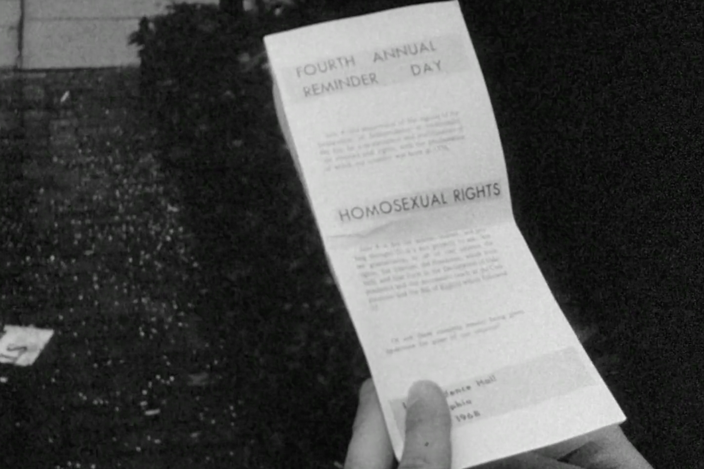
A still from 'The Second Largest Majority,' a documentary short in 1968, shows a pamphlet handed out to passersby during the fourth Annual Reminder Demonstration. The term homosexual was commonly used at the time.
Despite lackluster responses from the general public, the tradition continued for four more years, with the marches modestly growing in size. The final demonstration took place less than one week after the Stonewall uprising in 1969, during which police raided the Stonewall Inn in New York City, sparking city-wide riots.
"The five years leading up to 1969 were a time when the energies from (the Annual Reminder Demonstrations) were adding up to a movement that coincided with the Stonewall riots, which changed everything," Lawrence said. "...That is a period of time where a movement that was just getting off the ground took flight. It's huge. You can't say enough about it."
Activists eventually decided that the rigid, subdued form of protest that had defined Annual Reminder Demonstrations was not the future of the movement, and the tradition was abandoned after 1969. But the marches marked one of the first regularly-held demonstrations for LGBTQ+ rights in the country.
"For the people that came afterward, the demonstrations let them be aware that it was a possibility to make a change," Lawrence said. "That's what Pride is all about."
The Annual Reminder Demonstration is one of four "firsts" being celebrated as part of the Philadelphia Historic District 250th Committee's yearlong "52 Weeks of Firsts" program.
Every Saturday, a different person, invention or significant contribution with roots in the city is being honored with its own "Firstival" from 11 a.m. to 1 p.m. Each event includes family activities, giveaways, live music, entertainment and stories told by Once Upon A Nation actors.
The Philly Pride Visitor Center, which opened in January at 12th and Locust streets, will commemorate the demonstrations on Saturday, June 20. John S. James, who participated in the first march and lives in Center City, will speak with attendees, Lawrence said.
The three other "firsts" being celebrated this month are:
• First American Flag (1777): The Betsy Ross House, at 236 Arch St., will celebrate the pioneer who stitched the symbol of a new nation and share some lesser-known facts about the seamstress' life. The event takes place June 6.A full list of the "firsts" being celebrated this year can be found on Visit Philadelphia's website.
• First U.S. Army (1775): The Continental Congress in Philadelphia adopted the New England Army of Observation, a force of everyday citizens from the 13 colonies, on June 14, 1775. The Army members had limited military training. The Museum of the American Revolution, at 101 S. 3rd St., will hold a firstival celebration on June 13.
• First paper maker in America (1690): Shortly after Philadelphia's burgeoning printing press business took off, William Rittenhouse established the first paper mill along the Wissahickon Creek in what is now considered Germantown. Rittenhouse Town, at 6034 Wissahickon Ave., will host a firstival event on June 27.