




June 17, 2026
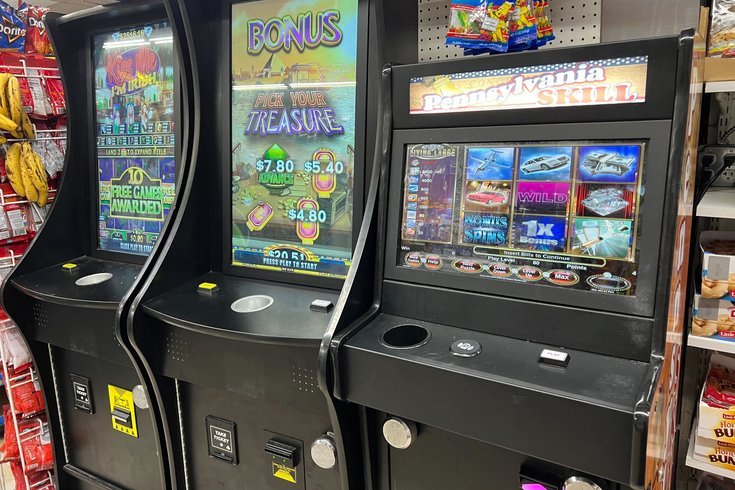 Chris Compendio/for PhillyVoice
The Pennsylvania Supreme Court ruled Monday that skill games, the gambling terminals commonly found at corner stores, are slot machines that must be regulated and taxed in accordance with gaming and crime statutes. Philadelphia Mayor Cherelle Parker supports the decision and says she wants skill games out of the city's vulnerable communities.
Mayor Cherelle Parker says she's "pleased" with the Pennsylvania Supreme Court's ruling Monday that skill games are equivalent to slot machines and must be subject to state regulation moving forward.
The gambling terminals, which have proliferated at corner stores and other businesses across the state, are disproportionately present in Philly's poorer neighborhoods, Parker said.
"They should not be easily accessible in neighborhoods that already face high rates of poverty, crime and violence," Parker said in a statement. "You only find them concentrated in our most vulnerable communities. You won't find these kind of stores — stop and go's, smoke shops — and these slot machines in wealthy neighborhoods. They aren't there. It's predatory, and it's not right."
The Supreme Court's decision had been long-awaited by lawmakers keen on tackling gaming reform in Pennsylvania. The justices reviewed a pair of lower-court cases to assess whether skill games truly require a degree of skill that rises above the element of chance in regulated slot machines.
The decision found that while skill can affect the outcomes of some games, chance remains the predominant factor in their operation. Legal definitions in the state's Gaming Act should be interpreted to group the terminals with slot machines, the majority found.
"The device meets the general definition of a 'slot machine' in the Gaming Act, and it always has," independent Justice David Wecht wrote for the majority.
The Supreme Court's ruling comes with a 120-day waiting period, meaning state lawmakers will now have four months to make changes to gambling and crime statutes. If nothing happens, the state's 70,000 gaming terminals would be subject to the same regulations and licensing for slot machines, which are only permitted at casinos.
City Council passed a ban on skill games in 2023, but enforcement of the ordinance was blocked as several cases worked their way through the courts. At the time, Parker argued the machines take advantage of residents with financial pressures.
"It is not OK to tempt our residents from low- and moderate-income neighborhoods with opportunities to gamble away their hard-earned dollars," Parker said after signing the bill, which was sponsored by City Councilmember Curtis Jones Jr. (D-4th).
Parker and other proponents of the ban also argued businesses with skill games had become magnets for crime.
"This kind of predatory activity only exacerbates seemingly intractable problems that we are challenged with solving," Parker said following the Supreme Court's decision this week. "And no one has come running to save our city with the revenue it needs to address these systemic issues."
Pace-O-Matic, the Georgia-based company that dominates the skill games market, said it is "disappointed" with the Supreme Court decision. The company claims its skill games have been a crucial revenue source for small businesses and fraternal clubs that operate on slim margins.
"Sadly, this opinion will have far-reaching consequences, with more than 10,000 Pennsylvania small businesses and fraternal clubs becoming the real victims," Pace-O-Matic said in a statement. "They are now potentially left facing an impossible choice: cease operating these games and lose an important source of revenue, or endure a legislative solution that could bring excessive regulation and crippling taxation, which will force them to cease operating these games and lose an important source of revenue."
Pennsylvania Gov. Josh Shapiro (D) has proposed a 52% tax on skill games that would put the terminals in line with taxation of slot machines. The governor's annual budget proposal estimates the tax on skill games could generate $765.9 million in new revenue in the first year.
“I’ve been calling for this for three straight years,” Shapiro told reporters Tuesday. "... What I’d encourage the Republican leadership of the Senate to do is to work with the Democratic leadership in the Senate and see what kind of package can get 26 votes in their chamber and get that bill to my desk."
Senate Republicans, who hold a majority in the chamber, called the regulation of skill games "a matter of public safety" and said new tax revenue should be directed to the state's general fund.
"We look forward to all parties swiftly engaging in meaningful conversations to resolve this issue," Senate President Pro Tempore Kim Ward (R) and Senate Majority Leader Joe Pittman (R) said in a joint statement.
One proposal from Senate leaders would tax skill games at 35%, well below Shapiro's proposal. Another from Sen. Gene Yaw (R-Lycoming) would tax skill games at 16%. Another bipartisan proposal from Yaw and Sen. Anthony Williams (D-Philadelphia) would levy a monthly fee of $500 per machine.
The legislature is up against a June 30 deadline to pass the state budget. A stalemate last year pushed budget negotiations into November as Shapiro and Senate Republicans battled over funding for public transit, including calls to use skill game revenue to support SEPTA and other agencies.
Shapiro ultimately approved SEPTA's use of $394 million in capital funds to stabilize its operating budget for two years. The governor also approved $220 million in SEPTA funding from PennDOT for critical Regional Rail repairs. Lawmakers have not said whether skill game regulation would be revisited this summer as a way to fund public transit.
Parker said she's not in favor of continuing to allow skill games in the corner stores and other small businesses where they've become most prevalent in the city.
“I'm going to be watching this issue very carefully," the mayor said. "In no way, shape or form do I think these slot machines should be in our neighborhoods already struggling from socioeconomic and public safety issues. If they are going to go anywhere, they should be in private clubs and casinos. They should not be accessible to our children or in our most vulnerable communities."