



June 24, 2026
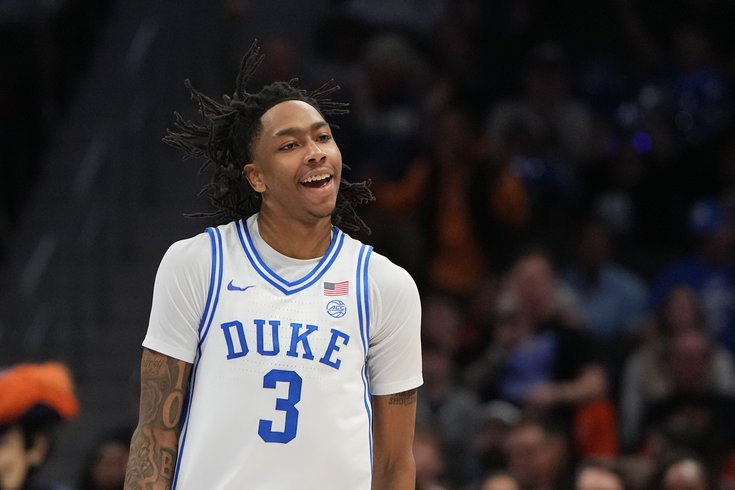 Bob Donnan/IMAGN IMAGES via Reuters Connect
Isaiah Evans, arguably the best shooter in the 2026 NBA Draft, was not picked in the first round.
CAMDEN, N.J. – As Sixers President of Basketball Operations Mike Gansey discussed his first draft pick as a lead decision-maker in the NBA – the Sixers' selection of Alabama guard Labaron Philon Jr. at No. 22 overall on Tuesday night – he opened the door for the team to trade into the second round of the 2026 NBA Draft.
"Tomorrow we'll meet, we'll obviously look at who's still left on the board. Obviously we don't have a pick now, but [we will evaluate] where we can get in, who we want to target – three guys, five guys, six guys – and then try to be aggressive," Gansey said. "We're always going to make calls and try to turn over every stone and see what's out there. We have roster spots. We have playing time. So trying to get someone that can fit [Nurse's] system and the way we want to play, the character piece, we're going to look at it all and try to get someone who can fit."
The first half of the first round came and went without any on-the-clock trades, but starting with the No. 16 overall pick, a massive rush of deals came in. The second round on Wednesday night should be similar in its activity level, starting with the New York Knicks, on the clock at No. 31 overall at 8:00 p.m. and open for business to deal the first pick of the second round.
Gansey appeared genuinely eager to take a crack at getting the Sixers back into this draft, and it is a realistic goal. Breaking down all angles of a potential second-round Sixers trade:
To some degree, of course, the price to trade for a second-round pick depends on where that selection is slotted. Surely, the defending champions in New York are aiming to cultivate a bidding war for No. 31 overall, which last year was dealt for the No. 36 pick and two future second-rounders – a strong price.
Ultimately, the Sixers will be dealing from an abundance of future second-rounders – a batch of assets impressive both in quality and quantity. In a seven-draft span from 2027 until 2033, the Sixers have 13 tradable second-round picks; only one of those is not a legitimate asset:
| Year | Sixers' second-round picks |
| 2027 | • PHI • Most favorable HOU/IND/MIA/OKC • More favorable GSW/PHX |
| 2028 | • GSW • PHX • MIL • DET (top-55 protected) |
| 2029 | • PHI |
| 2030 | • WAS • More favorable PHX/POR |
| 2031 | • PHI |
| 2032 | • Less favorable PHI/MEM |
| 2033 | • PHI |
This collection of second-rounders is not unparalleled around the league, but it is absolutely one of the heftier sums of second-round draft capital owned by an NBA team. In his final years running the Sixers, Daryl Morey made a concerted effort to stockpile second-round picks. That has positioned his successor to consolidate some of these picks to trade into the second round if the right player is available.
History suggests trading into the second round is not tremendously difficult from a cost perspective. There are always teams trying to kick the can down the road with second-rounders, or even simply trade out of the draft for cash. Part of the dynamic is that some prospects will begin telling teams not to draft them to set up prearranged deals in undrafted free agency.
There is no question that if Gansey has conviction in a prospect available in round two, he can go get that player – even if it means trading into the earliest portion of the round.
MORE: Get to know Philon with these highlights
Which teams are in play to trade second-rounders? Really, the answer is all of them – at this point of the draft, everybody has a price and nobody is absolutely resolute in sticking in and picking. There are 30 potential landing spots for the Sixers. But a handful of teams seem particularly likely to entertain offers:
• New York Knicks, No. 31 overall: New York traded the No. 24 pick for the No. 25 pick and cash, then traded the No. 25 pick for the No. 30 pick and two future second-rounders, then traded the No. 30 pick for the No. 47 pick and two more future second-rounders. They already owned the No. 31 pick and are reportedly open for business, all as part of their elaborate plans to save money as they attempt to keep their title-winning roster together and duck beneath the second apron.
• Memphis Grizzlies, No. 32 overall: After making both of their first-round picks on Tuesday, Memphis is likely to enter free agency carrying 15 players – and that is before a potential Ja Morant trade adds more depth to their team. Memphis already picked up five second-round picks between two first-round trades down the board, but it might make sense for them to trade out and collect even more.
Memphis, like the Knicks at No. 31, is actively fielding offers to move the No. 32 pick for Night 2 of the draft, per sources. So picks 31 and 32 are up for auction in trades around the NBA -- with future assets being proposed. https://t.co/HUbpZCinlB
— Shams Charania (@ShamsCharania) June 24, 2026
• Oklahoma City Thunder, No. 37 overall: Oklahoma City surprisingly used both of its first-round picks on players expected to be on the Thunder's standard roster next season, intensifying a roster crunch that began with their recent salary dump of Aaron Wiggins. They currently have 16 players; that is one too many. They gave up two second-round picks to move up just one spot and secure Iowa guard Bennett Stirtz, so trading this pick would be an opportunity to recoup that value.
• San Antonio Spurs, Nos. 42 and 44 overall: The Spurs drafted two backup bigs to support Victor Wembanyama in the first round, and the reigning champions of the Western Conference do not seem likely to carry four rookies and two sophomores next season.
MORE: Predicting decisions on Sixers' team options, Knicks win it all
There was no stunning omission from Tuesday's proceedings, but there are some intriguing prospects on the board as teams recalibrate their draft boards in preparation for the second round. Some prospects have particularly compelling cases for the Sixers:
• Isaiah Evans, SG/SF, Duke: Like Philon, Evans is a player whose slight frame might have prompted his unexpected draft slide. He was the most surprising player not to be picked on Tuesday and should be among the first names to go off the board on Wednesday. Arguably the draft's best three-point shooter, Evans averaged 15.0 points per game for the Blue Devils as a sophomore and had considerable first-round buzz.
• Henri Veesaar, C, North Carolina: Veesaar averaged 17.0 points and 8.2 rebounds per game for the Tar Heels, and the seven-footer is the favorite to be the first big drafted in the second round. Not only did Veesaar shoot three long-range attempts per game last season, he shot a whopping 42.6 percent on those looks. If he proves to be a capable defender in the NBA, he will fit a rare archetype as a floor-spacing, rim-protecting five. Some draft experts believe his shooting touch makes him a viable power forward in double-big lineups; that could come in handy next to Joel Embiid.
• Meleek Thomas, G, Arkansas: It seems hard to fathom the Sixers drafting another guard behind Tyrese Maxey, VJ Edgecombe, Philon and potentially Quentin Grimes, but Thomas is too good of a prospect to ignore. He shot 41.6 percent from three-point range on strong volume last season; the Pittsburgh native should hear his name called early on Wednesday night.
• Baba Miller, F, Cincinnati: Miller is a player with a stark set of strengths and weaknesses. He is a 208-pound forward, but measures at 6-foot-11.75. He is an absolutely elite rebounder, pulling down 11.7 rebounds per 36 minutes last season. However, he shot just 19.2 percent from three-point range, and his 65.8 percent clip on free throws suggests he is not much of a shooting prospect whatsoever. He also averaged 3.7 assists per game, and having some passing and decision-making chops is extremely valuable for a player whose scoring will come as a play finisher.
• Trevon Brazile, F, Arkansas: A popular sleeper in this year's class, Brazile is extremely old – he will turn 24 years old midway through his rookie season – but he has the makeup of a role-playing forward that helps a team win. He averaged 1.6 blocks and 1.5 steals per game last season and absolutely crushed the combine. Between his frame – 6-foot-10.75, 226 pounds and a 7-foot-3.75 wingspan – and stellar athletic testing numbers (41.5-inch vertical jump, 2.71-second shuttle run), it is hard to imagine Brazile being a bad NBA player. Even if he does not possess captivating upside, he is easy to see the vision for.
• Richie Saunders, G/F, BYU: Saunders is even older than Brazile. He will turn 25 years old before his rookie season even starts. Shooting is Saunders' calling card; he attempted 6.8 long-range tries per game last season and made 37.6 percent of them.
• Nick Martinelli, F, Northwestern: Martinelli averaged 23.0 points per game last season and made 41.7 percent of his three-point tries at modest volume. If the Sixers believe he can settle into an off-ball role, his positional size (6-foot-7.75, 224 pounds, 6-foot-10 wingspan) could make him a fit.
MORE: Sixers tap 'dynamic' Philon as newest young piece: 'He's going to fit Philly'